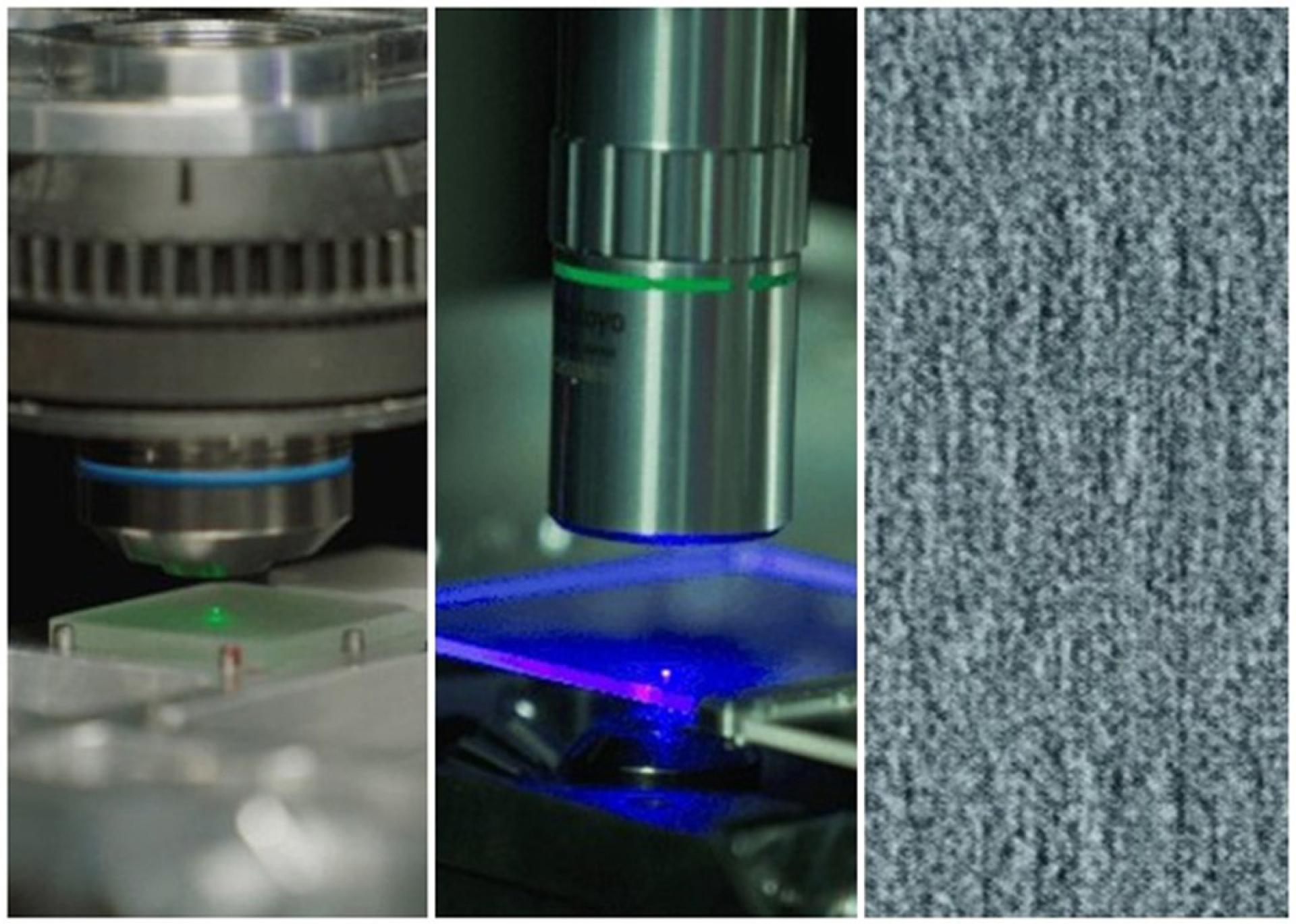
According to a report by British media on the 18th, current digital media long-term storage relies on hard drives and magnetic tapes, both of which have limited lifespans and require repeated maintenance. A team of experts at Microsoft's Cambridge division has recently invented a new method for archiving data, in which data written into glass using lasers can be preserved for thousands of years.
This method converts digital data into groups of symbols and then uses a femtosecond laser to encode these groups into tiny deformations (known as volumetric pixels) stored within a piece of glass. In a 12-square-centimeter, 2-millimeter-thick piece of fused quartz glass, hundreds of layers of such voxels can be created, storing 4.84TB of data—equivalent to the information contained in about 2 million printed books.
The team stated that by splitting the process into four independent laser beams writing data simultaneously, the technology is highly efficient, achieving a recording speed of 65.9 million bits per second. Once writing is complete, each layer of voxels can be read by scanning the glass sheet under an automated microscope, with a machine learning system automating the processing and decoding. Experiments show that the deformations created by the laser can persist for more than 10,000 years at room temperature, making the new method extremely stable. However, it is intended for use by large cloud companies and is unlikely to be used in home or office environments.