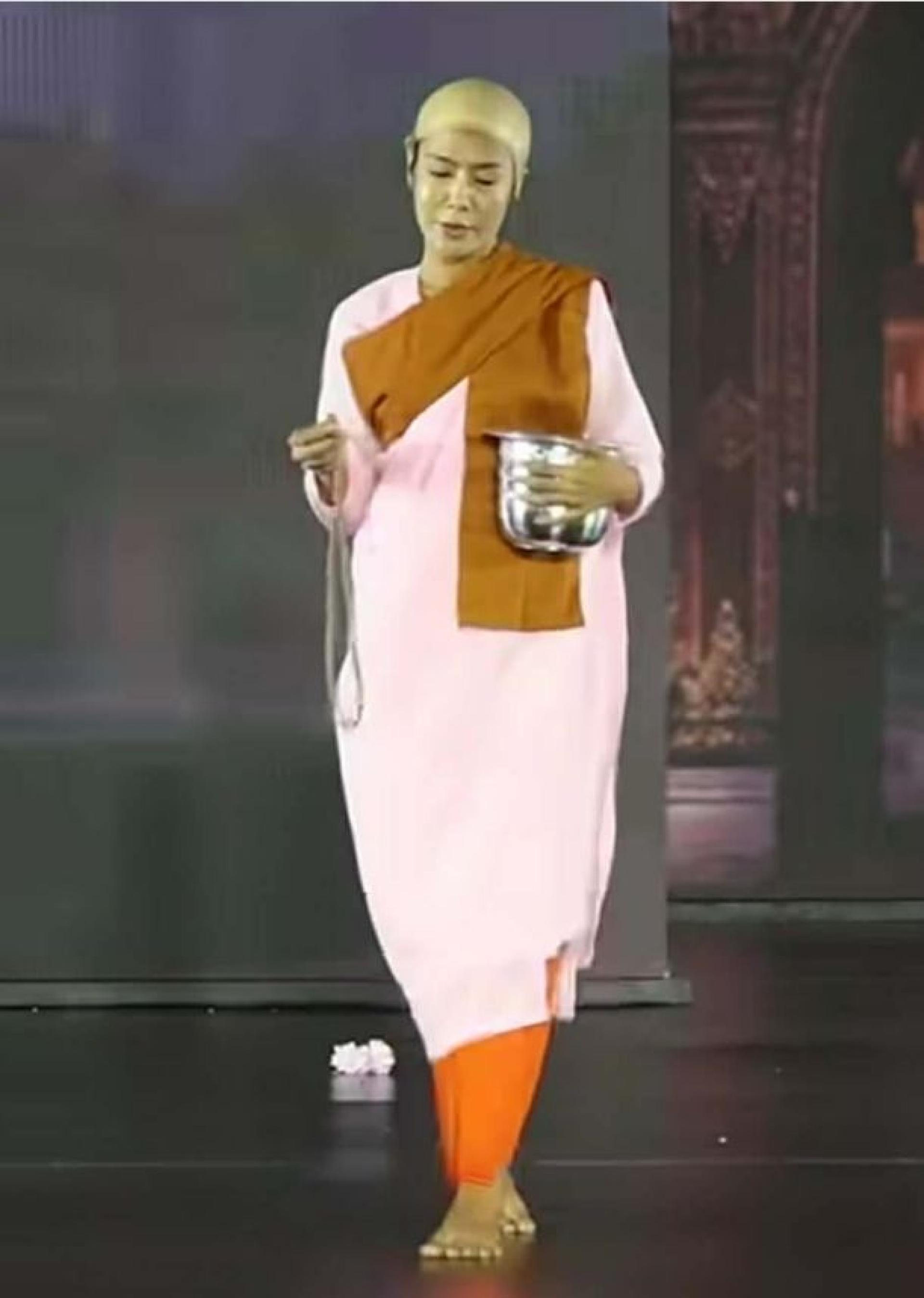
The national costume segment of Myanmar’s renowned “Miss Grand International 2026” selection competition erupted in religious controversy after a contestant wore the attire of a Theravada Buddhist 'Thilashin' (also known as 'Ten-Precept Nun', in Burmese Thilashin, meaning 'one who keeps precepts') on stage. This incited strong criticism from the Buddhist community and netizens, eventually leading the organizers to issue a public apology and announce the disqualification of the contestant.
The competition was held on May 4 in Yangon. The contestant in question participated under the theme “Auspicious Ear Piercing Fashion,” performing Myanmar’s traditional “Ear Piercing Ceremony” on stage while wearing a 'Thilashin' outfit and carrying a large rosary.
Related footage subsequently spread widely on social media and quickly sparked controversy. Many Buddhists believe that 'Thilashin' attire is a symbol of religious practice and should not be used as a costume in beauty pageants, criticizing the performance as lacking respect for religion.
A Myanmar ‘Thilashin’ expressed on social media that the attire worn by religious practitioners symbolizes devotion and faith, and is not intended for entertainment or competition. She criticized the behavior as desecrating religion and called on religious authorities and relevant organizations to address the incident seriously.
In addition, numerous social media pages saw a surge of negative comments. Some netizens pointed out that while the “ear piercing ceremony” itself might be understandable, wearing the 'Thilashin' attire and carrying a large rosary on the catwalk clearly crossed a line.
The competition's national director, Ma Yan Say No, later issued a public apology to the media, acknowledging that the incident hurt the feelings of Buddhists and promising to take responsibility.
She stated that the organizing committee would strengthen its review process in the future to prevent similar incidents from occurring again and would penalize the contestant concerned according to the competition’s contract provisions.
Contestant Explains No Intent to Offend
The contestant involved, Yi Mon Lin, explained that she did not intend to offend religion and only wished to respectfully present Buddhist culture. She emphasized that during the performance there were no frivolous acts, and she only portrayed meditation, paying homage to Buddha, and alms-rounds.
She stated she is willing to sincerely apologize if the performance caused public dissatisfaction.
However, some public opinion believed that the responsibility for the incident should not rest solely on the contestant, but rather on the failures of the event organizers. Some netizens questioned that such an outfit and performance could not have made it onstage without the organizers’ approval.
As the controversy continued to ferment, the organizers subsequently issued a statement announcing the disqualification of the contestant from Tachileik.
The statement noted that the purpose of the competition has always been to respect the culture and religious beliefs of all Myanmar ethnicities, and that organizers had previously made it clear to regional directors and contestants that any attire or behavior disrespecting national dignity or religion was prohibited.
The organizers also expressed their apologies again to the country’s Buddhist monks, 'Thilashin', and followers for the controversy triggered by the incident, and promised to strengthen supervision in the future to avoid a recurrence of similar incidents.