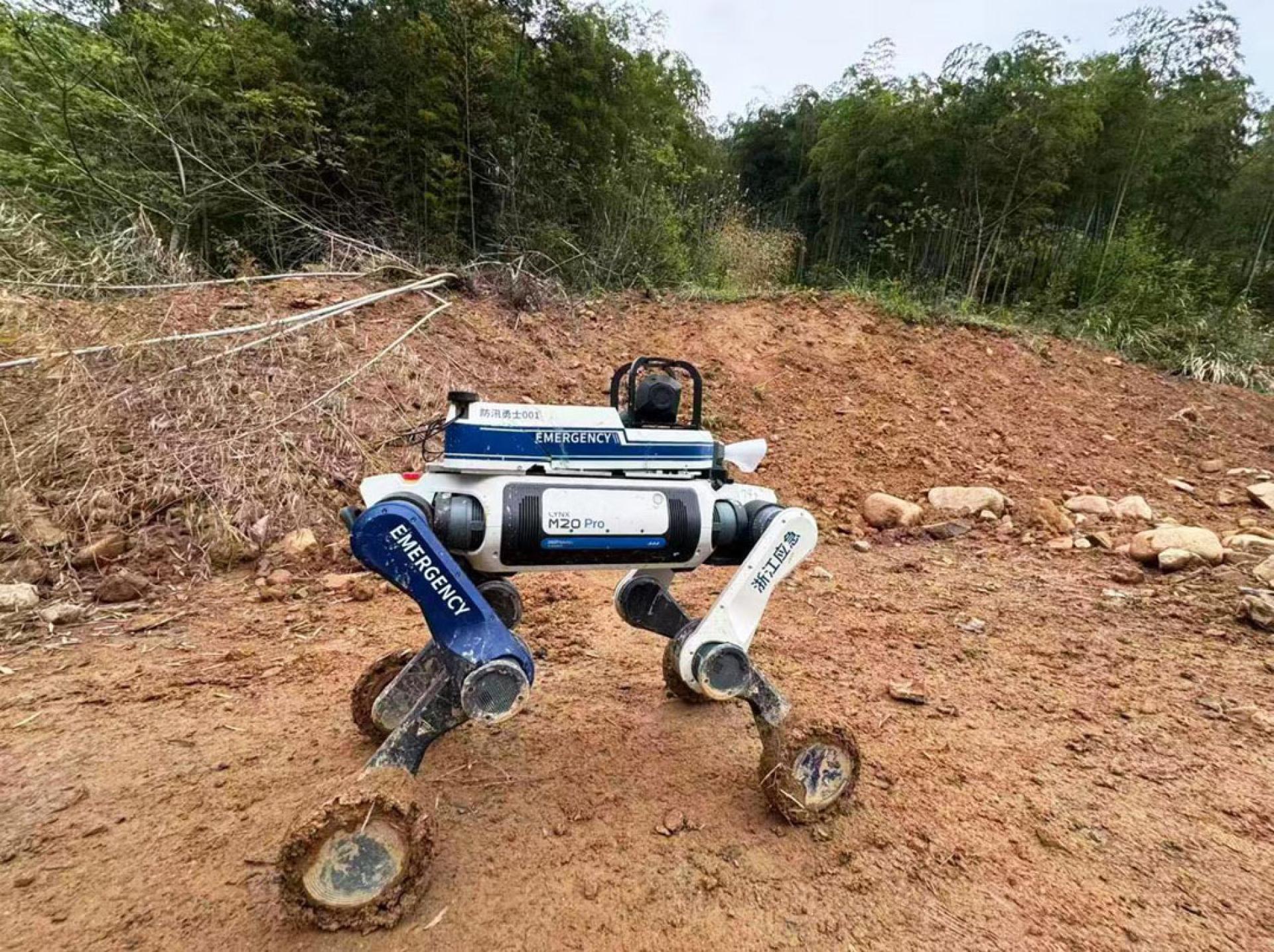
On Thursday, the Zhejiang Provincial Emergency Management Department announced the deployment of the flood and typhoon prevention robot dog, the 'AI Flood Control Warrior', aimed at overcoming pain points such as inability to reach high-risk areas, insufficient accuracy in hazard identification, and lagging emergency response efficiency in traditional flood control work.
The 'AI Flood Control Warrior' is built on CloudMinds' Scorpion M20 wheel-legged robot as a mobile platform, creatively integrating large models and an onboard platform, and is equipped with a dual-spectrum gimbal, 5G module, edge computing box, and other devices. It can replace humans in carrying out key flood control tasks such as hazard inspection, situation reconnaissance, and personnel search and rescue.
On the same day, the 'AI Flood Control Warrior' conducted a geological disaster hazard inspection drill at Shuichewu in Jingshan Town, Yuhang District, Hangzhou City, simulating typical emergencies that may occur during real flood seasons, such as fallen trees and landslide debris.
"The 'AI Flood Control Warrior' can penetrate deep into simulated accident sites and independently carry out close reconnaissance, panoramic photography, data collection, and dynamic monitoring in dangerous areas where it is unsafe for humans to reach," introduced Hu Yaowen, chief engineer of the Zhejiang Provincial Emergency Management Department. The robot dog’s AI early warning system can precisely identify various flood control hazards and synchronously transmit relevant data in real time to the command platform, providing scientific evidence for hazard disposal.
In addition, the emergency rescue vehicle is equipped with an onboard communication satellite, providing multiple communication options such as 5G and self-organizing networks. This ensures that the 'AI Flood Control Warrior' can still accomplish real-time transmission of reconnaissance data and precise execution of backend commands even in areas with weak signals.
Zhejiang has also simultaneously launched the 'AI+Short-term Early Warning' application. This app is designed for Zhejiang’s frequent and localized severe convective weather events and, based on data from more than 80 radars and over 3,000 meteorological observation stations, utilizes AI technology to develop minute-level and kilometer-level rainfall forecast products, aiming to solve problems such as insufficient precision and short lead times in short-term warning forecasts.