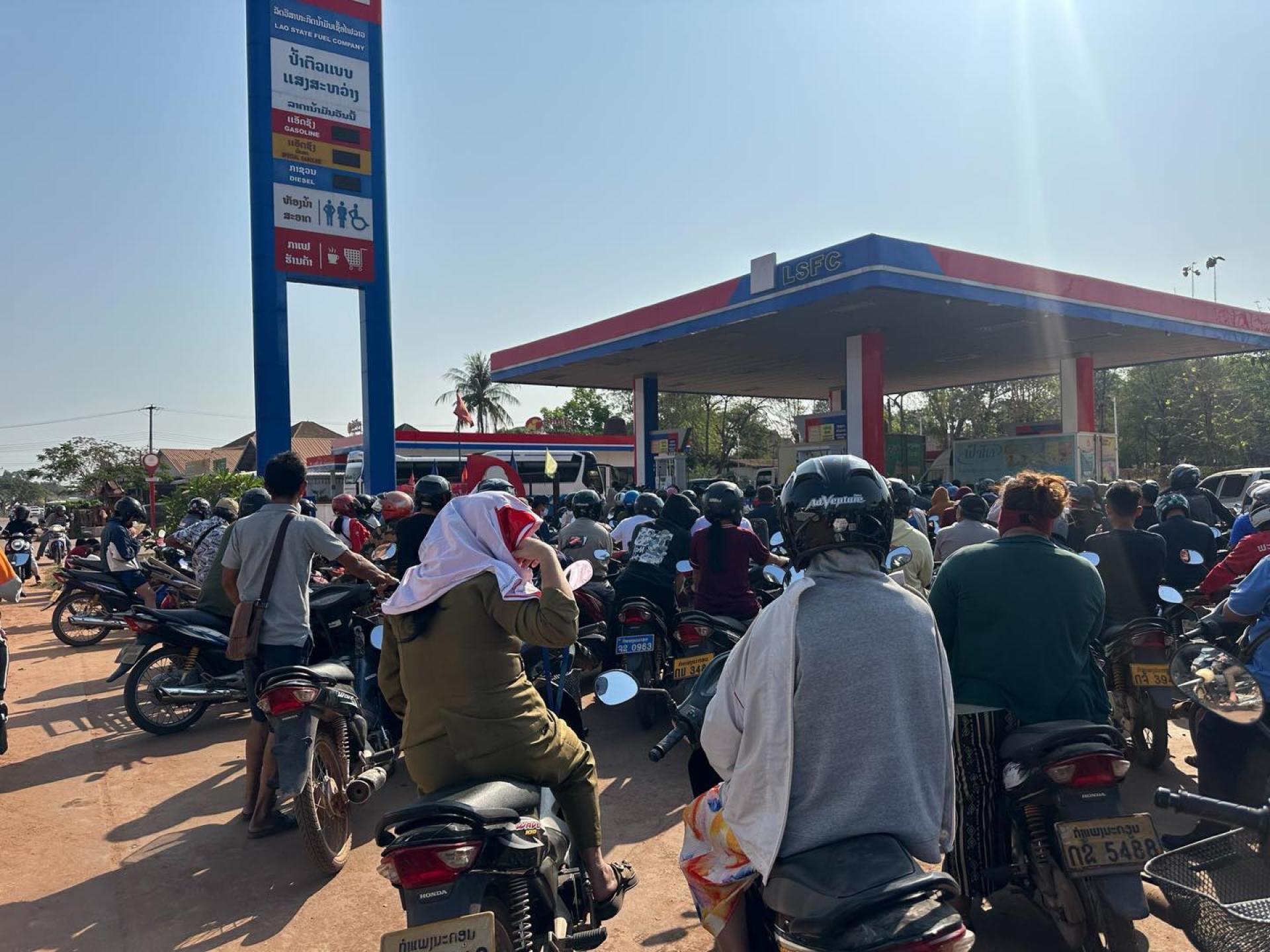
More than 1,000 gas stations across Laos have announced closures, triggering panic buying in many areas and visible queues everywhere. To stabilize domestic fuel supply, Lao authorities are stepping up countermeasures.
According to a March 16 report by the 'Laotian Times', citing data released by the Domestic Trade Bureau on March 11, Laos originally had 2,538 gas stations nationwide. However, as many as 1,061 have now reported closures, leaving only 1,477 still struggling to operate.
In Vientiane Province, 121 out of 207 gas stations have closed, leaving just 86 in operation. The closure rate in Xieng Khouang Province is similarly alarming, with 121 out of 153 stations closed, and only 32 remaining operational.
Meanwhile, hundreds of people have been forced to queue up for fuel, not only causing serious traffic congestion but further intensifying public fears of a fuel shortage.
As more stations across the country report suspending operations, running out of fuel, or limiting fuel sales, the government ordered a nationwide surprise inspection of fuel supplies on March 13.
Law enforcement officers have been instructed to thoroughly inspect the stock of gas stations and storage tanks, review supply contracts, and investigate delivery and sales records since February 1 to uncover the underlying reasons for the supply disruption.

Officials stated that the inspection actions will continue, and the investigation directions include supply chain disruptions, pricing disputes, and inventory management problems at retail stations.
On the other hand, as part of nationwide monitoring, authorities in Champasak Province fined three gas stations in Paksong District for selling gasoline and diesel at prices higher than the government cap.
During a patrol on March 14, Champasak Provincial Industry and Commerce Bureau officials found that these stations were charging far above the official price for the province.
Among them, the Bounmy gas station located in Lak 11 village was selling gasoline at 38,000 kip per liter (about $1.76) and diesel at 39,000 kip per liter (about $1.81).
The other two, located in Thongkataiy village and Xe Pian village, were even more outrageous, selling gasoline for 39,670 kip ($1.84) per liter, and diesel at 41,370 kip ($1.92) per liter.
It is understood that the official fuel cap price in Champasak Province on March 14 was: 32,530 kip per liter for gasoline (about $1.51), and 32,920 kip per liter for diesel (about $1.53).
Law enforcement officers immediately issued violation fines on-site and imposed a fine of 50 million kip (about $2,330) on the offending businesses. Officials issued stern warnings that repeated violations could result in a fine of up to 100 million kip ($4,662), or even have business licenses revoked.
To ease pressure on the fuel market, the Lao Ministry of Industry and Commerce announced on March 16 that the import tax for 95 premium gasoline would be reduced from 20% to 15%, bringing it in line with the tax rate for 91 regular gasoline.
This decision was reached after multi-party consultations between government officials, the Bank of Lao PDR, and representatives of the fuel industry. Officials indicated that the tax reduction aims to cut import costs and help stabilize retail fuel prices across the country.
In addition, the government also plans to allocate between 30 billion to 60 billion kip from the fuel subsidy fund to manage supply and buffer the impact of international oil price fluctuations.
The authorities emphasized that this fund will be used to support fuel distribution, and to stabilize domestic prices during these extraordinary times of drastic international price changes, to prevent runaway fuel prices and ensure a stable fuel supply for Lao consumers.