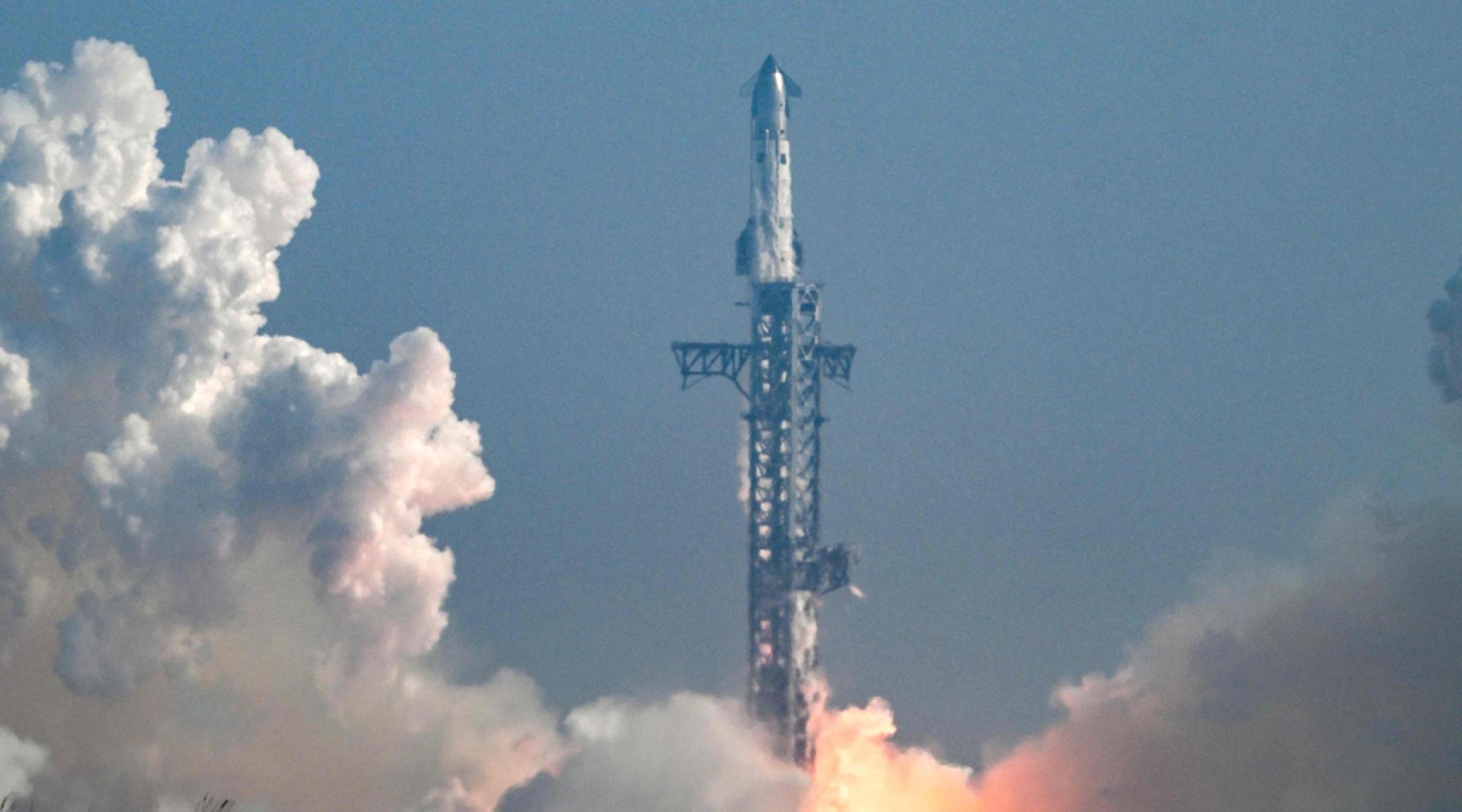
On the 22nd, American space exploration technology company SpaceX launched its 12th Starship rocket from its Texas base, conducting an unmanned test flight. As Elon Musk's rocket company is about to witness a record-breaking initial public offering, this test flight carries significant weight, aiming to test major upgrades on the next-generation spacecraft.
After being delayed on the 21st due to a hydraulic device failure, "Starship" finally lifted off. This 124-meter-tall, largest-ever rocket soared into the sky. Although the "Super Heavy Booster" failed to successfully perform the return ignition after separation and eventually lost control, plunging into the Gulf of Mexico, the company stated that the mission's main objective was to verify the redesigned flight performance.
SpaceX had not planned to recover the booster, but still hoped for a precise return.
During the flight, one of the engines malfunctioned, causing Starship to miss its exact planned orbit. The burn time of the remaining five engines was extended to compensate. Although a spokesperson admitted that this was not a perfect orbital insertion, it was still within the pre-analyzed orbital parameters. This mission also successfully deployed a simulated satellite and two Starlink satellites equipped with cameras to monitor the spacecraft's heat shield performance during atmospheric re-entry.
An hour later, Starship splashed down in the Indian Ocean, successfully completing Starship's twelfth flight test.
Starship V3 is designed to increase launch frequency for Starship satellites and execute NASA's future lunar missions.
The core breakthroughs of Starship V3 focus on boosting payload capacity from 35 tons to over 100 tons, and, for the first time, equipping an orbital propellant transfer system.
After months of testing delays, the maiden flight of the Starship V3 rocket marks a key milestone. As SpaceX is set to launch its initial public offering (IPO) next month—expected to be the largest in history—this test flight's outcome may also influence investor confidence.
With over $15 billion invested in Starship's development, the spacecraft is fully reusable and is crucial for Musk's ambitions to reduce launch costs, expand the Starship business, and pursue goals ranging from deep space exploration to orbital data centers. All these aspirations are factored into his aiming for a $1.75 trillion valuation for the company at IPO.
SpaceX had not planned to recover the booster, but still hoped for a precise return.
During the flight, one of the engines malfunctioned, causing Starship to miss its exact planned orbit. The burn time of the remaining five engines was extended to compensate. Although a spokesperson admitted that this was not a perfect orbital insertion, it was still within the pre-analyzed orbital parameters. This mission also successfully deployed a simulated satellite and two Starlink satellites equipped with cameras to monitor the spacecraft's heat shield performance during atmospheric re-entry.
An hour later, Starship splashed down in the Indian Ocean, successfully completing Starship's twelfth flight test.
Starship V3 is designed to increase launch frequency for Starship satellites and execute NASA's future lunar missions.
The core breakthroughs of Starship V3 focus on boosting payload capacity from 35 tons to over 100 tons, and, for the first time, equipping an orbital propellant transfer system.
After months of testing delays, the maiden flight of the Starship V3 rocket marks a key milestone. As SpaceX is set to launch its initial public offering (IPO) next month—expected to be the largest in history—this test flight's outcome may also influence investor confidence.
With over $15 billion invested in Starship's development, the spacecraft is fully reusable and is crucial for Musk's ambitions to reduce launch costs, expand the Starship business, and pursue goals ranging from deep space exploration to orbital data centers. All these aspirations are factored into his aiming for a $1.75 trillion valuation for the company at IPO.