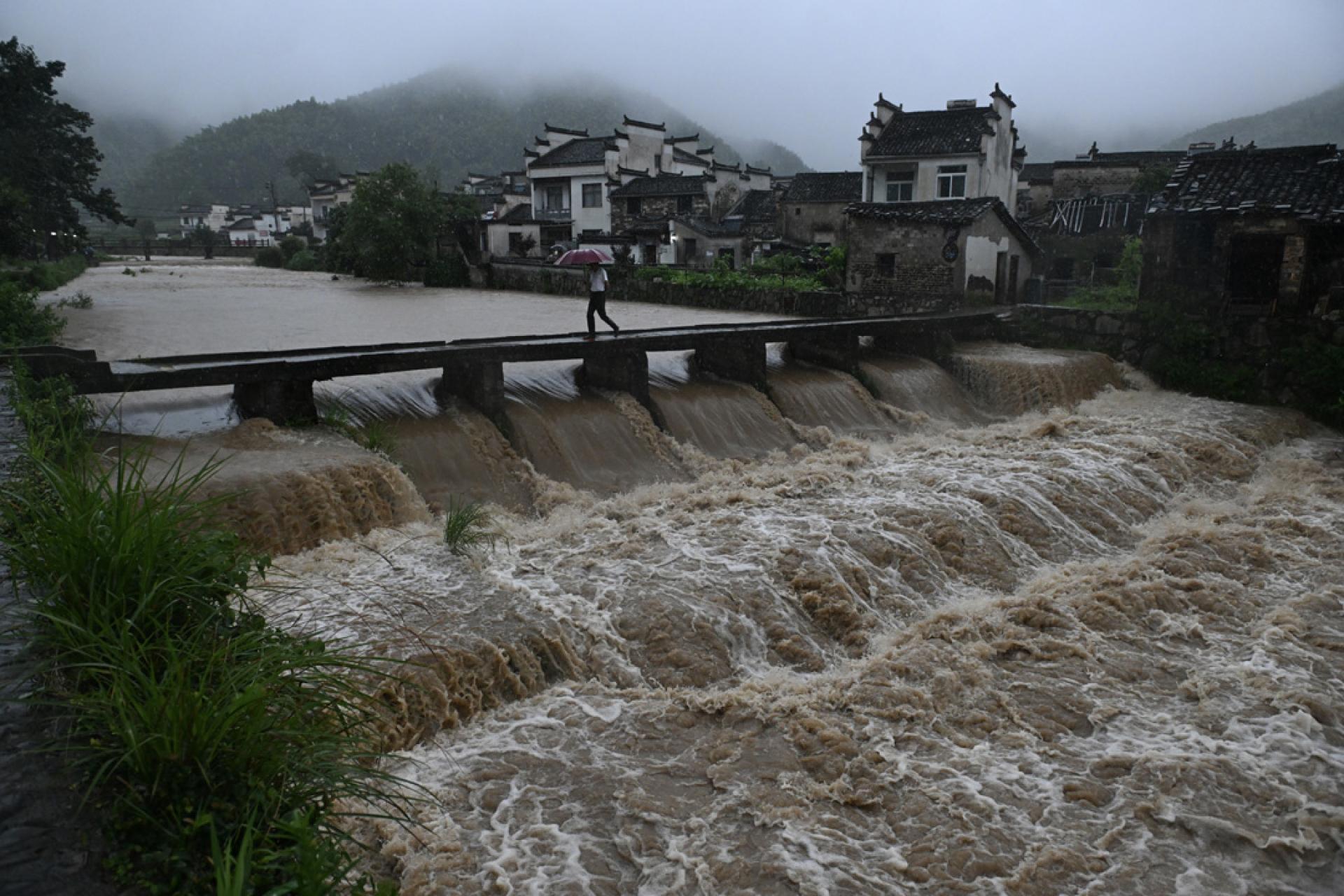
After Typhoon Bavi made landfall in Zhejiang Province, China on the 12th, it has now entered Anhui Province, but even the distant northeastern Liaoning Province has been affected by its peripheral circulation. Rivers in Lingyuan City, Liaoning have swollen, village roads have been damaged, and bridges and crops have been submerged by floodwaters.
According to comprehensive reports from CCTV News and other media, at 6 p.m. on the 12th, China's Ministry of Water Resources and China Meteorological Administration jointly issued a red meteorological alert for mountain flood disasters. The warning covers Liaoning, Jilin, and Anhui provinces.
Due to low atmospheric pressure and Typhoon Bavi's peripheral circulation, some areas in Lingyuan City, Liaoning have seen persistent heavy rains, causing river water levels to rise and damaging village roads. In particular, Daoerdeng Town in Lingyuan has experienced continuous heavy rainfall since the 10th, with a total of 180 millimeters of rain over two days.
Reports indicate that of the 12 reservoirs in the area, 11 have surpassed the maximum flood season water level. Many trees and farmland have been soaked, with corn fields submerged under water up to 1 meter deep. According to preliminary statistics, over 6,200 mu (around 1,021 acres) of farmland and 1.5 kilometers of road in the town have suffered varying degrees of damage, and one bridge has been completely submerged by floodwaters.
China's meteorological alert for mountain flood disasters is divided into four levels, with red representing the highest risk, indicating immediate evacuation is required.