Dato' Wang Xiaoting, Special Affairs Officer to Deputy Prime Minister Dato’ Seri Ahmad Zahid, pointed out that the future of Malaysia, China, and ASEAN does not simply depend on agreements between governments, nor solely on investments and business exchanges between enterprises. What truly determines how far the relationship can go is how much young people of both sides understand and trust each other.
She said that future cooperation between Malaysia, China, and ASEAN should be fostered through education, language, culture, technology, and youth interaction, in order to build a deeper foundation of mutual trust for the next generation.
“What gives life to China-ASEAN relations is when today’s young people, upon entering universities, enterprises, government, research institutions, or starting their own businesses, are still willing to cooperate with each other and face common problems together.”
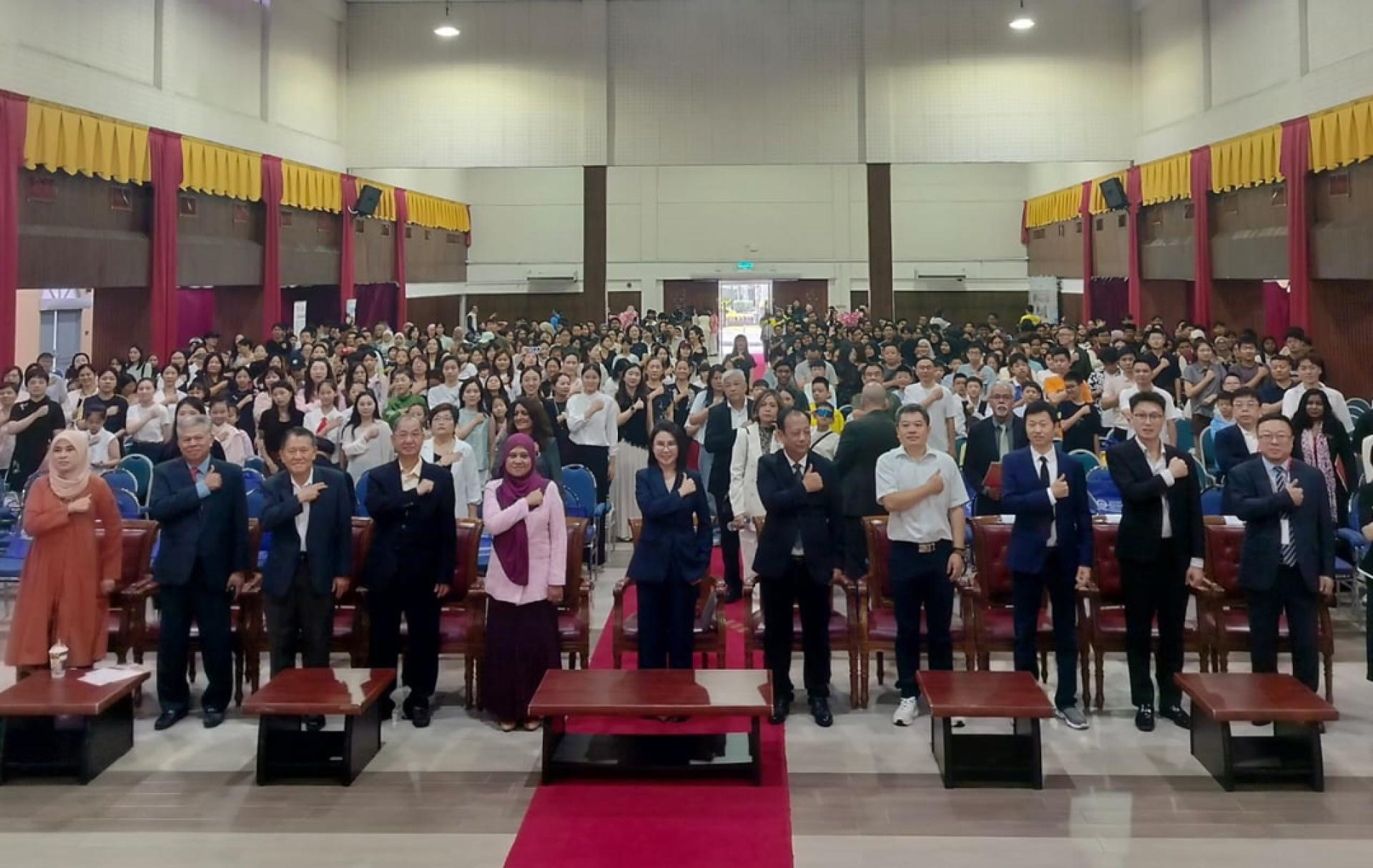
Wang Xiaoting made these remarks while presiding over the opening of the main forum of the "Chinese Language Talks ASEAN" 2026 China-ASEAN Youth Language and Culture Exchange and Civilizational Mutual Learning Event held on Friday (28th) at Sultan Idris Education University (UPSI). Attendees included the organizing committee chair Wang Haoyu, UPSI Deputy Vice-Chancellor of Academic and International Affairs Professor Raja Nor, Chairman of the Malaysia Han Cultural Center Dato’ Wu Hengcan, among others.
In her speech, she also introduced Tanjung Malim to the teachers, students, and guests from China, noting that today's Tanjung Malim is no longer just an “education city”—it is also gradually developing into a key hub for Malaysia’s technology and automotive industries.
She said that Tanjung Malim boasts over a century of educational tradition, and Sultan Idris Education University has long been one of the most important cradles for teacher training and educational development in Malaysia; Tanjung Malim is also an important production and industrial base for Proton, Malaysia’s national automotive brand, forming a significant industrial partnership with Chinese automotive company Geely.
She pointed out that today’s automotive manufacturing industry is no longer just about traditional mechanical engineering, but is increasingly intertwined with artificial intelligence, automation, robotics, smart manufacturing, new energy vehicles, supply chain technology, and high-skilled talent development.
“Therefore, Tanjung Malim has a very special advantage. Here, talent is nurtured while industries are developed; it is a place where a century-old educational tradition meets the technologies of the future.”
Wang Xiaoting said that the best way for a city to develop is not to only have universities or only factories, but to enable talents cultivated by universities to enter industry, and for the technologies and problems industry needs to then feed back into universities for research, innovation, and further talent cultivation.
She also welcomed universities, schools, enterprises, and youth from China to further engage with Tanjung Malim in the future, and encouraged not to regard it as merely a venue for a one-off event.
She noted that cities with future competitiveness must truly be able to connect education, talent, technology, and industry, and that Tanjung Malim is equipped with such development conditions.