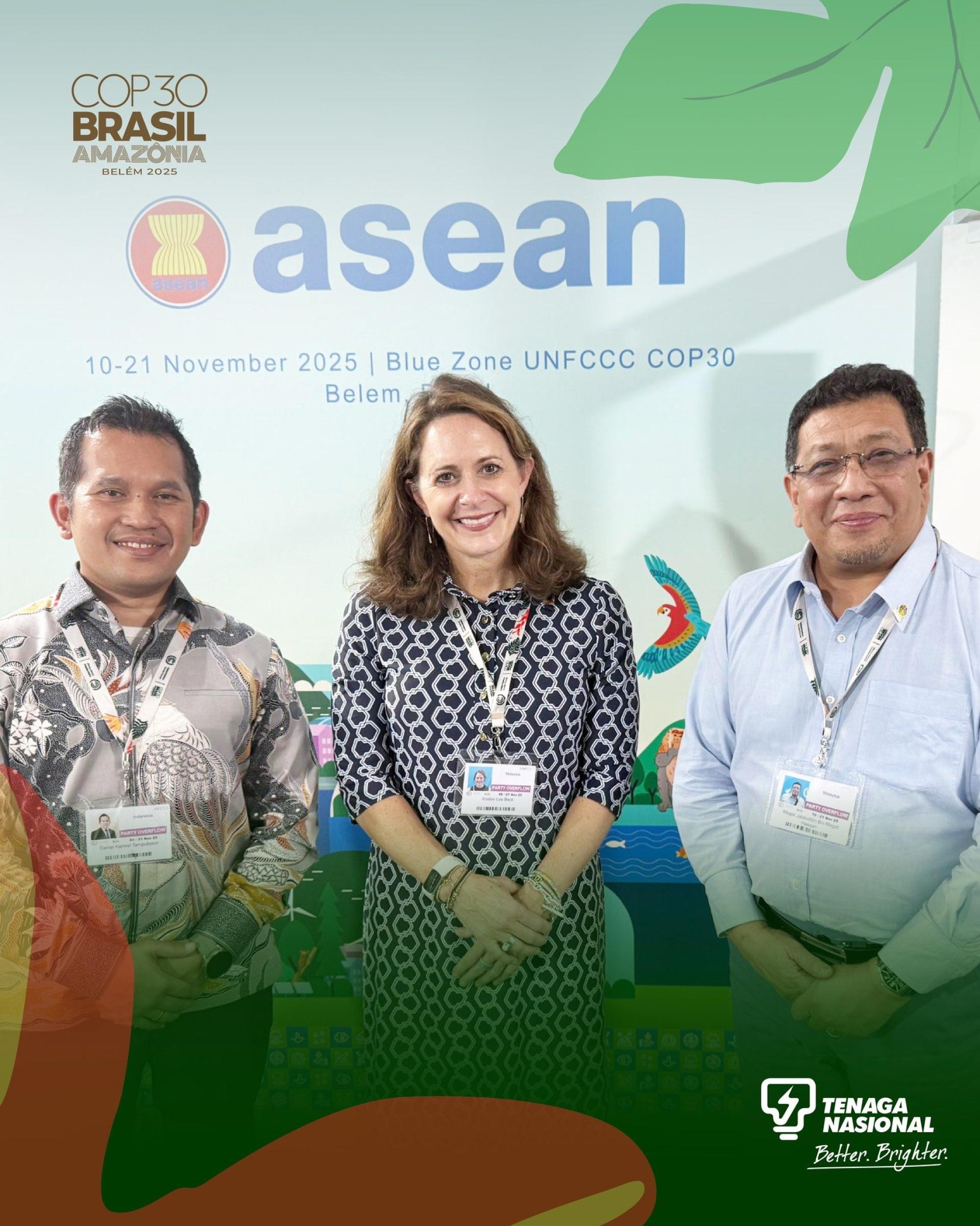
As one of the key utilities under the ASEAN Power Grid (APG) initiative, Tenaga Nasional Berhad (TNB) will continue to serve as an important driving force in advancing ASEAN’s collective energy transition, viewing cross-border electricity interconnection as a crucial driver for promoting regional energy integration.
TNB President and CEO, Datuk Megat Jalaluddin Megat Hassan, pointed out during COP30 that the Laos-Thailand-Malaysia-Singapore power integration project is a viable and impactful model for regional energy cooperation.
TNB recently posted his interview at COP30 on social media. He said, taking this integration project as an example, pragmatic cooperation, reliable interconnection mechanisms, and scalable initiatives have proven that multilateral electricity trade in ASEAN is not only feasible, but also highly impactful.
COP30 refers to the 30th United Nations Climate Change Conference (Conference of the Parties to the UNFCCC), which was held last month at the Hangar Convention Center in Belém, Brazil.
During the conference, another regional cooperation initiative being explored was the Vietnam-Malaysia-Singapore electricity interconnection project, which aims to study the development of renewable energy in Vietnam and the transmission of electricity across borders to Peninsular Malaysia and Singapore.
This initiative involves multiple utilities and energy companies, including TNB, PETRONAS, Sembcorp, and Petrovietnam, reflecting continued efforts by stakeholders to assess the feasibility of expanding multilateral electricity trade to support ASEAN Power Grid development goals.
Both of these projects support the overall vision of the ASEAN Power Grid—to enhance regional energy security and accelerate the ASEAN-wide energy transition through cross-border electricity trading and shared renewable resources.

As the ASEAN Chair in 2025, Malaysia continues to play a coordinating role, uniting utilities, policymakers, and partners to accelerate the establishment of a more secure, resilient, and interconnected regional power system.
He stated that strengthening interconnection and building trust among ASEAN member countries are crucial to driving collective regional progress.
Looking ahead, Megat Jalaluddin said the region should set out clear actions to align grid infrastructure, technical standards, and regulatory frameworks, thereby facilitating the smooth flow of clean energy throughout the region.
He noted that further strengthening intergovernmental dialogue mechanisms would better align policy goals with technological maturity, particularly in smart grids, digitalization, and distributed energy resources.
In addition, the region could explore practical pathways to expand the framework for multilateral resource sharing, including launching an ASEAN Power Grid working group, conducting feasibility studies for multilateral electricity trading corridors, and promoting knowledge exchange through the ASEAN Centre for Energy.
At the national level, Megat Jalaluddin said Malaysia’s National Energy Transition Roadmap (NETR) is an important guiding framework for the country’s transition to a low-carbon economy, with grid readiness and flexibility seen as key enablers.
NETR is a strategic blueprint launched by the Malaysian government in 2023, aiming to transition the nation from fossil fuels to a green economy by 2050, with a focus on renewable energy, energy efficiency, hydrogen, bioenergy, and green transportation.
He pointed out that TNB's three core goals include increasing grid-based generation capacity, ensuring Malaysia’s grid flexibility to integrate diverse energy sources, and making users the main beneficiaries of the net-zero transition.
He said: “With the above efforts, we are confident of achieving our goals by 2050.”
Malaysia’s national pavilion at COP30, themed “Climate Action Now: Net Zero Pathway Unlocked,” demonstrates the country's firm commitment to accelerating climate action and deepening regional cooperation.
TNB also supported the pavilion’s showcase of Malaysia’s overall energy transition journey, including grid modernization, renewable energy integration, and a fair and feasible pathway to achieving net-zero emissions by 2050.