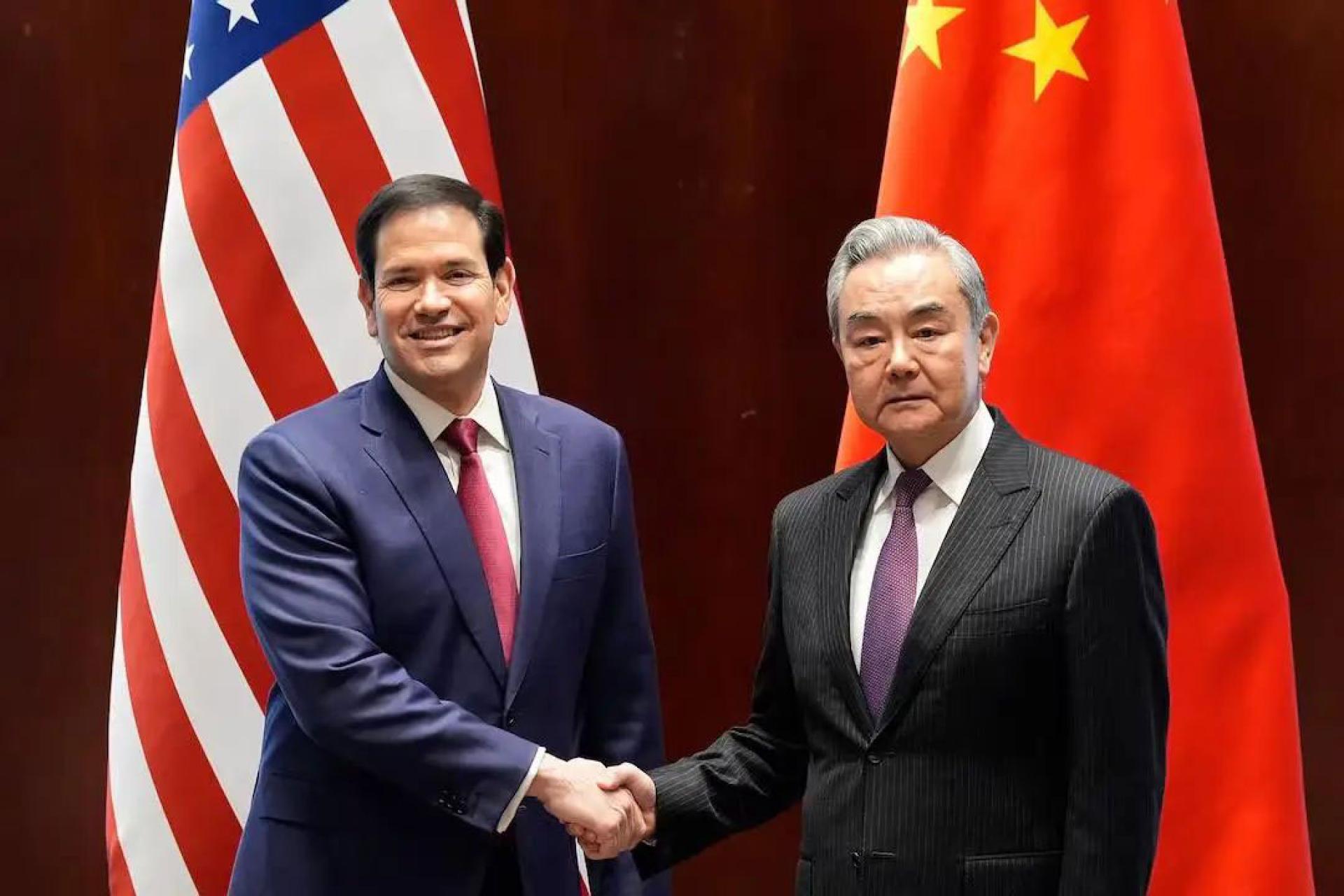
Known for his tough stance toward China, US Secretary of State Rubio has taken the rare step of proactively signaling his willingness to meet with Chinese Foreign Minister Wang Yi, while repeatedly stating he has "no intention to apply pressure."
On July 19, speaking to accompanying media reporters at Joint Base Andrews in Maryland, just before boarding a flight to Manila to attend the 59th ASEAN Foreign Ministers’ Meeting, he clearly expressed this wish. As soon as he spoke, major global news agencies and regional media quickly published analytical reports, regarding this as an important indicator for China-US diplomatic interaction.
The following day, July 20, at a routine press conference of China’s Ministry of Foreign Affairs, a reporter asked whether the two foreign ministers would meet in Manila. The spokesperson simply replied, "Relevant arrangements will be announced in due course based on actual circumstances," maintaining a calm tone and careful wording, neither confirming nor denying the possibility.
This time, Rubio opted to express his intent for a meeting not through the traditional, confidential diplomatic channels, but instead chose to do so directly and publicly under the spotlight. When asked by reporters if he planned to engage with the Chinese and Russian foreign ministers during the ASEAN meeting, he did not dodge the question and responded candidly: "We always welcome constructive dialogue with both counterparts." His statement was brief, with no added political preconditions, nor did he deliberately distinguish between the parties.
His remarks addressed both the Chinese and Russian sides simultaneously, which not only reflects the US side’s approach to coordination in multilateral diplomatic settings, but also avoids the risk of being misinterpreted as making "special concessions" to China only.
This year’s ASEAN Foreign Ministers’ Meeting is being held in Manila from July 19 to 23, bringing together, in addition to the ten ASEAN member states, senior diplomats from more than a dozen dialogue partner countries such as China, the US, Russia, Japan, South Korea, Australia, and India—making it one of the Asia-Pacific region's most representative annual multilateral diplomatic platforms.
If Rubio, Wang Yi, and Russian Foreign Minister Lavrov were to sit in the same conference room discussing regional security, that scene in itself would be full of tension.