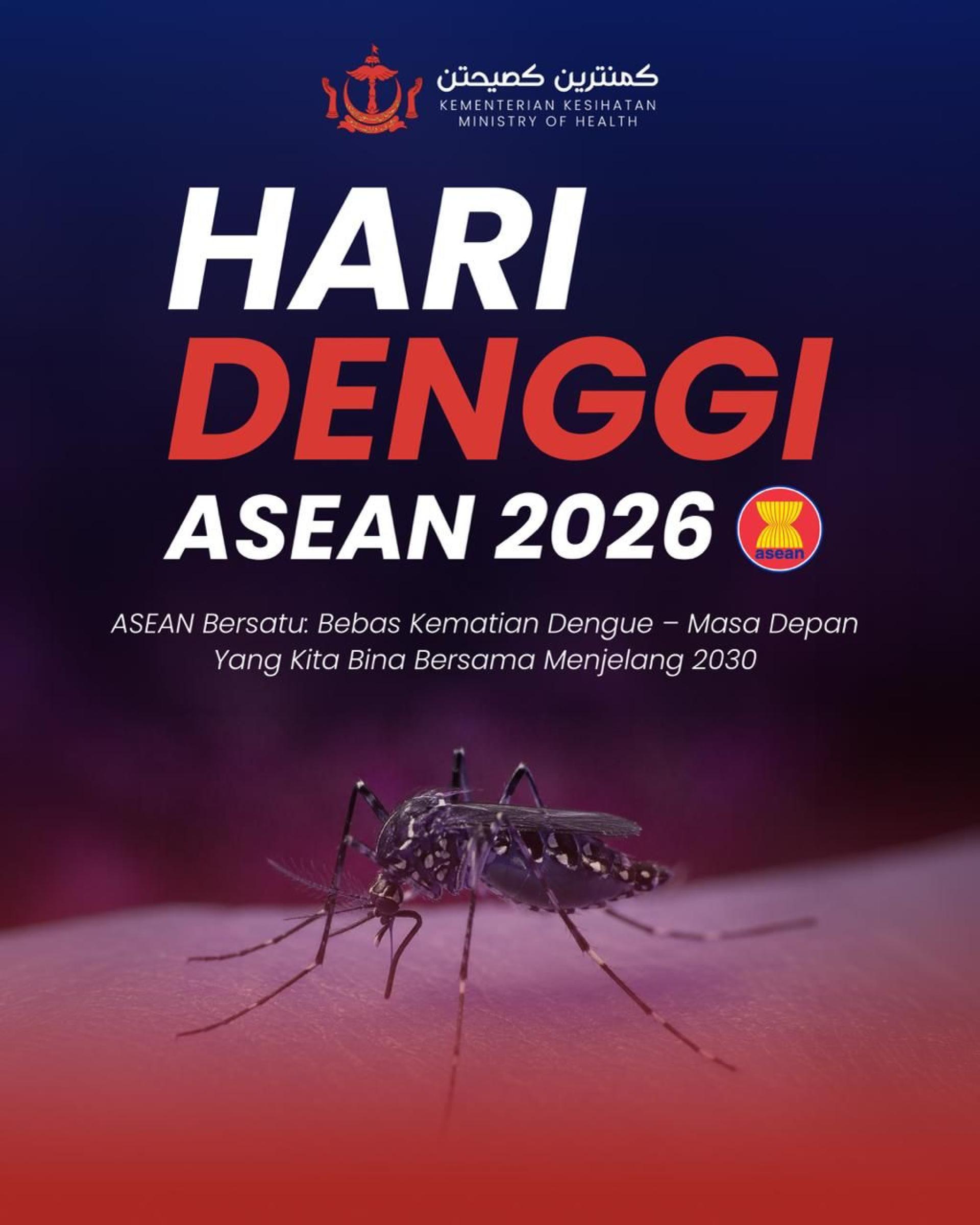
(Bandar Seri Begawan, 15th) June 15 is ASEAN Dengue Day, jointly celebrated each year by ASEAN countries to raise public awareness of dengue and emphasize the significance of reducing dengue transmission through public cooperation, capacity building, and encouraging stakeholders to take collective action, thus alleviating the burden of dengue.
This year's ASEAN Dengue Day celebration is themed "ASEAN Unity: Zero Dengue Deaths—Building the Future of 2030 Together," focusing on raising public awareness and strengthening collaboration and coordinated action among all parties. Sustainable integrated approaches, complemented by proactive dengue surveillance, comprehensive vector management, and active participation of all stakeholders including the community, along with rapid and effective response measures, are important components for strengthening effective and sustainable management, prevention, and control of dengue in ASEAN member states.
Minister of Health Dato Isham issued a statement in conjunction with ASEAN Dengue Day.
Dengue is one of the most common mosquito-borne diseases worldwide, with an estimated 390 million people infected each year and remains one of the leading causes of global morbidity and mortality. Over the past two decades, dengue incidence has continued to rise, becoming a significant public health challenge worldwide.
In Brunei, dengue is endemic. Infection rates fluctuate throughout the year, and the number of cases tends to spike every few years. Over the past decade, the average annual number of dengue cases in Brunei was 54, with the highest number recorded in 2019 at 119 cases, followed by 100 cases in 2024.
Dengue is transmitted to humans through bites from infected mosquitoes, with Aedes mosquitoes identified as the main vector for dengue transmission in Brunei. Most dengue cases are mild or asymptomatic. Symptoms include high fever, headache, muscle pain, nausea, vomiting, and rash. However, a small number of patients may experience severe dengue symptoms, such as bleeding gums, nosebleeds or vomiting blood, severe abdominal pain, fatigue, and weakness. Without timely detection and treatment, these can lead to death.
The Ministry of Health will continue to strengthen the surveillance and control of mosquito-borne diseases. This includes enhancing the response capacity of the health system and surveillance capability for mosquito-borne diseases, monitoring mosquitoes, raising awareness of prevention and control among all age groups including school-age children and adults, as well as expanding cooperation with institutions and the public to jointly control dengue infections.
Prevention is an important foundation for reducing the risk of dengue infection. Keeping the environment clean, eliminating or covering water reservoirs, cleaning drains, and regularly changing water in flower pots are simple measures that help reduce mosquito breeding.
The public is advised to always remain vigilant and maintain a clean environment to more effectively prevent and control dengue. This requires the participation and cooperation of the entire community to ensure our environment is clean and safe. Spraying insecticide is only a temporary control measure, while more effective long-term control measures include keeping the environment clean and ensuring there are no mosquito breeding sites.
In addition, preventive measures against dengue infection include wearing light-colored long-sleeved clothing and pants, using mosquito repellents, and avoiding outdoor activities during peak mosquito activity times (i.e., dawn and dusk).
Let us reiterate our commitment to protecting families and communities from dengue infection, enhance health culture, raise health awareness, and strengthen cooperation to collectively build a healthier and safer society while reducing dengue cases. In the spirit of "United ASEAN: Zero Dengue Deaths—The Future We Build Together (2030)," let us join hands to protect future generations from the threat of dengue.
This year's ASEAN Dengue Day celebration is themed "ASEAN Unity: Zero Dengue Deaths—Building the Future of 2030 Together," focusing on raising public awareness and strengthening collaboration and coordinated action among all parties. Sustainable integrated approaches, complemented by proactive dengue surveillance, comprehensive vector management, and active participation of all stakeholders including the community, along with rapid and effective response measures, are important components for strengthening effective and sustainable management, prevention, and control of dengue in ASEAN member states.
Minister of Health Dato Isham issued a statement in conjunction with ASEAN Dengue Day.
Dengue is one of the most common mosquito-borne diseases worldwide, with an estimated 390 million people infected each year and remains one of the leading causes of global morbidity and mortality. Over the past two decades, dengue incidence has continued to rise, becoming a significant public health challenge worldwide.
In Brunei, dengue is endemic. Infection rates fluctuate throughout the year, and the number of cases tends to spike every few years. Over the past decade, the average annual number of dengue cases in Brunei was 54, with the highest number recorded in 2019 at 119 cases, followed by 100 cases in 2024.
Dengue is transmitted to humans through bites from infected mosquitoes, with Aedes mosquitoes identified as the main vector for dengue transmission in Brunei. Most dengue cases are mild or asymptomatic. Symptoms include high fever, headache, muscle pain, nausea, vomiting, and rash. However, a small number of patients may experience severe dengue symptoms, such as bleeding gums, nosebleeds or vomiting blood, severe abdominal pain, fatigue, and weakness. Without timely detection and treatment, these can lead to death.
The Ministry of Health will continue to strengthen the surveillance and control of mosquito-borne diseases. This includes enhancing the response capacity of the health system and surveillance capability for mosquito-borne diseases, monitoring mosquitoes, raising awareness of prevention and control among all age groups including school-age children and adults, as well as expanding cooperation with institutions and the public to jointly control dengue infections.
Prevention is an important foundation for reducing the risk of dengue infection. Keeping the environment clean, eliminating or covering water reservoirs, cleaning drains, and regularly changing water in flower pots are simple measures that help reduce mosquito breeding.
The public is advised to always remain vigilant and maintain a clean environment to more effectively prevent and control dengue. This requires the participation and cooperation of the entire community to ensure our environment is clean and safe. Spraying insecticide is only a temporary control measure, while more effective long-term control measures include keeping the environment clean and ensuring there are no mosquito breeding sites.
In addition, preventive measures against dengue infection include wearing light-colored long-sleeved clothing and pants, using mosquito repellents, and avoiding outdoor activities during peak mosquito activity times (i.e., dawn and dusk).
Let us reiterate our commitment to protecting families and communities from dengue infection, enhance health culture, raise health awareness, and strengthen cooperation to collectively build a healthier and safer society while reducing dengue cases. In the spirit of "United ASEAN: Zero Dengue Deaths—The Future We Build Together (2030)," let us join hands to protect future generations from the threat of dengue.