Robots Entering Homes: Unitree Robotics Predicts As Soon As 2-3 Years
Published atAug 21, 2026 02:38 pm
On the 20th, Wang Xingxing, CEO of Chinese humanoid robot manufacturer Unitree Robotics, predicted at the World Robot Conference that robots will truly enter daily life and households in as quickly as two to three years, or as long as five to ten years.
He stated that at present, humanoid robots still lack practical work efficiency and generalization capability and are not yet prepared for large-scale deployment. Only when humanoid robots are able to complete 80% of tasks in unfamiliar scenarios according to instructions such as voice commands will the "ChatGPT moment" for humanoid robots truly arrive. Once the technology breaks through this inflection point, robots can gradually achieve large-scale commercialization.
On the 19th, Unitree Robotics was listed on the Shanghai STAR Market, being regarded as China's "first stock of humanoid robots." The next day, Wang Xingxing made an appearance in Yizhuang, Beijing, delivering a speech at the main forum of the 2026 World Robot Conference, looking ahead to the next decade of the humanoid robot industry.
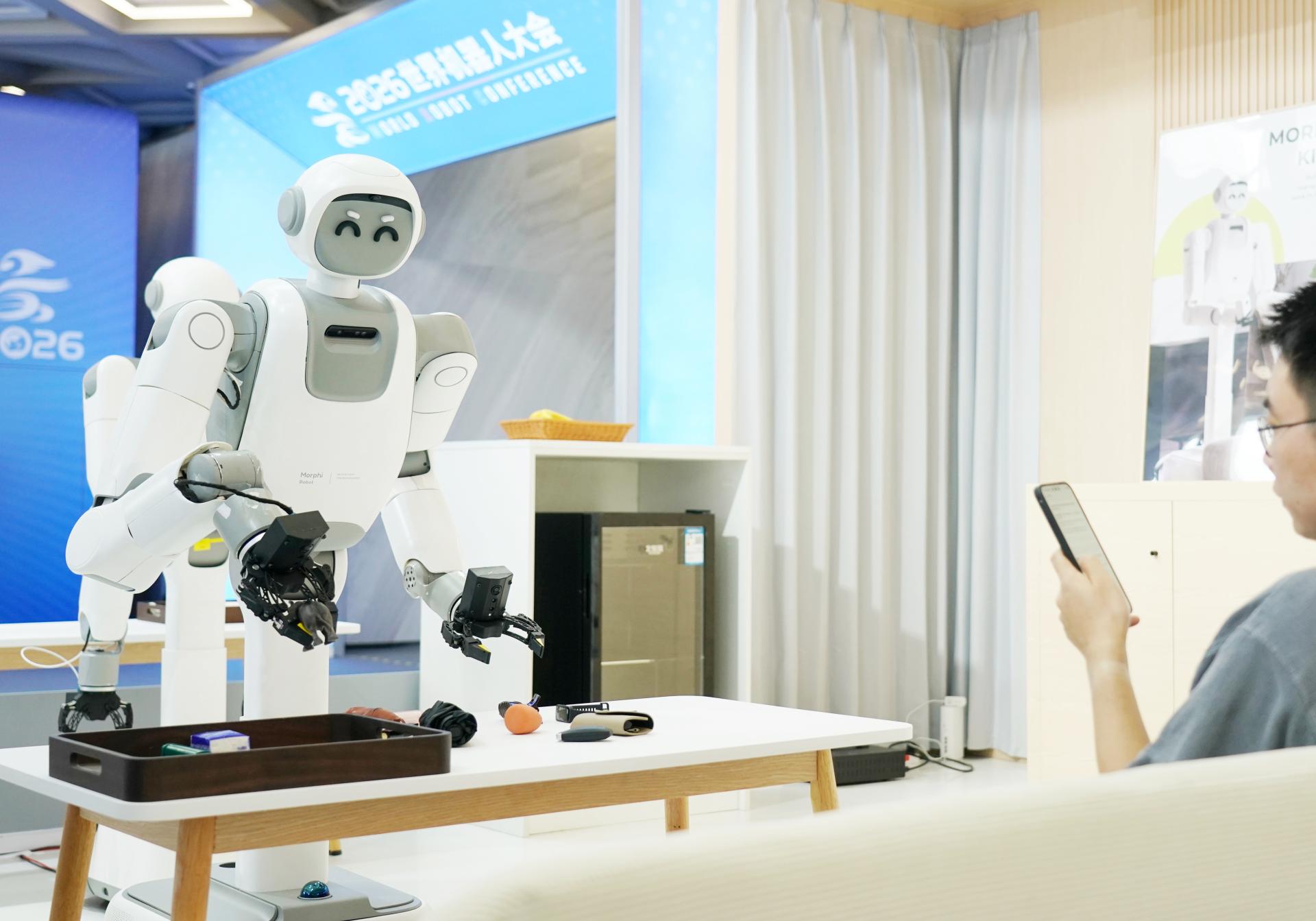
With the pursuit from capital and official strategic support, China's robot industry is accelerating towards commercial implementation. The 2026 World Robot Conference hosted more than 300 manufacturers, showcasing a complete industrial chain layout from R&D to application, from components to complete robot assembly. Virtually every Chinese exhibitor brought real scenarios of their robots at work into the exhibition area, from assembling screws in factories, logistics and transportation, to retail sales, and further to entertainment and education—robots are being used in increasingly diversified scenarios.
The Central Enterprise Robot Innovation Consortium, led by China North Industries Group, announced on the opening day of the 19th that it is globally recruiting mass-produced products such as quadruped robots, humanoid robots, and dexterous hands, offering them to innovation teams free of charge. The goal is to accelerate the implementation of these technologies in real-world scenarios. Unitree Robotics' humanoid robot demonstrating table tennis. (Photo: Xinhua News Agency)Wang Xingxing delivering a speech at the main forum of the conference.Founded in 2024 and focusing on the R&D and manufacturing of industrial robots, Yu Chao, founder of Shenzhen Embodied Intelligence company Luming Robotics, said in an interview that any technology must ultimately generate value in real scenarios. The entire robotics industry is now at an inflection point of seeking practical value. Whether a robotics company has competitiveness is no longer judged by whether it can run, jump, or perform simple interactions, but rather "whether it can be implemented, and how well it is implemented."
On the 20th, the World Robot Conference also released the "2026 Humanoid Robot Industry Development Report."
The report analyzed the development status of five countries—China, the US, Germany, South Korea, and Japan—pointing out that current technological innovation has entered a phase of "cluster emergence." The industry chain has already formed complete manufacturing capability from key chips and components to whole-machine assembly. Humanoid robots are accelerating from small-scale pilots to normalized deployment and large-scale application, taking the industry into deep waters.
The report also believes that humanoid robots are expected to become another disruptive product after computers, smartphones, and new energy vehicles.
This article has been translated using our AI technology. While we strive for accuracy,
AI translations
may contain errors. For the most precise information, please refer to the original article.