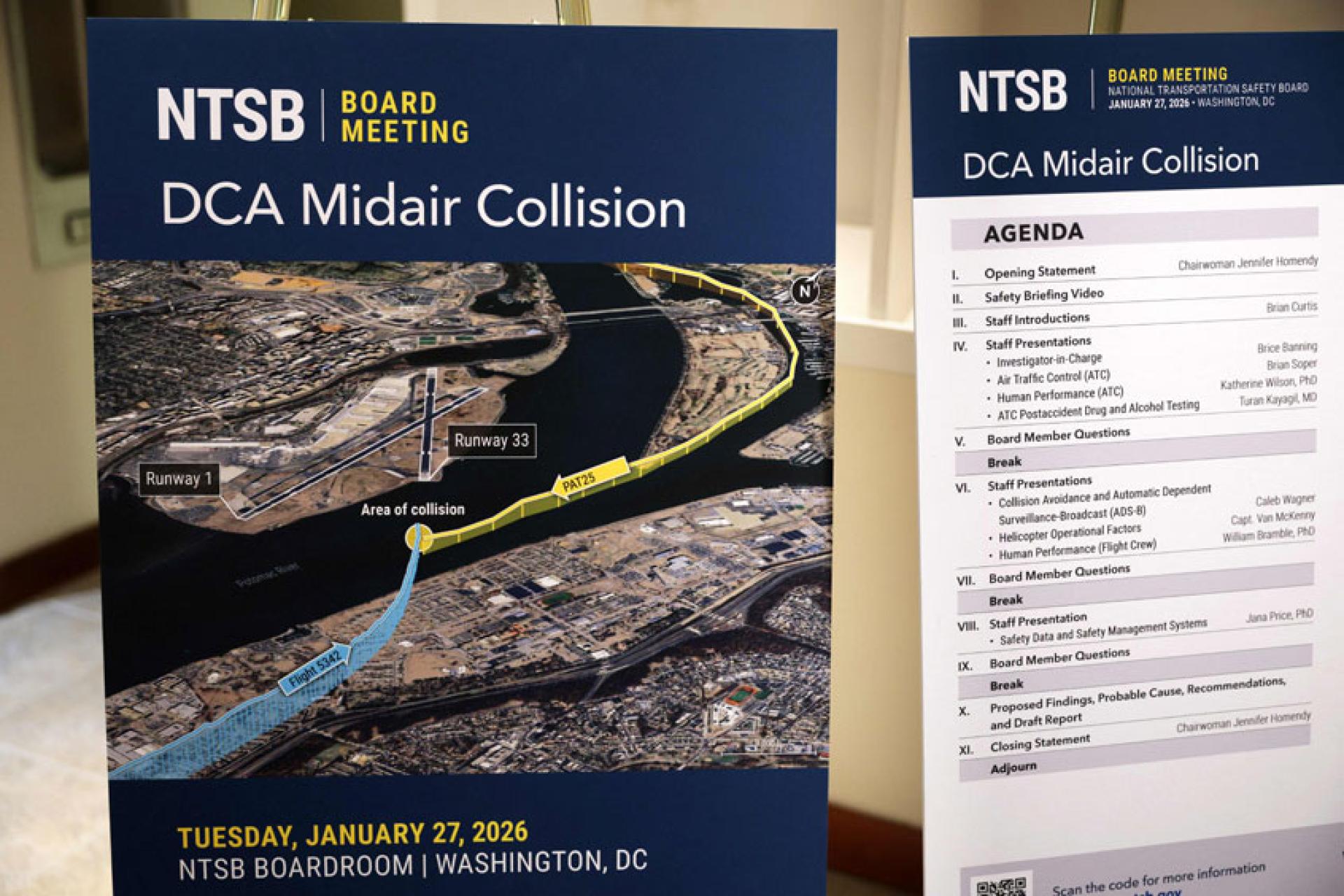
The U.S. National Transportation Safety Board stated that the plane-military aircraft collision near Washington Reagan National Airport at the end of January 2025 was caused by "systemic errors," and that this tragedy was "preventable."
This conclusion was announced by the agency after a year-long investigation.
On the night of January 29, 2025, a Pacific Southwest Airlines Bombardier jet carrying 64 people collided with a "Black Hawk" helicopter carrying three military personnel during its landing approach at Reagan National Airport in Washington. Both aircraft subsequently crashed into the Potomac River. There were no survivors.
NTSB Chair Jennifer Homendy stated at a meeting on the 27th that multiple deep-rooted, fundamental systemic errors and flaws combined to ultimately cause this "devastating tragedy."
During an interview with media during the meeting, Homendy bluntly said that allowing a helicopter route to cross Reagan National Airport's Runway 33—with only about 23 meters vertical separation from civilian aircraft—was unacceptable anywhere in the airspace. Runway 33 was the one the ill-fated jet was attempting to land on.
Homendy strongly criticized the inaction of the Federal Aviation Administration.
She pointed out that the FAA had received over 80 reports in recent years of near-miss incidents between helicopters and passenger aircraft, “the data already exists in the system,” yet the agency took no action in response to concerns raised by airport air traffic controllers.
She noted that this fatal incident was “preventable.”
According to U.S. media disclosure of the accident investigation report, multiple factors likely contributed to the accident, including establishing helicopter flight routes in already crowded airspace, critical equipment failures, and human error.
National Public Radio reported that the investigation found an instrument failure on the helicopter may have caused pilots to misread their flight altitude, with the actual altitude being about 30.5 meters higher than indicated. At the time of the crash, one air traffic controller was responsible for both the airport and helicopter traffic. This controller had earlier expressed that they were under excessive work pressure, but this was not addressed by the watch supervisor.
The report also pointed out insufficient communication between the controller and the helicopter pilots. At the critical moment when the helicopter and airliner were converging, the controller should have issued a safety warning. A press conference in February last year also highlighted communication issues: 17 seconds before the collision, the controller instructed the helicopter to pass behind the plane, but cockpit voice recordings indicate the “pass behind” instruction may not have been received by the helicopter crew.