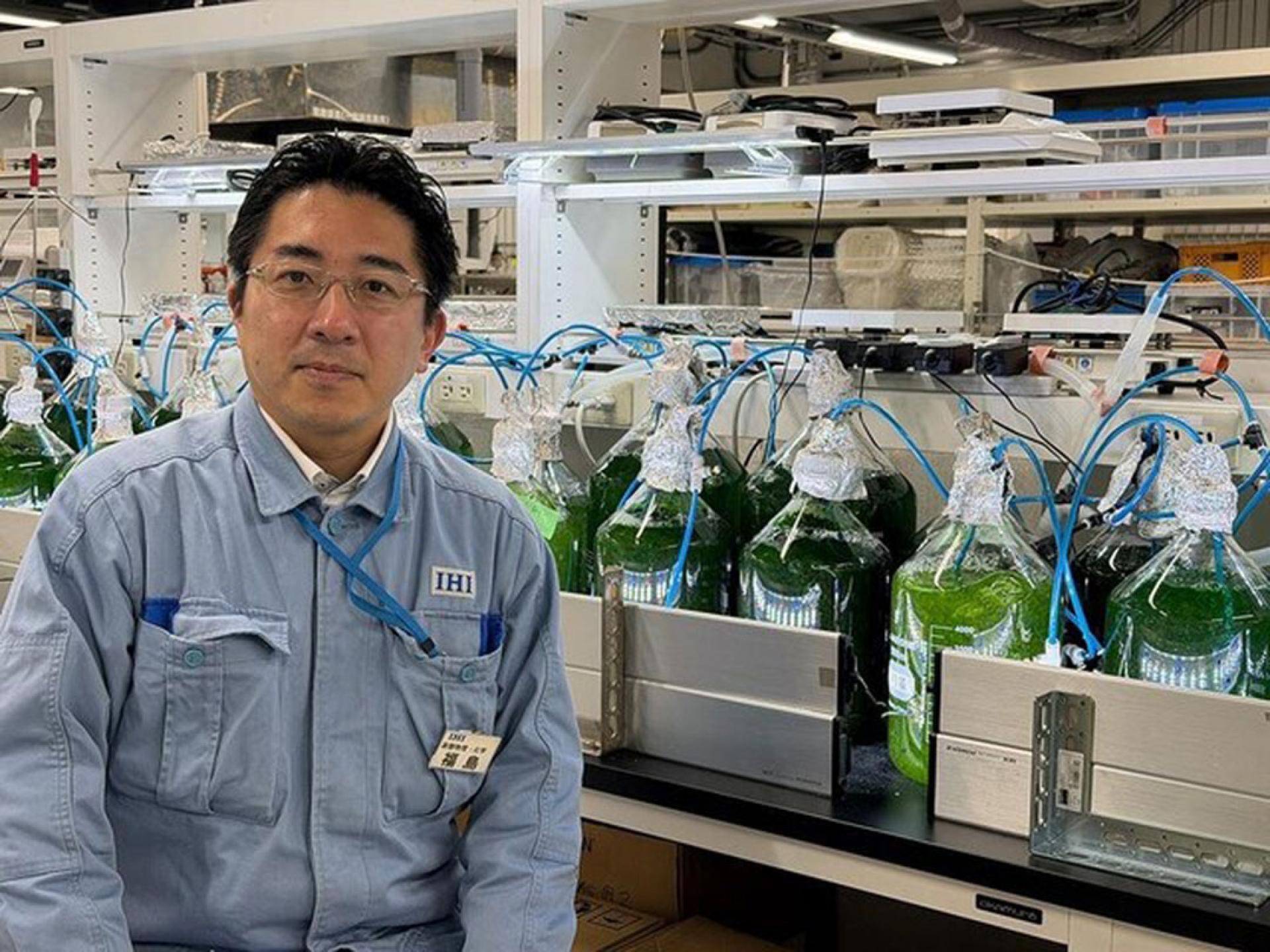
There have been recent reports that Japan is developing a special algae-based technique to extract gold from seawater. Some analysts believe that if this technology is successfully commercialized, gold will cease to be a scarce asset, which could lead to a further decline in gold prices.
●Principle Proven Feasible, Only Awaiting Commercialization
According to Business Insider Japan, Japanese heavy industry giant IHI is working on using a special type of algae to extract gold from seawater. If this technology can be commercialized, it could unlock as much as 5 billion tons of gold reserves in the ocean. According to IHI principal researcher Yasuyuki Fukushima, the team has spent nearly 10 years developing a “biosorption” technique, using a kind of special algae found in hot springs in northeastern Japan, capable of converting gold dissolved in water into solid gold particles.
Fukushima admits, “The principle of the technology has already been proven feasible, and now it only awaits commercialization. If, in future, gold can be extracted from the sea, there will indeed be downward pressure on gold prices.”
The Fukushima team discovered that this hot spring algae can survive in highly alkaline environments, and its components can trigger a chemical reaction that reduces gold, which exists in seawater as “gold chloride,” back into the metallic element. Yasuyuki Fukushima notes, “Of all elements, gold is the least prone to ionization and is the easiest to reduce.”
Under laboratory conditions, 5 grams of dried algae can absorb up to 0.5 grams of gold. But in reality, the absorption rate might be only one hundred thousandth, or even one millionth of that, meaning each ton of seawater contains only about one hundred-millionth of a gram of gold. Previous sea trials failed because marine organisms ate the algae. Fukushima says that, for gold extraction from seawater to have commercial value, gold prices would likely need to increase 100 times, that is, break through one million dollars per ounce, before it would be worthwhile. Therefore, IHI is now turning to more feasible scenarios, such as application in hot spring water and mine wastewater, which are higher in concentration.
It is worth noting that Fukushima emphasizes that gold is highly corrosion-resistant and an excellent conductor, and there is huge demand from the electronics industry, only limited by high prices. If supply increases greatly, the supply structure will be completely changed.
Some data indicates that 180,000 tons of gold have already been mined and only 50,000 tons remain underground. But Fukushima points out that this view neglects a key variable: “recoverable reserves” depend on current technology and gold prices. He explains that many low-grade mines have been abandoned due to high cost but, if gold prices rise or technology breaks through, these waste rocks could become treasures. “It’s just like the oil industry, with resources recoverable steadily increasing thanks to technology.”
The real potential resource, however, lies in the oceans. Scientists generally estimate that about 5 billion tons of gold are dissolved in the world’s oceans, over 20,000 times the total amount mined by humanity.
●The Concept Is Not Fantasy—Reviving a Nobel Laureate’s Unsolved Problem
In fact, this concept is not science fiction. As early as 100 years ago, Fritz Haber, the German Nobel laureate who invented ammonia synthesis, sought to tackle this problem to repay Germany’s huge World War I reparations, but he ultimately failed due to excessive costs.
Yasuyuki Fukushima admits that he was deeply inspired when he read this piece of scientific history in middle school. Although Haber failed, since the 1970s, scientists have discovered that yeast and fungi have metal-reducing abilities, giving the experiment new hope.