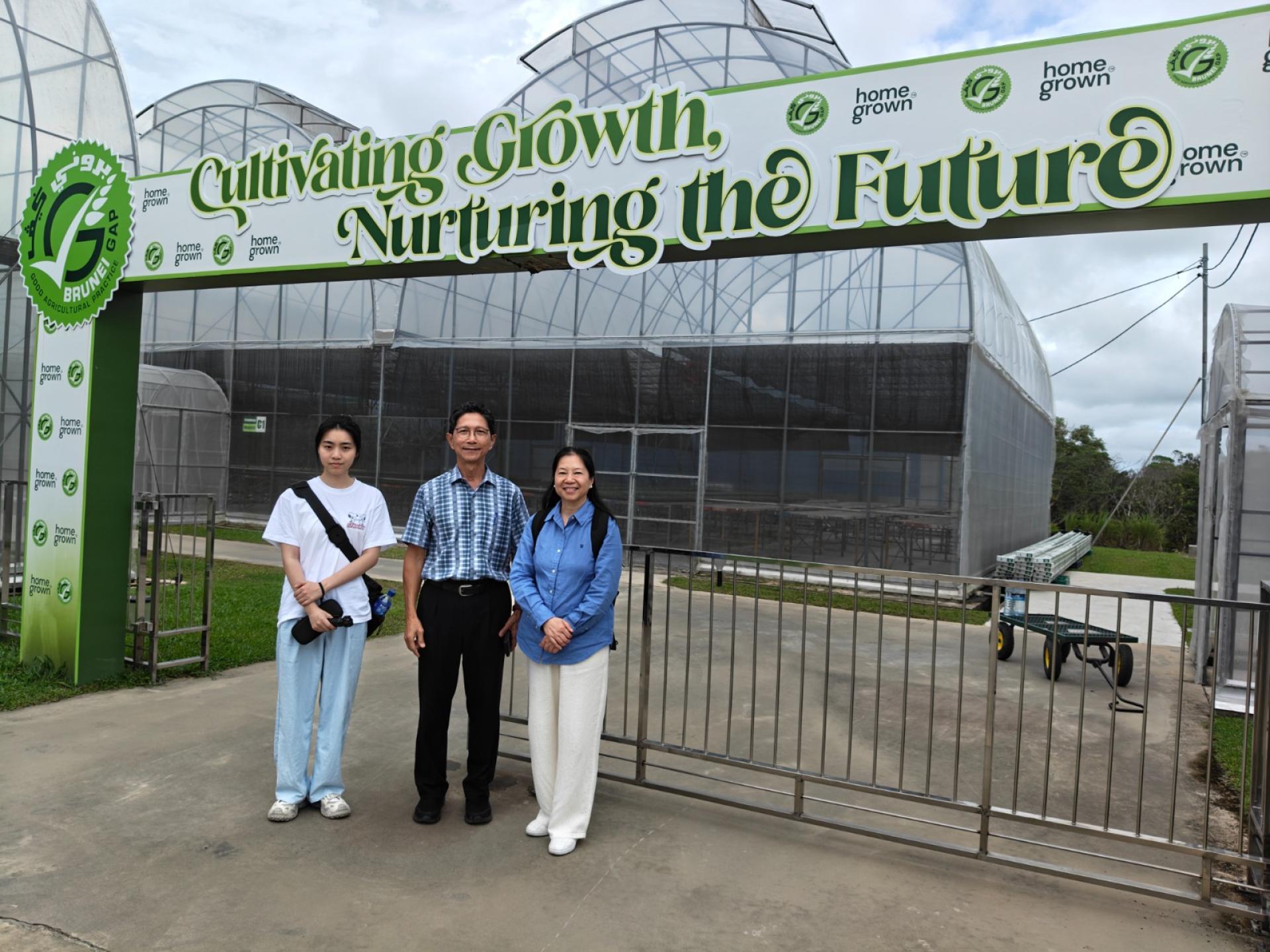
(Seria, 26th) Professor Pan Yanqin, Director of the Brunei Research Institute at Guangxi Minzu University, and research assistant Liang Sichang, recently visited Brunei’s leading modern farm, Home Grown, accompanied by institute advisor Shen Renxiang, to conduct research and gain in-depth insights into new agricultural development models that combine Chinese and international technologies. The farm manager, Shen Zongxiang, personally received them and provided a detailed introduction.
After years of inspection, research, and technological improvements, the farm has adopted an innovative solution that primarily uses Chinese technology supplemented with international scientific research, successfully establishing a 'soilless, safe, and organic' greenhouse vegetable cultivation system tailored to Brunei’s local environmental requirements. This system employs reverse osmosis purified water in combination with agricultural nutrient solutions, and has incorporated computerized automatic irrigation technology, setting an important benchmark in Brunei’s vegetable planting industry.
The farm features tightly controlled greenhouse designs that effectively prevent the intrusion of pests and diseases. It fully employs soilless cultivation technology, and irrigated water even meets the standards of direct drinking water. Combined with a computerized automatic nutrient solution regulation system, this ensures that vegetables grow healthily in a safe, organic, and pesticide-free environment.
Generally, people think soilless cultivation means hydroponics, but in fact, this farm uses an expensive imported substrate blend of coconut coir, cocopeat, and perlite to replace traditional soil, overturning common planting concepts.
Since commencing production, the farm has passed multiple inspections and audits, successfully obtaining Brunei’s Good Agricultural Practice (GAP) certification. This certification, officially launched in 2014 by the Department of Agriculture and Agrifood under the Ministry of Primary Resources and Tourism, aims to improve the quality of local agricultural products and enhance their competitiveness in the Southeast Asian and international markets. The core objectives of the GAP standard include: ensuring products are free from E. coli and other bacterial contamination, pesticide residues do not exceed limits; standardizing production to guarantee high-quality agricultural products; emphasizing systematic farm management and requiring the establishment of complete production records to ensure product traceability.
During the research visit, manager Shen Zongxiang gave a detailed introduction to the entire production process, from sowing and seedling cultivation, transplantation, temperature, humidity and light management, water resource treatment, nutrient solution control, to final packaging of finished products. Notably, the farm has independently developed Southeast Asia’s first automated non-soil sterilization system, demonstrating the operators' dedication and input in the development of local agriculture.
Professor Pan Yanqin, who participated years ago in technical exchanges and helped promote this collaborative project, felt gratified and proud seeing the farm’s achievements today. This research visit further deepens the Brunei Research Institute of Guangxi Minzu University’s understanding of the development of modern agriculture in Brunei, and lays a more solid foundation for future exchange and cooperation in the fields of agricultural technology and academic research between the two sides.
After years of inspection, research, and technological improvements, the farm has adopted an innovative solution that primarily uses Chinese technology supplemented with international scientific research, successfully establishing a 'soilless, safe, and organic' greenhouse vegetable cultivation system tailored to Brunei’s local environmental requirements. This system employs reverse osmosis purified water in combination with agricultural nutrient solutions, and has incorporated computerized automatic irrigation technology, setting an important benchmark in Brunei’s vegetable planting industry.
The farm features tightly controlled greenhouse designs that effectively prevent the intrusion of pests and diseases. It fully employs soilless cultivation technology, and irrigated water even meets the standards of direct drinking water. Combined with a computerized automatic nutrient solution regulation system, this ensures that vegetables grow healthily in a safe, organic, and pesticide-free environment.
Generally, people think soilless cultivation means hydroponics, but in fact, this farm uses an expensive imported substrate blend of coconut coir, cocopeat, and perlite to replace traditional soil, overturning common planting concepts.
Since commencing production, the farm has passed multiple inspections and audits, successfully obtaining Brunei’s Good Agricultural Practice (GAP) certification. This certification, officially launched in 2014 by the Department of Agriculture and Agrifood under the Ministry of Primary Resources and Tourism, aims to improve the quality of local agricultural products and enhance their competitiveness in the Southeast Asian and international markets. The core objectives of the GAP standard include: ensuring products are free from E. coli and other bacterial contamination, pesticide residues do not exceed limits; standardizing production to guarantee high-quality agricultural products; emphasizing systematic farm management and requiring the establishment of complete production records to ensure product traceability.
During the research visit, manager Shen Zongxiang gave a detailed introduction to the entire production process, from sowing and seedling cultivation, transplantation, temperature, humidity and light management, water resource treatment, nutrient solution control, to final packaging of finished products. Notably, the farm has independently developed Southeast Asia’s first automated non-soil sterilization system, demonstrating the operators' dedication and input in the development of local agriculture.
Professor Pan Yanqin, who participated years ago in technical exchanges and helped promote this collaborative project, felt gratified and proud seeing the farm’s achievements today. This research visit further deepens the Brunei Research Institute of Guangxi Minzu University’s understanding of the development of modern agriculture in Brunei, and lays a more solid foundation for future exchange and cooperation in the fields of agricultural technology and academic research between the two sides.