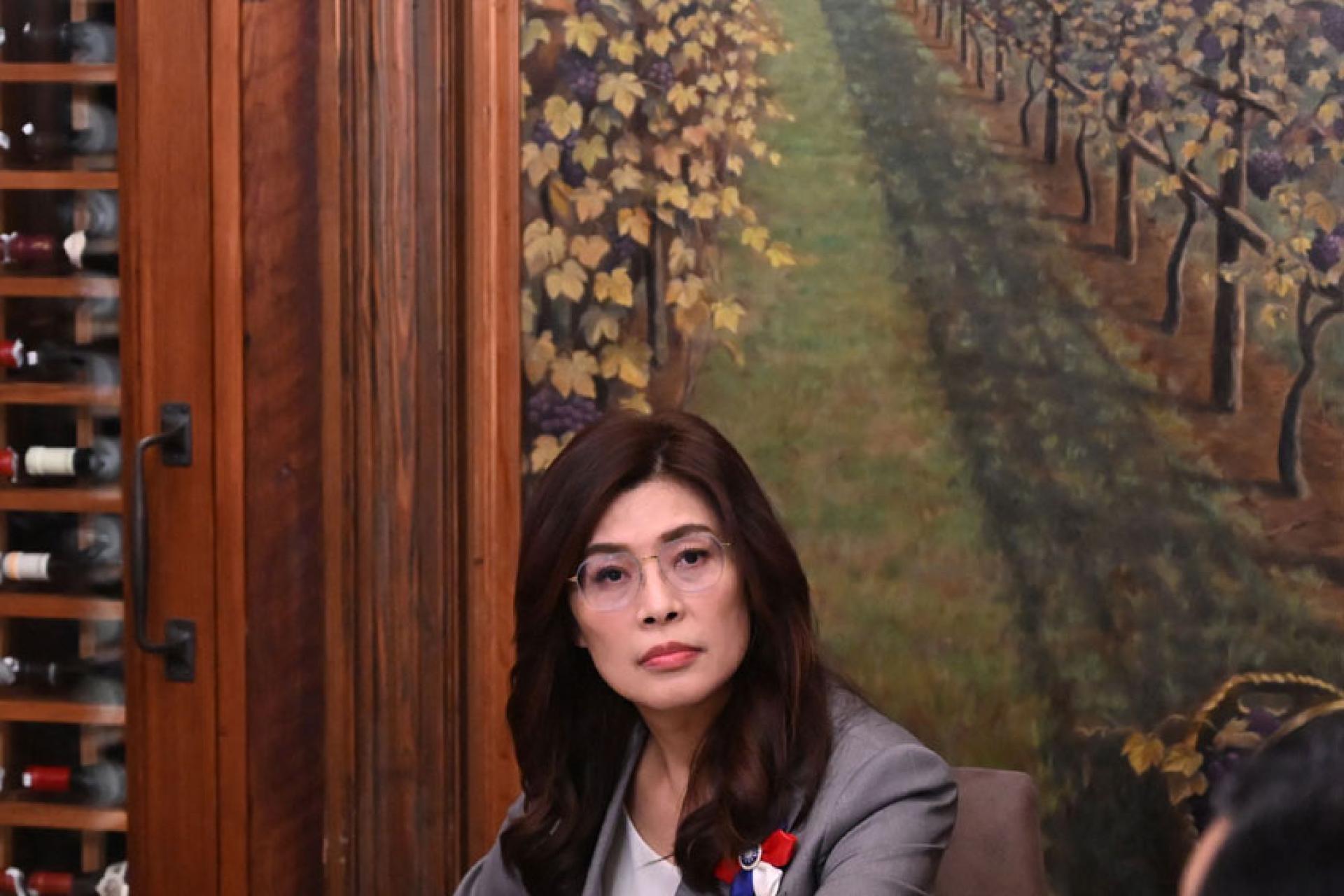
Chairperson of Taiwan’s Kuomintang Cheng Li-wen said that the Kuomintang and the Chinese Communist Party are two different political parties. The Kuomintang has always adhered to the Constitution of the Republic of China and the Three Principles of the People, and does not support communism.
According to United Daily News, Cheng Li-wen has concluded her two-week visit to the US. In response to outside concerns over whether the Kuomintang should adjust its anti-communist platform after restarting exchanges with the Chinese Communist Party, Cheng Li-wen stated at a press conference in Los Angeles on Sunday local time that the KMT and the CCP are two separate parties with different ideas and institutional foundations. The KMT has always followed the Constitution of the Republic of China and the Three Principles of the People, and does not support communism.
Cheng Li-wen said that dialogue and exchanges with the CCP do not mean giving up the KMT’s values and stance.
Cheng Li-wen pointed out that the Chinese Civil War caused millions of casualties, marking an extremely tragic chapter in history. Long-term cross-strait isolation during the Cold War also led to many tragedies.
She further stated that with the end of the Cold War and the progress of globalization, the two sides of the Taiwan Strait saw opportunities for reconciliation and exchange in the 1990s, which led to the formation of the 1992 Consensus. The aim was to set aside disputes and enhance dialogue to reduce the risk of conflict.
Cheng Li-wen also said that since all Democratic Progressive Party (DPP) leaders have said “Taiwan independence” is not feasible or that related issues are not the current priority, the DPP should reconsider its Taiwan independence platform. She advocated that cross-strait peace and exchanges should not be the sole province of any specific party, but ought to be a common goal for all of Taiwanese society.
Before her trip to the US, Cheng Li-wen had made it clear that efforts to deepen cross-strait peace and regional stability require the support of the international community—especially from the US. For this reason, she actively communicated with major American think tanks, nine members of Congress, and representatives of the US administration.
Pro-DPP media reported that a US National Security Council official cancelled a meeting with Cheng, and the level of administration officials she met was downgraded by three levels. At the American Institute in Taiwan (AIT) headquarters, she only met with officials from a State Department section, allegedly reflecting Washington’s grave concerns over Cheng’s “overly pro-China political stance.”
The KMT, however, emphasized that Cheng “met those she needed to meet and said what she wanted to say,” effectively deepening mutual trust with several US administrative departments. Party sources even revealed that the delegation held a one-hour “secret session” in a building near AIT headquarters, hinting at contact with officials close to President Donald Trump.