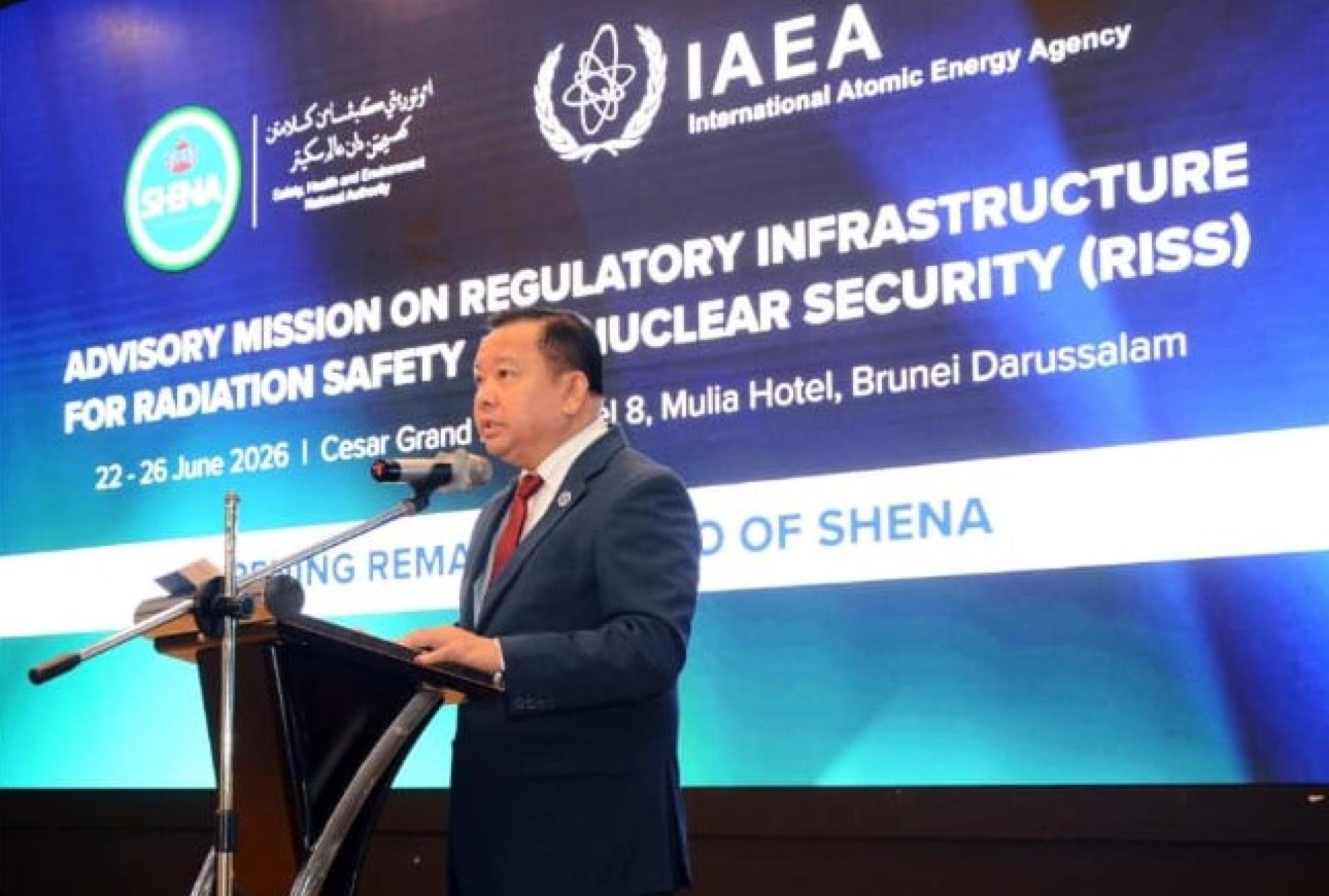
(Bandar Seri Begawan, 23rd)—The Brunei National Security, Health and Environment Authority (SHENA) yesterday held the opening ceremony of the International Atomic Energy Agency (IAEA) Regulatory Infrastructure for Radiation Safety and Nuclear Security (RISS) fact-finding mission and workshop, marking significant progress in Brunei's efforts to strengthen its national regulatory framework for radiation safety and nuclear security.
SHENA Chief Executive Officer Mohsin attended the opening ceremony as the guest of honor at the Brunei Grand Hotel.
In his speech, Mohsin emphasized that the RISS mission provides Brunei with a valuable opportunity to assess its regulatory arrangements against international standards and best practices, identifying areas that require further improvement.
He stated that, as nuclear and radiation technologies become increasingly widely used in the fields of medicine, agriculture, industry, and research, it is essential to establish a robust, safe, reliable, and sustainable regulatory framework to support these advances.
The opening ceremony was attended by SHENA senior officials, representatives from relevant government agencies, and members of the IAEA's Radiation Safety and Security Strategies (RISS) team.
This five-day mission and workshop, held from June 22 to 26, 2026, brought together international experts from the IAEA and stakeholders from various countries to assess and provide recommendations on Brunei's regulatory infrastructure in the realm of radiation safety and radioactive material security.
The RISS mission is a benchmarking and advisory activity that operates based on internationally recognized standards and guidelines, including the IAEA Safety Standards and the Code of Conduct on the Safety and Security of Radioactive Sources.
The findings of the mission will help Brunei strengthen its regulatory framework and align it with international best practices, while also identifying opportunities for ongoing improvement.
During the mission, the IAEA RISS team held workshops on radiation safety and radioactive material security, had technical discussions with relevant national agencies, and conducted on-site inspections of facilities involved in radiation safety and related technical services.
The mission will conclude with the submission of a preliminary report outlining the main observations, recommendations, and proposed actions.
This mission reflects Brunei's ongoing progress in strengthening its national radiation safety and nuclear security capabilities. In October 2024, Brunei formally expressed its political commitment to the IAEA Code of Conduct on the Safety and Security of Radioactive Sources and its supplementary guidance documents.
Based on this commitment, Brunei commissioned the establishment of its first early warning environmental radiation monitoring system and launched a radiation dosimetry service laboratory in April 2025.
These efforts have strengthened the country's capabilities in environmental radiation monitoring, occupational radiation protection, and radioactive emergency preparedness and response.
Additionally, progress has been further consolidated by implementing dedicated air and water monitoring systems and jointly establishing a radiation sampling and analysis laboratory with Politeknik Brunei, which began operations in February 2026.
Recently, Brunei also joined the Asian Nuclear Safety Network (ANSN), thereby strengthening regional cooperation through the sharing of knowledge, technical expertise, and regulatory experience.
As one of the comprehensive measures to strengthen the national nuclear safety system, the National Radiation and Nuclear Affairs Working Committee (JKRN) was established in 2024 under the National Committee for Chemical, Biological, Radiological, Nuclear and Explosives (CBRNe).
This committee serves as an inter-agency platform responsible for coordinating national-level affairs related to radiation safety and nuclear security. SHENA also expressed gratitude for the continued support, expertise, and cooperation from the IAEA and RISS team.
SHENA looks forward to the findings and recommendations of this mission, which will help Brunei continuously improve its radiation safety and nuclear security framework.
SHENA Chief Executive Officer Mohsin attended the opening ceremony as the guest of honor at the Brunei Grand Hotel.
In his speech, Mohsin emphasized that the RISS mission provides Brunei with a valuable opportunity to assess its regulatory arrangements against international standards and best practices, identifying areas that require further improvement.
He stated that, as nuclear and radiation technologies become increasingly widely used in the fields of medicine, agriculture, industry, and research, it is essential to establish a robust, safe, reliable, and sustainable regulatory framework to support these advances.
The opening ceremony was attended by SHENA senior officials, representatives from relevant government agencies, and members of the IAEA's Radiation Safety and Security Strategies (RISS) team.
This five-day mission and workshop, held from June 22 to 26, 2026, brought together international experts from the IAEA and stakeholders from various countries to assess and provide recommendations on Brunei's regulatory infrastructure in the realm of radiation safety and radioactive material security.
The RISS mission is a benchmarking and advisory activity that operates based on internationally recognized standards and guidelines, including the IAEA Safety Standards and the Code of Conduct on the Safety and Security of Radioactive Sources.
The findings of the mission will help Brunei strengthen its regulatory framework and align it with international best practices, while also identifying opportunities for ongoing improvement.
During the mission, the IAEA RISS team held workshops on radiation safety and radioactive material security, had technical discussions with relevant national agencies, and conducted on-site inspections of facilities involved in radiation safety and related technical services.
The mission will conclude with the submission of a preliminary report outlining the main observations, recommendations, and proposed actions.
This mission reflects Brunei's ongoing progress in strengthening its national radiation safety and nuclear security capabilities. In October 2024, Brunei formally expressed its political commitment to the IAEA Code of Conduct on the Safety and Security of Radioactive Sources and its supplementary guidance documents.
Based on this commitment, Brunei commissioned the establishment of its first early warning environmental radiation monitoring system and launched a radiation dosimetry service laboratory in April 2025.
These efforts have strengthened the country's capabilities in environmental radiation monitoring, occupational radiation protection, and radioactive emergency preparedness and response.
Additionally, progress has been further consolidated by implementing dedicated air and water monitoring systems and jointly establishing a radiation sampling and analysis laboratory with Politeknik Brunei, which began operations in February 2026.
Recently, Brunei also joined the Asian Nuclear Safety Network (ANSN), thereby strengthening regional cooperation through the sharing of knowledge, technical expertise, and regulatory experience.
As one of the comprehensive measures to strengthen the national nuclear safety system, the National Radiation and Nuclear Affairs Working Committee (JKRN) was established in 2024 under the National Committee for Chemical, Biological, Radiological, Nuclear and Explosives (CBRNe).
This committee serves as an inter-agency platform responsible for coordinating national-level affairs related to radiation safety and nuclear security. SHENA also expressed gratitude for the continued support, expertise, and cooperation from the IAEA and RISS team.
SHENA looks forward to the findings and recommendations of this mission, which will help Brunei continuously improve its radiation safety and nuclear security framework.