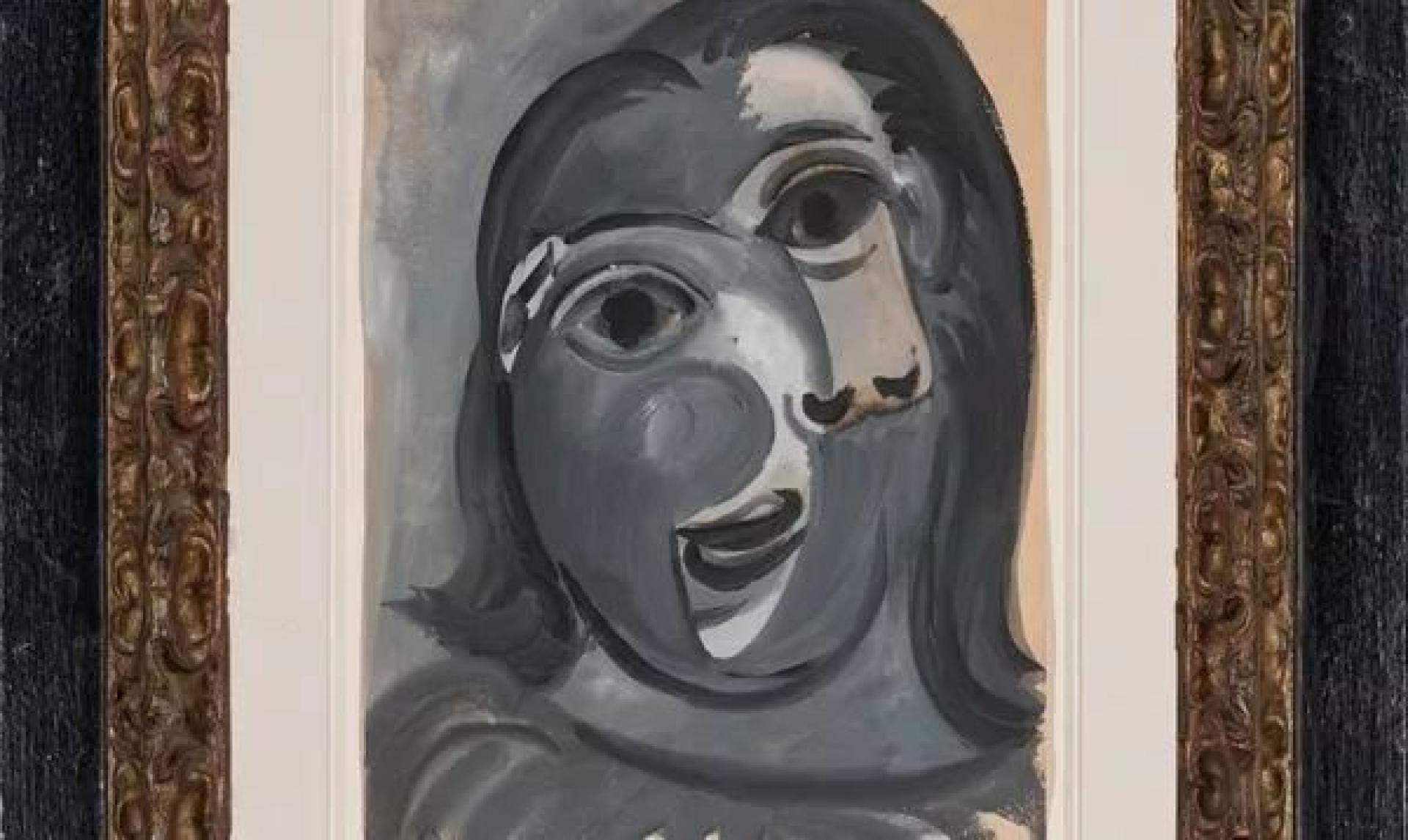
The art market witnessed an incredible event at a Paris charity gala. Ari Hodara, a software salesman, spent just 100 euros (about 466 ringgit)—the price of a Paris dinner—and was lucky enough to win, in a raffle, the Spanish master Picasso’s 1941 opaque watercolor painting “Tête de Femme (Woman’s Head),” a work estimated to be worth over $1 million (about 3.95 million ringgit).
In fact, this work could be worth far more than market estimates. Picasso’s grandson Olivier pointed out that his grandfather completed this “Tête de Femme” in the same studio where he created the masterpiece “Guernica.”
Although its current valuation is $1 million, considering that Picasso’s “Women of Algiers” once fetched a sky-high price of $179 million (about 700 million ringgit) at auction, this cubist portrait measuring about 38.1 x 25.4 cm is undoubtedly a truly weighty prize. The female figure appears in shades of grey and black, with twisted lines reflecting the artist’s profound introspection and focus in his Paris studio under the German occupation during World War II.
When Ari received the winning phone call, his initial reaction was to ask in astonishment if it was a scam, and only when the organizer switched to a video call to show him the crowd on site did he realize he really was the luckiest one among 120,000 participants.
This event not only made an ordinary person’s art dream come true, but also carried deep humanitarian significance. All proceeds from the raffle will be donated to the Alzheimer’s research foundation to fund clinical research across Europe, continuing the event’s tradition of supporting Lebanese heritage restoration and global public health initiatives.
As for the future of this masterpiece, Olivier made it clear that the winner has 100 percent ownership and disposal rights. He recalled stories of his grandfather and his lover Marie, emphasizing that Picasso always gave recipients complete freedom whenever he gifted his artwork. He believes that if Picasso were alive today, he would also be interested in this modern charity model combining new technology and humanitarianism.
No matter if Ari decides to display this precious “Tête de Femme” in his living room, send it to a museum exhibition, or re-sell it on the art market, the organizers hold a stance of complete respect. This auction was not only a game of luck, but also demonstrated how art can transcend class, enter daily life, and ultimately give back to society and scientific research.