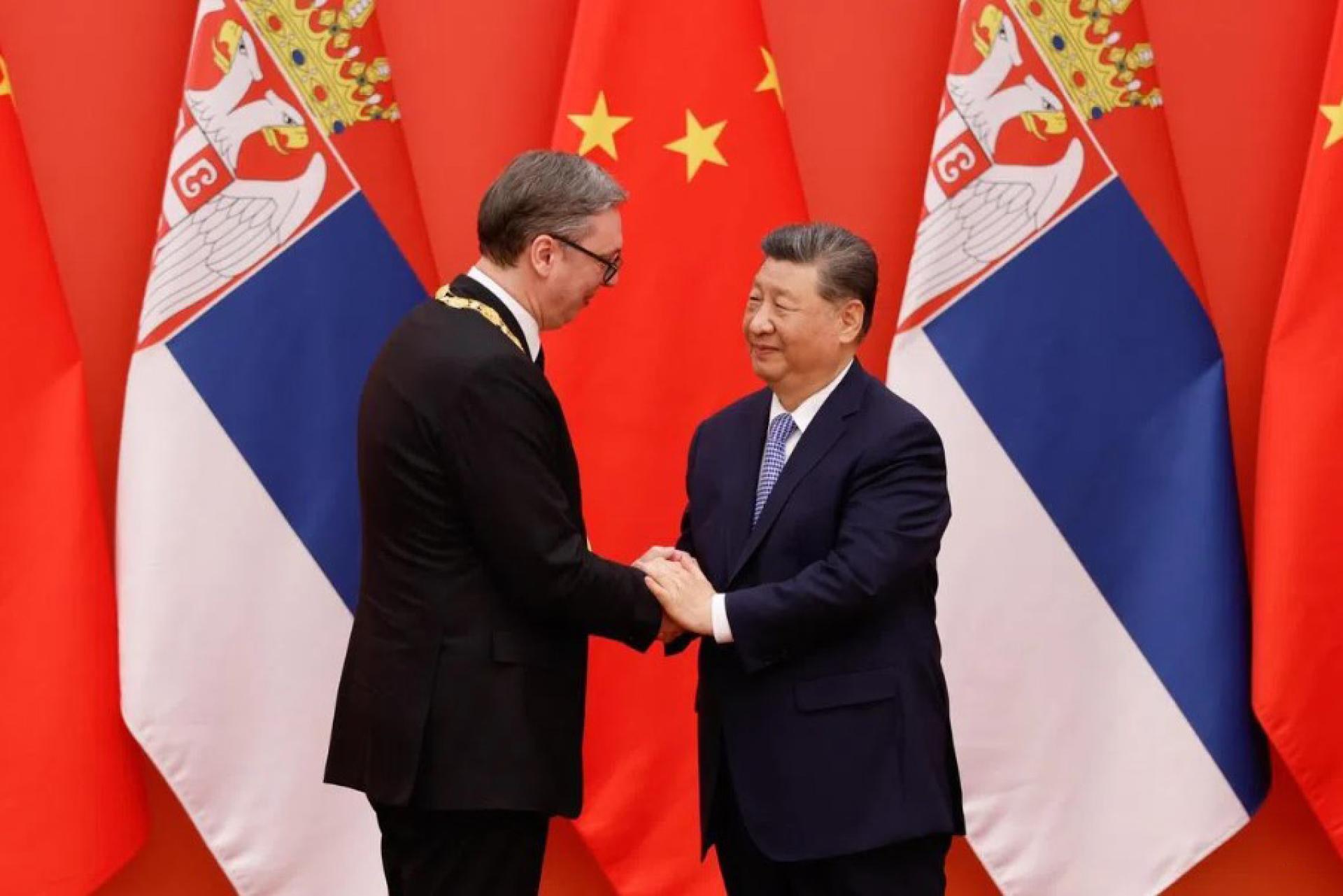
China and Serbia have issued a joint statement asserting that differences and disputes should be peacefully resolved through dialogue and consultation, supporting efforts by the international community to promote political resolution of the Ukraine crisis and restore peace and stability in the Gulf and Middle East regions.
According to the Chinese Ministry of Foreign Affairs website, at the invitation of Chinese President Xi Jinping, Serbian President Aleksandar Vučić paid a state visit to China from May 24 to 28. During the visit, the two sides issued the "Joint Statement Between the People's Republic of China and the Republic of Serbia on Jointly Promoting the Implementation of the Four Global Initiatives."
The joint statement points out that both sides agree that the world today faces many common challenges and critical historical choices. China and Serbia are committed to building a community with a shared future for mankind in the new era, will continue to strengthen strategic communication, closely cooperate within the United Nations and other multilateral mechanisms, practice genuine multilateralism, oppose hegemony and power politics, uphold international fairness and justice, and jointly raise the strong voice of the times for building a community with a shared future for humanity.
In the joint statement, the two sides reiterated their willingness to continue advancing the process of economic globalization, maintain the stability of global industrial and supply chains, safeguard an open, inclusive, transparent, and non-discriminatory multilateral trading system centered on the World Trade Organization, support making world trade rules keep pace with the times, and promote trade and investment liberalization and facilitation.
The joint statement points out that both sides will work together to implement the Global Security Initiative, advocate that all countries adhere to the common, comprehensive, cooperative, and sustainable security concept, respect the sovereignty and territorial integrity of all countries, and refrain from interfering in other countries’ internal affairs. They will strengthen dialogue, exchanges, and pragmatic cooperation within the framework of the Global Security Initiative, jointly enhance their ability to address traditional and non-traditional security risks and challenges, and work together to improve global security governance.
The two sides emphasized that differences and disputes should be peacefully resolved through dialogue and consultation. They support the efforts of the international community to promote a political solution to the Ukraine crisis and restore peace and stability in the Gulf and Middle East regions, and call on all parties to fully comply with international humanitarian law and make every effort to prevent the proliferation and spread of conflicts.
The two sides reaffirmed their condemnation and opposition to all forms of terrorism, stressed that the international community should continuously strengthen counter-terrorism cooperation, give full play to the UN’s central coordinating role, adopt comprehensive measures, and address both the symptoms and root causes to eradicate the breeding grounds of terrorism. They oppose double standards and the politicization or instrumentalization of counter-terrorism issues, and will continue to strengthen bilateral and multilateral counter-terrorism cooperation, including within the United Nations framework.
According to the joint statement, both sides will work together to implement the Global Civilization Initiative, promote the vision of equality, mutual learning, dialogue, inclusiveness among civilizations, and the common values of peace, development, fairness, justice, democracy, and freedom for all humanity, and oppose imposing one's own values and models on others.
The two sides believe that promoting and protecting human rights is a common cause of all humanity, and that countries should cooperate to promote and protect human rights on the basis of mutual respect and equality, and must not politicize or instrumentalize human rights issues.
Both sides will work together to implement the Global Governance Initiative, advocate adherence to the core concepts of sovereign equality, observance of international rule of law, practice of multilateralism, people-oriented approach, and focus on action-oriented principles, and adhere to the global governance concept of extensive consultation, joint contribution, and shared benefits, with the aim to promote the building of a more just and reasonable global governance system. They reaffirm that under the current complex and turbulent international situation, all parties should firmly uphold the international system with the UN at its core, the international order based on international law, and the basic norms governing international relations based on the purposes and principles of the UN Charter. Serbia is willing to join and actively participate in the "Group of Friends on Global Governance." Both sides will jointly promote the International Mediation Court to play an active role in peacefully resolving disputes and promoting friendly cooperation among countries.