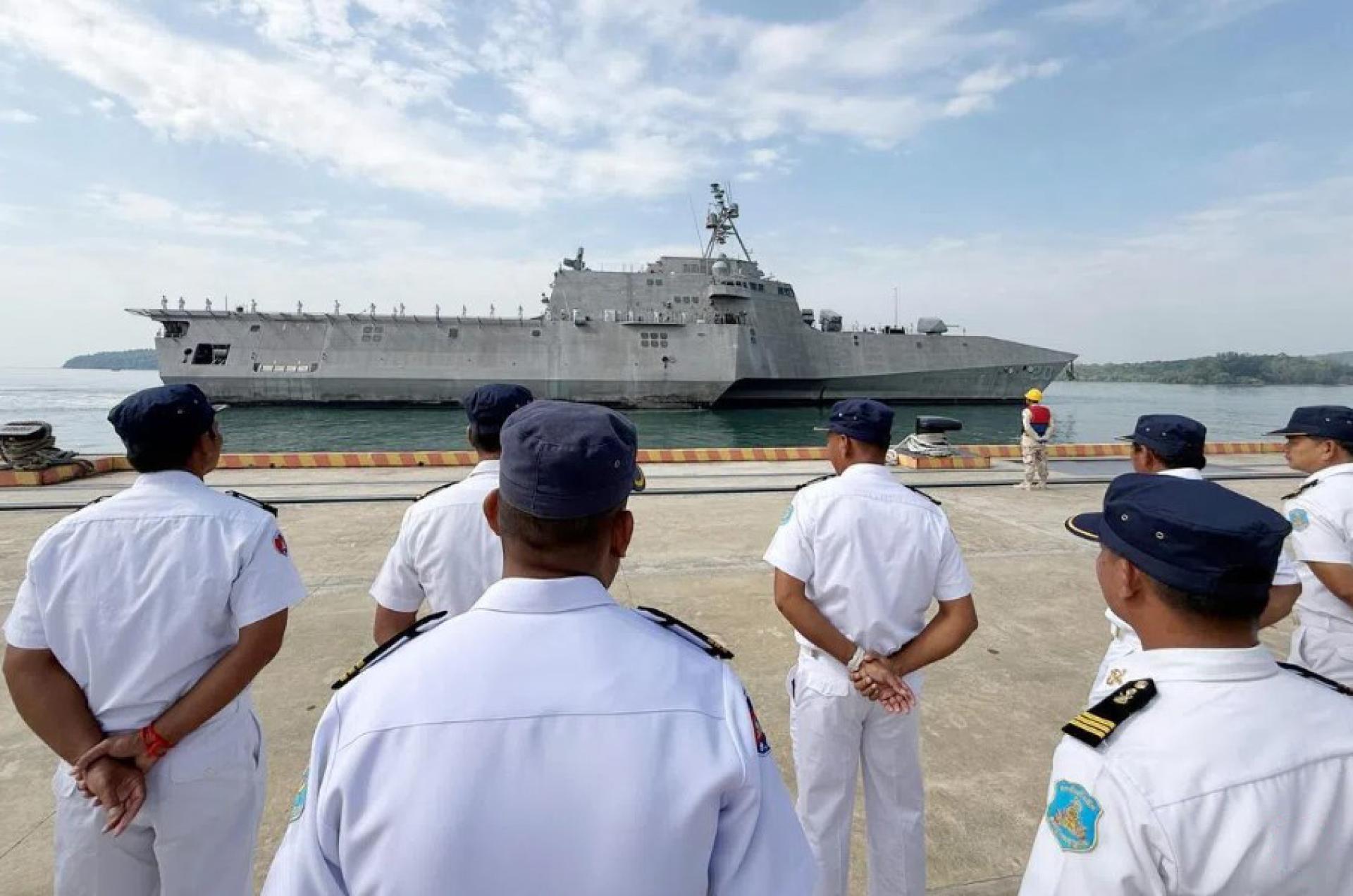
(Phnom Penh/Singapore, 25th) — The US littoral combat ship USS Cincinnati is making a five-day visit to Cambodia, docking at the Ream Naval Base, which was constructed with Chinese assistance.
The USS Cincinnati arrived at the Ream Naval Base on Saturday (January 24) morning, berthing just 150 meters from two Chinese warships.
Commander of the USS Cincinnati, Lyle Carmay, told reporters: “We are honored to be the first US warship to dock at the Ream Naval Base. We hope this marks the beginning of a long tradition and friendship.”
In a statement, the Ream base said that the visit by the USS Cincinnati would promote cooperation between Cambodia and the United States and demonstrates Cambodia’s commitment to open and transparent partnerships with international partners. The two navies are scheduled to hold meetings and joint exercises focusing on maritime security and operational coordination.
The Ream Naval Base was originally built partly with US funding. Later, in 2019, Cambodia signed a cooperation agreement with China to construct comprehensive support facilities and a training center at the Ream base. During the project's progress, there was strong opposition from the United States and others, accusing Cambodia of handing the base to China for exclusive military use. The Ream Naval Base is located at the mouth of the Gulf of Thailand, close to the disputed South China Sea.
The Ream base was reopened in April last year after upgrades. At the opening ceremony, Prime Minister Hun Manet firmly denied that China had exclusive military use rights to the base. Two weeks later, two Japanese warships became the first to dock at the Ream base.
However, according to the Asia Maritime Transparency Initiative under the Center for Strategic and International Studies (CSIS), China has continued to use the facilities at the base.
This is the first time a US warship has docked at the Ream base since its renovation, highlighting the recent strengthening of Cambodia-US engagement. In November last year, the United States lifted a weapons embargo on Cambodia that had been in place for more than three years, and the two countries will also resume joint military exercises that were suspended in 2017.
Commander of the USS Cincinnati, Lyle Carmay, told reporters: “We are honored to be the first US warship to dock at the Ream Naval Base. We hope this marks the beginning of a long tradition and friendship.”
In a statement, the Ream base said that the visit by the USS Cincinnati would promote cooperation between Cambodia and the United States and demonstrates Cambodia’s commitment to open and transparent partnerships with international partners. The two navies are scheduled to hold meetings and joint exercises focusing on maritime security and operational coordination.
The Ream Naval Base was originally built partly with US funding. Later, in 2019, Cambodia signed a cooperation agreement with China to construct comprehensive support facilities and a training center at the Ream base. During the project's progress, there was strong opposition from the United States and others, accusing Cambodia of handing the base to China for exclusive military use. The Ream Naval Base is located at the mouth of the Gulf of Thailand, close to the disputed South China Sea.
The Ream base was reopened in April last year after upgrades. At the opening ceremony, Prime Minister Hun Manet firmly denied that China had exclusive military use rights to the base. Two weeks later, two Japanese warships became the first to dock at the Ream base.
However, according to the Asia Maritime Transparency Initiative under the Center for Strategic and International Studies (CSIS), China has continued to use the facilities at the base.
This is the first time a US warship has docked at the Ream base since its renovation, highlighting the recent strengthening of Cambodia-US engagement. In November last year, the United States lifted a weapons embargo on Cambodia that had been in place for more than three years, and the two countries will also resume joint military exercises that were suspended in 2017.