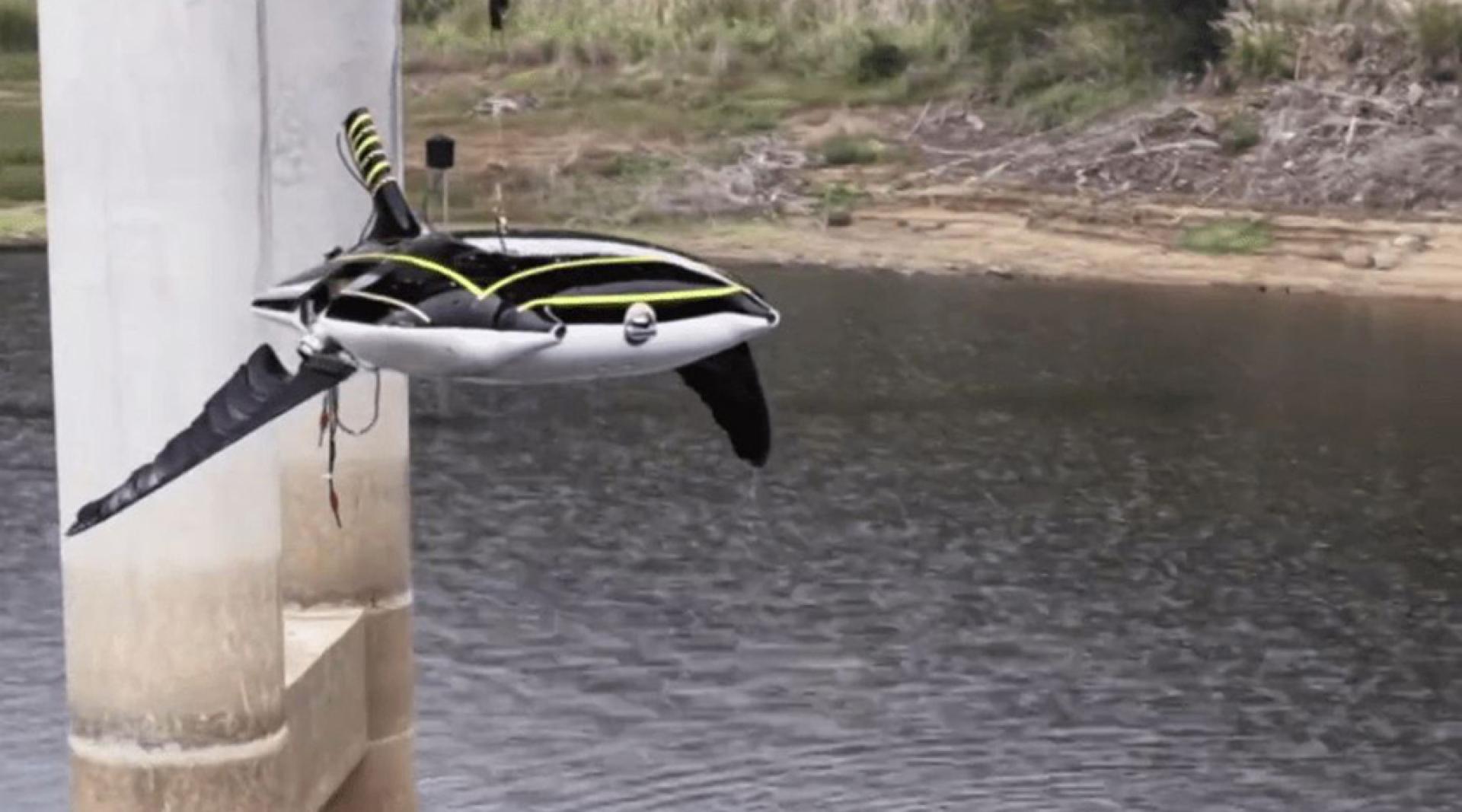
(China, 29th) China’s official media 'CCTV Military' on the 27th for the first time unveiled images of the domestically-made 'Manta Ray' underwater vehicle identifying simulated explosives in deep water. Reportedly, this vehicle is a world-exclusive innovation—capable of autonomous underwater navigation in turbid waters with less than one meter visibility, featuring a battery endurance of several dozen hours at top speed. It is designed for high-precision underwater detection and explosive ordnance disposal tasks.
The 'Manta Ray' is officially named 'Soaring', a V-shaped bionic, soft-bodied undersea vehicle modeled after the devil ray, developed by the Ningbo Research Institute of Northwestern Polytechnical University. From the images released by CCTV, we can see that underwater, the 'Manta Ray' uses a forward-looking sonar to penetrate darkness and track targets, whilst the side-scan sonar simultaneously sweeps the seabed and instantly relays data, quickly mapping the underwater terrain to clear obstacles for its journey.
This 'Manta Ray' also excels in pressure resistance and endurance: it can withstand deep-sea pressure of around 200 atmospheres, and is equipped with a battery capacity equivalent to half that of a small electric car, enabling it to cruise at top speed for dozens of hours, covering several hundred kilometers per charge. When adjusting buoyancy to glide in the sea, its range can exceed a thousand kilometers. Even if the wired communication is cut off, it does not get lost in the deep sea, and can autonomously approach its target.
The creature commonly known as the manta ray—scientifically the giant oceanic manta ray—has a flat body and wide pectoral fins, swimming forward in a wavelike undulation while keeping almost the entire body motionless. Thus, this bionically-inspired underwater vehicle boasts ample internal space for complex mission payloads, and its stable movement ensures that sensitive instruments like high-precision sonar operate reliably.
This 'Manta Ray' also excels in pressure resistance and endurance: it can withstand deep-sea pressure of around 200 atmospheres, and is equipped with a battery capacity equivalent to half that of a small electric car, enabling it to cruise at top speed for dozens of hours, covering several hundred kilometers per charge. When adjusting buoyancy to glide in the sea, its range can exceed a thousand kilometers. Even if the wired communication is cut off, it does not get lost in the deep sea, and can autonomously approach its target.
The creature commonly known as the manta ray—scientifically the giant oceanic manta ray—has a flat body and wide pectoral fins, swimming forward in a wavelike undulation while keeping almost the entire body motionless. Thus, this bionically-inspired underwater vehicle boasts ample internal space for complex mission payloads, and its stable movement ensures that sensitive instruments like high-precision sonar operate reliably.