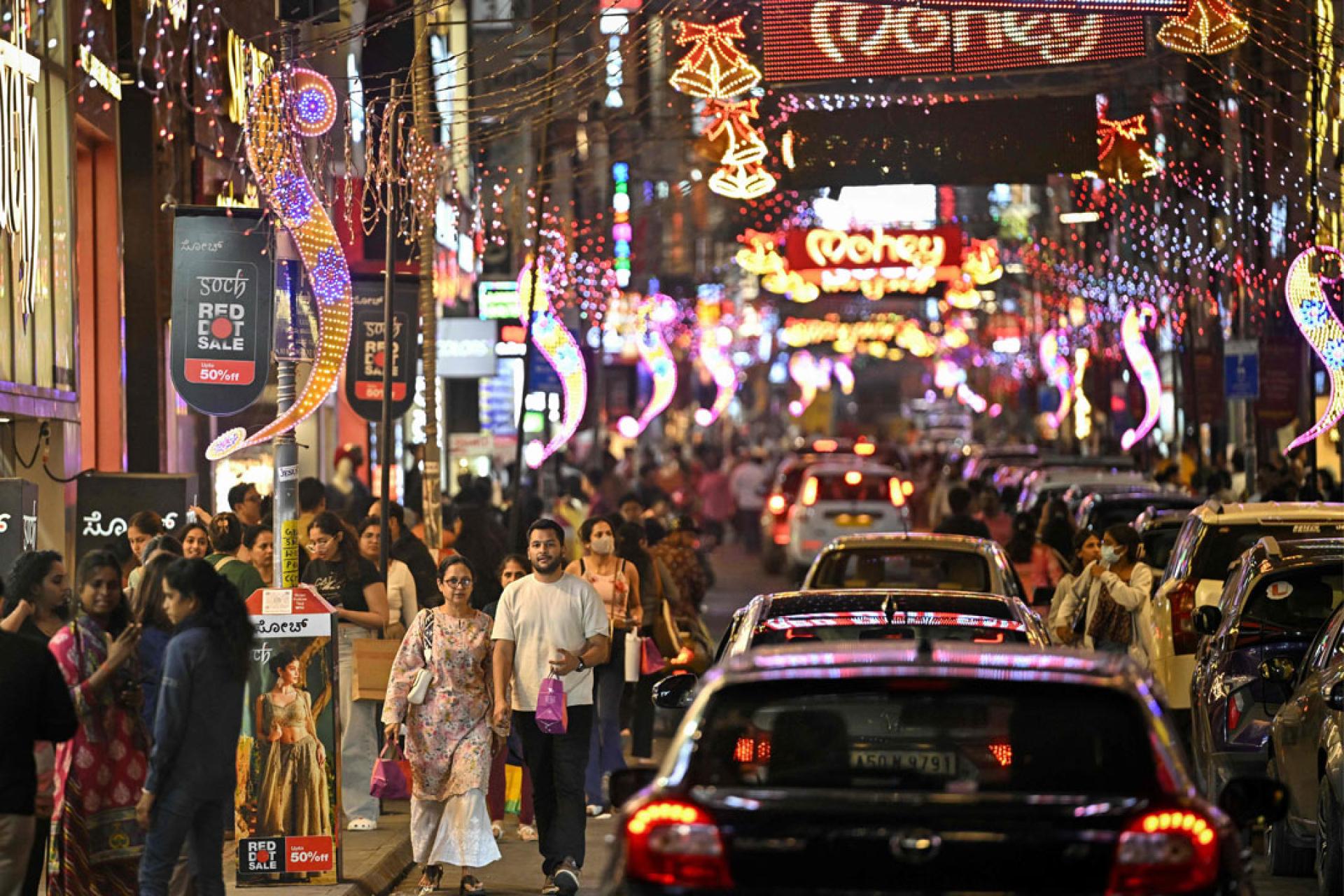
In its year-end economic review, the Indian government pointed out that India has surpassed Japan to become the world's fourth largest economy. Indian officials hope to replace Germany within three years to rank as the third largest economy.
The economic briefing published by the Indian government highlights that India is one of the fastest-growing major economies in the world and is well positioned to maintain this momentum. With a GDP valued at $4.18 trillion, India has already surpassed Japan to become the world's fourth largest economy, and is expected in the next two and a half to three years, with a projected $7.3 trillion GDP by 2030, to replace Germany and rank third.
In any case, Indian authorities will still need to wait for the final annual GDP data to be released next year to officially confirm that it has surpassed Japan.
The International Monetary Fund (IMF) predicts that India will officially surpass Japan next year. According to the IMF's forecasts for next year, India's economic scale will reach $4.51 trillion, while Japan's will be $4.46 trillion.
However, in other indicators, India's prospects are not as optimistic as expected.
In terms of population, India surpassed China in 2023 to become the world's most populous country.
According to the latest World Bank data, India's per capita GDP last year was $2,694 (about 11,000 ringgit), only 1/12 of Japan's $32,487, and 1/20 of Germany's $56,103.
According to Indian government data, more than a quarter of India's 1.4 billion people are aged between 10 and 26 years old, and the country is already facing difficulties in creating high-paying jobs for millions of young graduates.
The briefing pointed out that as one of the youngest countries in the world, the course of India's economic growth will be determined by whether it can create quality employment. Such quality jobs can effectively absorb the ever-expanding labor force and achieve inclusive and sustainable growth.
As India has failed to reach a trade agreement with the United States, and concerns continue about the impact of new tariffs on merchandise exports, the Indian rupee fell to a historic low against the U.S. dollar in early December, having depreciated by about 5% so far this year.