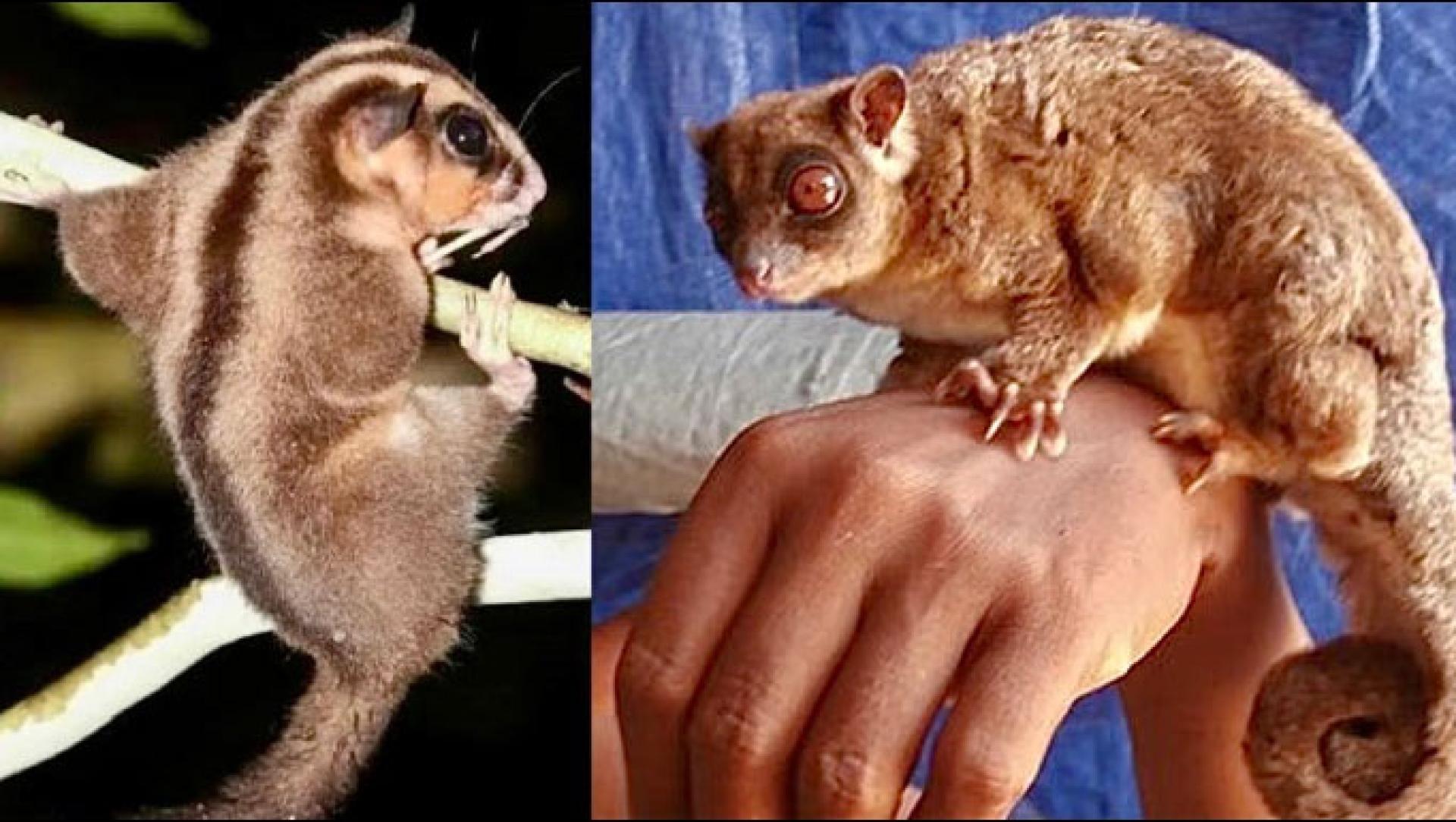
After disappearing for over 6,000 years, two rare marsupial species have now been confirmed by scientists to still be living! This “incredible” discovery took place in the tropical rainforests of the Vogelkop Peninsula in West Papua Province, Indonesia.
This groundbreaking research was led by Professor Tim Flannery, Distinguished Visiting Researcher at the Australian Museum and renowned biologist, confirming that two species long thought extinct—the Pygmy Long-fingered Possum (scientific name: Dactylonax kambuayai) and the Ring-tailed Glider (scientific name: Tous ayamaruensis)—are still present today.
These two animals are referred to by the scientific community as “Lazarus taxa,” meaning creatures thought to have disappeared from Earth only to be rediscovered years later.
The research team pieced together this major discovery through various clues, including a specimen collected by the Australian Museum in 1992 that was misidentified for years, rare photos taken by local researchers, and fossil fragments from collections around the world.
Scientists noted that long-term collaboration with University of Papua researchers, as well as assistance from local elders in Tambrauw and Maybrat, were key to successfully locating these animals.
The ecological knowledge accumulated over generations by local residents helped researchers find the marsupials’ habitats and provided essential information difficult to obtain through scientific surveys alone.
Professor Flannery stated: “Even the discovery of a single recently extinct ‘Lazarus taxon’ is an extremely rare find; but discovering two species thought gone for thousands of years is even more extraordinary.”
He pointed out that this discovery again highlights the importance of protecting unique ecological regions, and proves that combining scientific research with traditional local knowledge is key to detecting and safeguarding hidden biodiversity.
It is understood that the Pygmy Long-fingered Possum has a unique appearance, with stripes on its body and one finger approximately twice as long as the others, helping it probe into trees to find hidden insect larvae.
This species used to inhabit Australia, but during the Ice Age, it gradually disappeared along with other large animals of the time, including the giant Diprotodon and Tasmanian tiger.
The other species, the Ring-tailed Glider, is smaller than its Australian relatives and is one of the closest living kin of the Greater Glider. It has ears not covered in fur, a prehensile tail, and forms long-term pairs with mates, with only one offspring born each year.
This animal usually lives in tree hollows high in the forest but is currently threatened by logging activities.
For the local Tambrauw and Maybrat peoples, the Ring-tailed Glider is also of great cultural significance.
Locals call it “Tous,” and some tribes believe it symbolizes the incarnation of ancestral spirits and plays an important role in traditional initiation ceremonies.
Co-author of the study, Rika Korain from the Maybrat people, said that without the cooperation and support of traditional local owners, this discovery would have been nearly impossible.
Dr. Aksamina Yohanita from University of Papua also said she was honored to see Papua researchers participate in this milestone discovery and thanked the local communities for their assistance in field surveys.
Scientists pointed out that these two animals were previously only known from Australian fossils and early Holocene specimens from New Guinea, and now their reappearance in remote lowland forests provides important clues for studying the region’s geological history.
Professor Flannery described the Vogelkop Peninsula as an ancient part of the Australian continent that later became part of the New Guinea island, and its forests “may still conceal more relics of life from ancient Australia.”
This research was supported by the Global Wildlife Fund and the Minderoo Foundation. Conservation organizations are currently working with local communities to protect these rediscovered species’ last habitats.
The researchers emphasized that this discovery proves that combining indigenous wisdom with modern science offers opportunities to reveal even more undiscovered biological secrets on our planet.