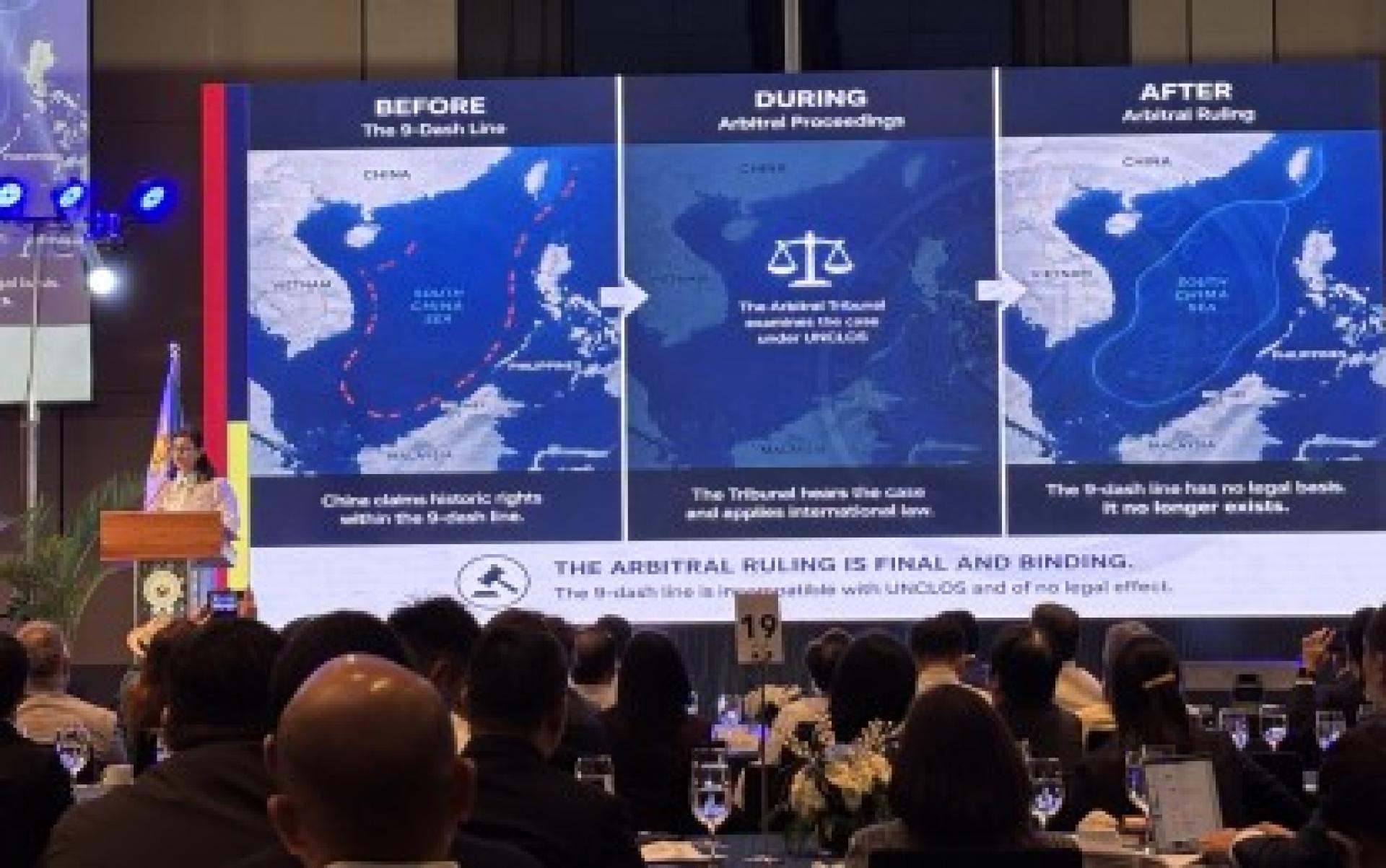
(Manila, 11th) — On Saturday, the Philippines commemorated the 10th anniversary of the South China Sea Arbitration ruling. The Philippine government and numerous legal and marine experts emphasized that the 2016 ruling by the Hague arbitral tribunal not only affirmed the Philippines’ exclusive economic zone (EEZ) and continental shelf rights in the West Philippine Sea (part of the South China Sea), but also concerns the nation’s food security, energy security, and the interests of future generations. They called on all citizens to jointly safeguard these rights.
The Philippine Department of Foreign Affairs held a commemorative forum on Friday. Philippine Solicitor General Darlene Marie Berberabe stated that the arbitral award means the fishery resources within the West Philippine Sea’s EEZ legally belong to the Filipino people, and the natural gas resources under the Recto Bank also rightfully belong to the Philippines.
She pointed out that Scarborough Shoal (referred to in the Philippines as "Bajo de Masinloc") legally remains a traditional fishing ground for Filipino fishermen, who have the legal right to operate in those waters.
She emphasized that the South China Sea arbitration award not only guarantees fishermen’s livelihoods, but also preserves the nation’s future food and energy supplies.
Michael Atrigenio, director of the Marine Science Institute at the University of the Philippines, noted that even those living far from the West Philippine Sea are affected by the situation in the South China Sea.
He said that if fish catches decline, nationwide fish prices will rise. Therefore, whatever happens in the West Philippine Sea is closely tied to the Filipino people.
Denial of the "Nine-Dash Line" Claim
In 2013, based on the United Nations Convention on the Law of the Sea, the Philippines submitted a request for arbitration to the Permanent Court of Arbitration in The Hague. On July 12, 2016, the tribunal ruled that China’s “nine-dash line” historic rights claim had no legal basis, and confirmed that the South China Sea features claimed by China did not generate an exclusive economic zone.
Berberabe noted that if China’s claim were recognized, most of the Philippines’ EEZ resources would be encompassed within it.
She said the arbitral award clearly confirms that the Philippines is entitled by law to the exclusive rights to explore, develop, conserve, and manage marine resources, the seabed, and subsoil resources within its exclusive economic zone.
Fretti Ganchoon, senior legal adviser to the Philippine Department of Justice, stated that the arbitration ruling resolved previous legal uncertainties regarding overlapping maritime rights in the West Philippine Sea.
She pointed out that all marine resources—including fisheries, oil, and natural gas—legally belong to the Philippines and must be protected to benefit both current citizens and future generations.
Integrating the Ruling into Domestic Law
Berberabe said that over the past decade, successive Philippine governments have consistently incorporated the spirit of the arbitral award into national laws and policies and promoted related institution building.
She said that since 2022, the Philippine government has continually publicized the harassment of Philippine ships and fishermen by Chinese vessels in the West Philippine Sea and has informed the international community of these incidents.
In 2024, the Marcos administration further reorganized the National Coast Watch Council into the National Maritime Council to unify the coordination of West Philippine Sea affairs and strengthen the safeguarding of maritime rights.
Berberabe stated that at present, the Philippine Coast Guard, the Bureau of Fisheries and Aquatic Resources (BFAR), the National Mapping and Resource Information Authority (NAMRIA), the Department of Foreign Affairs, and the Armed Forces are all fulfilling their respective duties, carrying out patrols, mapping, diplomatic protests, and maintaining a presence in the West Philippine Sea to safeguard the country’s maritime rights in practice.
She pointed out that Scarborough Shoal (referred to in the Philippines as "Bajo de Masinloc") legally remains a traditional fishing ground for Filipino fishermen, who have the legal right to operate in those waters.
She emphasized that the South China Sea arbitration award not only guarantees fishermen’s livelihoods, but also preserves the nation’s future food and energy supplies.
Michael Atrigenio, director of the Marine Science Institute at the University of the Philippines, noted that even those living far from the West Philippine Sea are affected by the situation in the South China Sea.
He said that if fish catches decline, nationwide fish prices will rise. Therefore, whatever happens in the West Philippine Sea is closely tied to the Filipino people.
Denial of the "Nine-Dash Line" Claim
In 2013, based on the United Nations Convention on the Law of the Sea, the Philippines submitted a request for arbitration to the Permanent Court of Arbitration in The Hague. On July 12, 2016, the tribunal ruled that China’s “nine-dash line” historic rights claim had no legal basis, and confirmed that the South China Sea features claimed by China did not generate an exclusive economic zone.
Berberabe noted that if China’s claim were recognized, most of the Philippines’ EEZ resources would be encompassed within it.
She said the arbitral award clearly confirms that the Philippines is entitled by law to the exclusive rights to explore, develop, conserve, and manage marine resources, the seabed, and subsoil resources within its exclusive economic zone.
Fretti Ganchoon, senior legal adviser to the Philippine Department of Justice, stated that the arbitration ruling resolved previous legal uncertainties regarding overlapping maritime rights in the West Philippine Sea.
She pointed out that all marine resources—including fisheries, oil, and natural gas—legally belong to the Philippines and must be protected to benefit both current citizens and future generations.
Integrating the Ruling into Domestic Law
Berberabe said that over the past decade, successive Philippine governments have consistently incorporated the spirit of the arbitral award into national laws and policies and promoted related institution building.
She said that since 2022, the Philippine government has continually publicized the harassment of Philippine ships and fishermen by Chinese vessels in the West Philippine Sea and has informed the international community of these incidents.
In 2024, the Marcos administration further reorganized the National Coast Watch Council into the National Maritime Council to unify the coordination of West Philippine Sea affairs and strengthen the safeguarding of maritime rights.
Berberabe stated that at present, the Philippine Coast Guard, the Bureau of Fisheries and Aquatic Resources (BFAR), the National Mapping and Resource Information Authority (NAMRIA), the Department of Foreign Affairs, and the Armed Forces are all fulfilling their respective duties, carrying out patrols, mapping, diplomatic protests, and maintaining a presence in the West Philippine Sea to safeguard the country’s maritime rights in practice.