Severe Rainstorm Disasters in Northern Thailand: 2 Dead and Over 30,000 Affected in Nan Province
Published atAug 21, 2026 02:50 pm
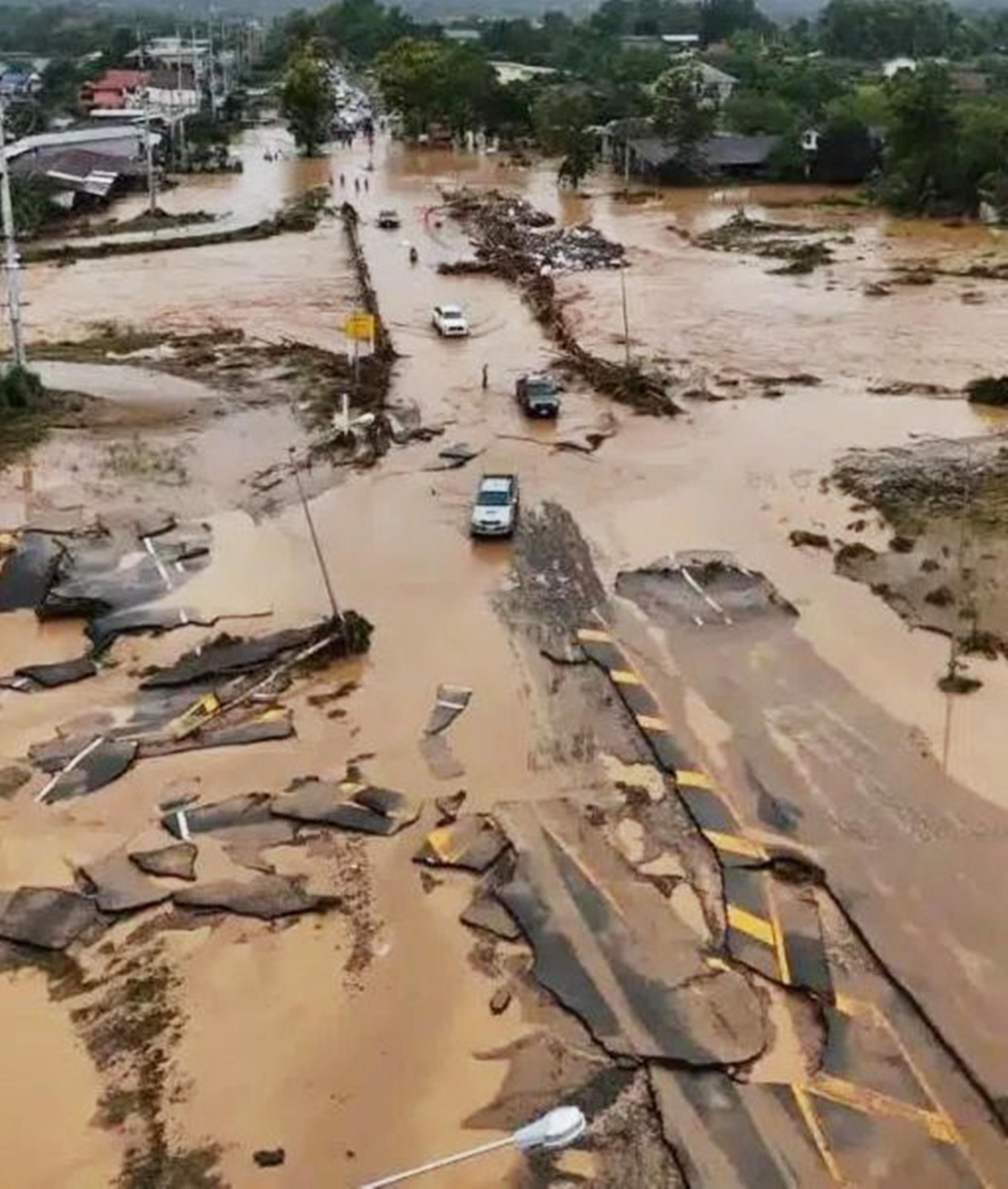
Heavy rainfall in Nan Province, northern Thailand has caused flash floods and river overflows, inundating homes in multiple areas and rendering several roads impassable.
On the 20th, Dr. Cheri, Director of the Climate Change and Disaster Center at Rangsit University, stated that the situation is expected to improve over the next two days, with water levels likely to drop significantly on the 21st and 22nd. The Nan River water level is expected to recede below the riverbank by the 21st.
However, meteorologists are closely monitoring a low-pressure system located in northern Vietnam, which may bring a new round of rainfall to northern Thailand on the 23rd. Flooding has already occurred on the roads, in the communities, and business districts outside Phumin Temple.Heavy rain began in Nan Province on the morning of the 19th. At 5:30 a.m. on the 20th, floodwaters began to overflow into the area surrounding the landmark Phumin Temple in Nan's ancient city. Although the prayer hall with the temple's famous murals has not yet flooded, the roads, communities, and business districts outside the temple are already inundated.
The main roads connecting Nan's Pua District, Doi Phu Kha National Park, and Bo Kluea District have been cut off, with some bridges on Highway 1256 damaged and power poles knocked down or leaning on certain stretches. Doi Phu Kha National Park has set up temporary relief points to accommodate stranded residents and tourists.
The Civil Aviation Authority of Thailand advises travelers entering or leaving Nan Province to check road and flight statuses in advance and to allow at least three to four hours to get to the airport.
Previously, the flash floods that erupted upstream in Pua District did not subside, but rather continued to move downstream along the Nan River, passing through Tha Wang Pha District, entering the central district (Mueang District) of Nan, and continuing toward the lower-lying Wiang Sa District.
As of the afternoon of the 20th, the latest summary from the Department of Disaster Prevention and Mitigation of Thailand shows that the flood disaster in Nan Province has affected four districts, more than 13,000 households, and over 30,000 people, with two confirmed deaths. Areas of 'extreme risk' for flooding in deep red on the map are still expanding. The Disaster Is Spreading Along the Nan River
At 4 p.m. on the 19th, the hardest-hit Pua District had around 8,000 households and 16,000 people affected. At that time, while water levels in some areas had begun to recede, huge volumes of water pouring down from the mountains continued to flow downstream. By the afternoon of the 20th, the affected area had expanded to include the four districts of Pua, Phuphiang, Santi Suk, and Tha Wang Pha, with the number of affected people surpassing 30,000.
Even more concerning, areas marked as deep red on satellite risk maps—denoting 'extreme risk' for flooding—are still expanding: Sukhothai, Phitsanulok, and several provinces in northeastern Thailand are entering a new high-risk period for flooding.
In Sukhothai Province, the deep red area stretches from Si Satchanalai District and Sawankhalok District in the north all the way down to the central district (Mueang Sukhothai) and Kong Krailat District; in Phitsanulok, a large deep red area is also seen in Bang Rakam District and surrounding areas; in the south of Uttaradit and the north of Phichit, red and yellow risk zones are intermixed.
The Thai Meteorological Department issued the 11th heavy rainfall warning on the 20th, confirming that the north and northeast may still experience heavy to very heavy rainfall, with impacts lasting through the 21st. Mountain areas, riverbanks, and low-lying regions must continue to guard against flash floods, landslides, and temporary water accumulation.
The National Water Resources Office of Thailand pointed out that this bout of extreme rainfall is not the so-called 'rain bomb' phenomenon as rumored online. The main reason is that the monsoon trough is stretching across northern Thailand, interacting with a strong southwest monsoon, leading to short periods of intensive rainfall.
This article has been translated using our AI technology. While we strive for accuracy,
AI translations
may contain errors. For the most precise information, please refer to the original article.