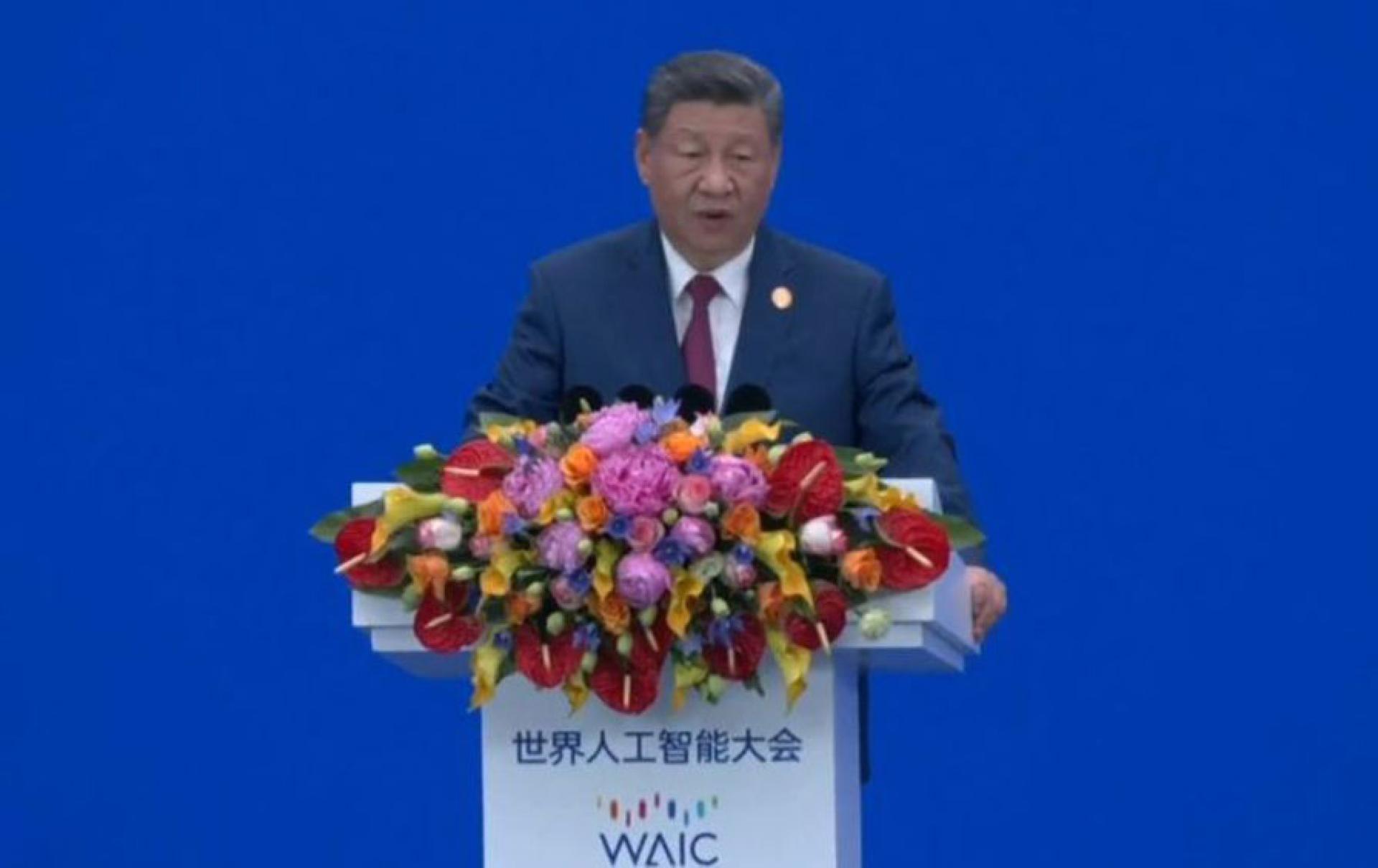
Chinese President Xi Jinping said that to further support global artificial intelligence (AI) development and promote global AI capacity building, in the next five years, China will provide 5,000 AI-themed training opportunities for developing countries; establish international AI application cooperation centers aimed at ASEAN, the Arab League, the African Union, CELAC, SCO, and BRICS countries; and advance the implementation of the meteorological intelligent early warning project "Mazu" in 30 countries.
On the 17th, Xi Jinping attended the opening ceremony of the 2026 World Artificial Intelligence Conference and the High-Level Meeting on Global AI Governance in Shanghai, where he announced the above support initiatives in his keynote speech.
Xi Jinping noted that at present, the world is undergoing accelerated changes unseen in a century, and global AI technological innovation is entering an unprecedentedly active period. Regarding how humanity should interact with AI, how to keep governance up to speed, and how to achieve inclusivity, he put forward four points of view.
First is to uphold openness and win-win cooperation to drive innovative development; second is to strengthen risk awareness to ensure security and controllability; third is to encourage inclusivity and mutual learning to promote joint civilization building; and fourth is to advocate solidarity and mutual assistance to improve global governance.
This year’s World Artificial Intelligence Conference will be held from the 17th to the 20th in Shanghai Expo, Zhangjiang, and West Bund—"three locations and four venues"—with the theme “Intelligent Partners, Creating the Future Together,” focusing on showcasing advanced AI technologies and practical application results. The scale of this year’s conference has expanded, with total exhibition space exceeding 100,000 square meters for the first time, and more than 1,100 companies exhibiting.
AI Sparks Security Concerns
According to Bloomberg, the rise of China’s AI large models has given Beijing a bigger say in reshaping global AI rules. However, these models’ ever-increasing capabilities are also sparking security concerns among decision-makers in both China and the United States.
Bloomberg noted that Beijing now faces the same dilemma as Washington: as the capabilities of AI models grow increasingly powerful, how to balance the widespread adoption of technology with the baseline of national security.
Sources told Bloomberg that Chinese officials have recently held internal discussions with AI companies including Alibaba, assessing how to hedge against the security risks posed by cutting-edge large models. Although the talks are still at an early stage, restricting overseas users’ access to top-level models has become one of the options.
Beijing’s caution is similar to that of Washington. Last month, for national security reasons, the U.S. briefly blocked foreign users from accessing Anthropic’s Mythos and Fable models, citing that such advanced systems can exploit deep software vulnerabilities without human intervention.