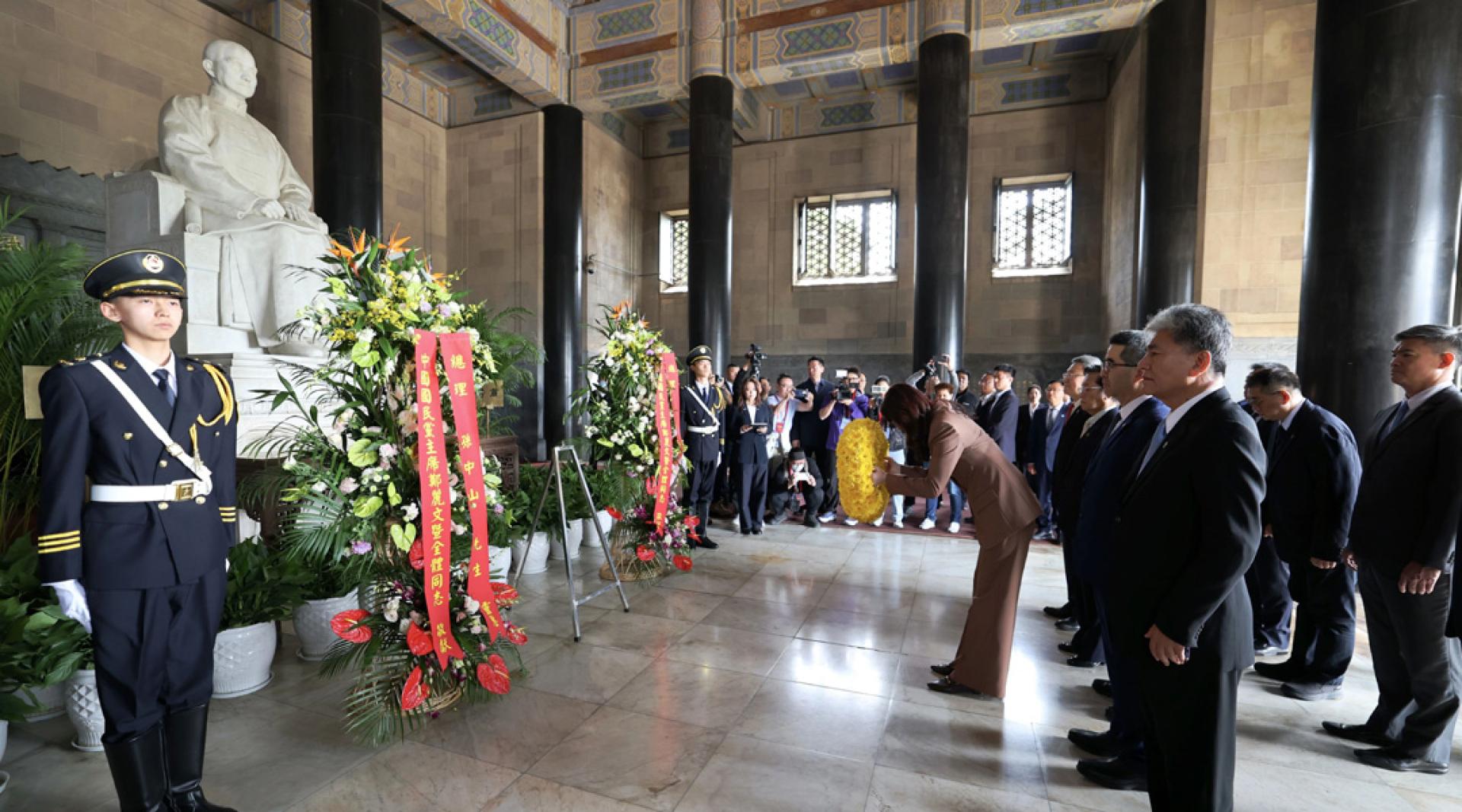
The “Xi-Zheng meeting” concluded on the 10th. Taiwan’s Mainland Affairs Council (MAC) criticized the KMT’s proposal for the institutionalization of cross-strait peace, saying it amounts to a “one country, two systems Taiwan plan.” KMT Vice Chairman Zhang Rong-gong stated that if those in charge of administration lack knowledge, it is regrettable for Taiwanese society. There are currently 23 agreements between Taiwan and Mainland China, which are still being implemented under the DPP government. The existence of these agreements itself represents the institutionalization of peaceful cross-strait relations.
According to United Daily News, Zhang Rong-gong said in an interview on the 11th that Xi Jinping did in fact mention that developing cross-strait relations requires persistent effort and calls for “perseverance” and “patience.” This shows that cross-strait peace is quite achievable; it depends on how Taiwan pursues its own cross-strait policy.
Zhang Rong-gong said the KMT has always advocated “opposing Taiwan independence” to avoid war and using the “1992 Consensus” to promote peace. Based on the existing political foundation between the two sides, this should complement Xi Jinping’s thinking. After all, opposing Taiwan independence and upholding the 1992 Consensus both stem from Taiwan’s own basic law and legal system.
Zhang Rong-gong said that the existence of agencies like the MAC and SEF (Straits Exchange Foundation) itself represents that cross-strait relations definitely are not “state-to-state relations”; if they were, DPP’s President Lai Ching-te would certainly have the power to abolish these bodies immediately. Therefore, interacting and promoting cross-strait peace under Taiwan’s own legal system achieves “peace with dignity,” as opposed to what President Lai Ching-te calls “bowing one’s head to shake hands.”
He said that maintaining these frameworks shows that if similar agreements increase, peace will be even more assured. The existence of these agreements itself represents the institutionalization of peaceful cross-strait relations. The more agreements there are, the stronger the peace, which is exactly what Cheng Li-wen meant by a “cross-strait peace framework.”
Cheng Li-wen: Hopes Cross-Strait Peace Will Not Regress
On the 10th, Cheng Li-wen, while describing the two parties’ dialogue and cooperation mechanisms, especially mentioned the hope that the KMT and CCP (Chinese Communist Party) will jointly promote the institutionalization of cross-strait peace. On the political foundation of adhering to the 1992 Consensus and opposing Taiwan independence, the two sides should further plan and establish a systemic and sustainable mechanism for dialogue and cooperation, “so that peaceful cross-strait development becomes irreversible, fundamentally eliminating all inducements for conflict.”
As for concrete details of this mechanism, Cheng Li-wen further pointed out during a post-meeting press conference that it is due to the hope that peaceful cross-strait relations do not reverse or regress, which is why “we hope to have institutionalization and ultimately even produce a cross-strait peace framework.”
MAC: The ‘Peace Framework’ Is Actually a ‘Unification Framework’
Following the Xi-Zheng meeting, the MAC stated on the night of the 10th that Cheng Li-wen’s insistence on the “1992 Consensus” is in fact endorsing the CCP’s intention of “eliminating the Republic of China.” What Cheng referred to as the “peace framework” is essentially a “unification framework”; the so-called “institutionalization of cross-strait peace” is actually a “one country, two systems Taiwan plan.”