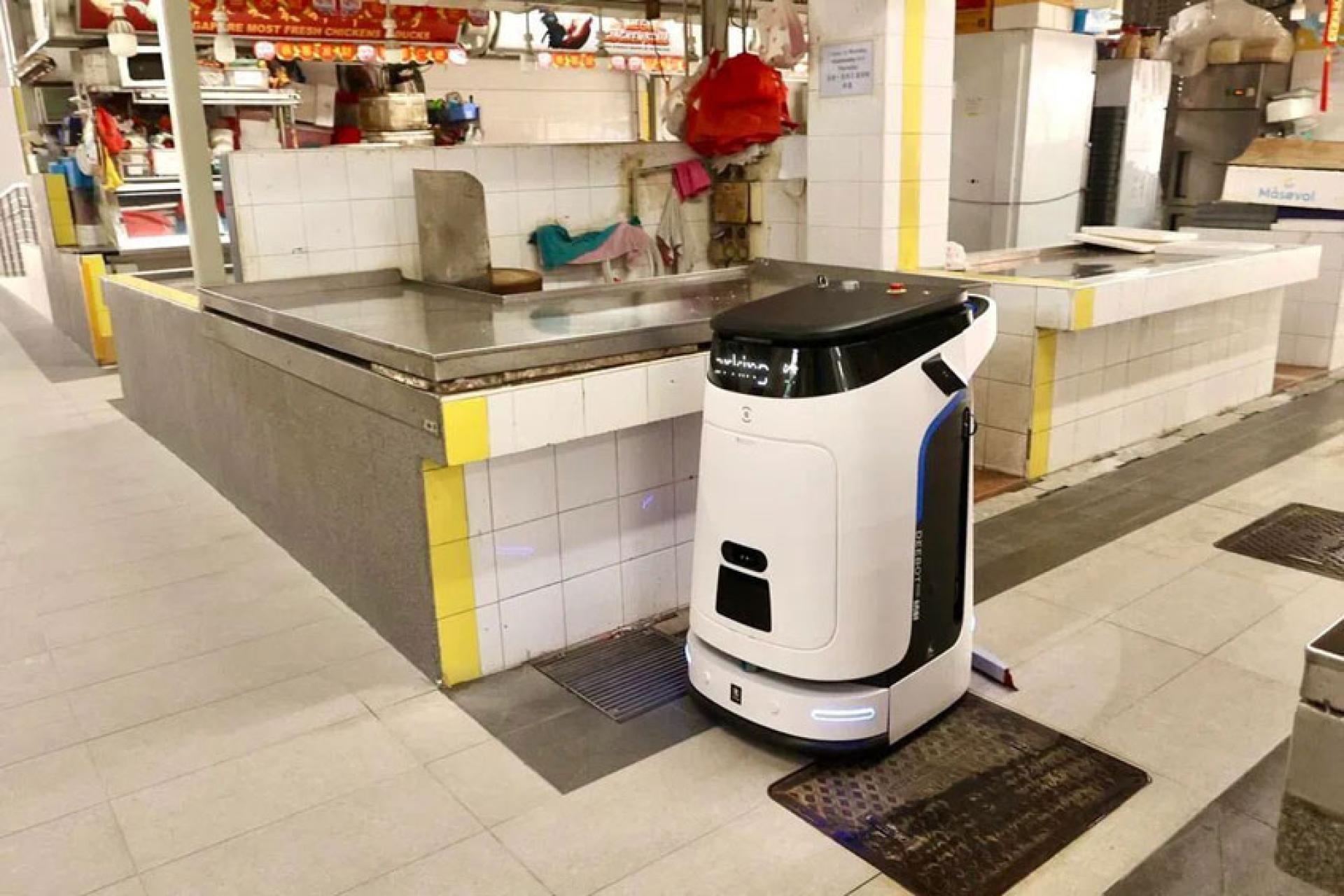
To keep up with technological developments, provide residents with cleaner public spaces, and also address manpower shortages, the Bishan-Toa Payoh Town Council in Singapore has brought floor-cleaning robots—commonly seen in large shopping malls and MRT stations—to wet markets and hawker centres, testing whether they can handle more complex cleaning tasks.
In response to an inquiry from Lianhe Zaobao, Bishan-Toa Payoh Town Council said it is working with Bright Robotics, a cleaning robot distributor, to conduct a proof-of-concept test from Monday to Wednesday (April 20 to 22) at Toa Payoh West Market & Food Centre, as well as the nearby covered court Plaza@128. The test aims to see if the robots can clean these areas reliably, safely, and efficiently.
When a Lianhe Zaobao reporter visited the site, it was observed that the robot could smoothly navigate the walkways between market stalls for cleaning, and even go up ramps. In terms of obstacle avoidance, when there were pedestrians passing by or curious individuals lingering nearby, the robot would automatically stop and resume cleaning only after people had left.
Shen Jing Cai, Business Development Manager at Bright Robotics, who was in charge of the test, said in an interview that the testing mainly took place during off-peak hours.
“I had the robot clean half of the market for a comparison, and it seems to meet basic cleaning needs. However, the distance between tables and chairs at the second-floor hawker centre is a bit narrow for this robot, making it difficult to navigate. I also took a video (and sent it to the Town Council) to let them know this might not be entirely suitable.”
He revealed that in recent months, the company has also worked with other Town Councils to conduct tests at the community plaza next to Hougang MRT station and at a neighborhood mall in Jurong West, but this is the first time testing at wet markets and hawker centres.
According to Shen Jing Cai, compared to the current cleaning mode using human cleaners, cleaning robots can save a lot of water, keep floors dry, and can complete cleaning autonomously during undisturbed periods such as at night, without affecting public use.
The robot being tested is a commercial cleaning robot by ECOVACS (a Chinese brand) called Deebot Pro M1; it is not the same model used in MRT stations. This model can clean various types of flooring, the battery supports continuous cleaning for eight hours or intensive cleaning for more than an hour, the 35-liter water tank can cover a cleaning area of 3,000 to 4,000 square meters, and each unit costs over 20,000 SGD (about RM62,100).
The Town Council said that currently, it takes at least two cleaners two to three hours to wash the floors at wet markets and hawker centres, so this test is also examining whether the robot is efficient and cost-effective.
“If this technology is proven feasible, we will fully consider the potential impact on cleaning workers, and will work closely with contractors to explore how to adjust the positions or provide support for affected employees, while ensuring fair employment commitments.”
The Town Council emphasized that they will closely study and evaluate the results of this test before deciding whether to officially use the robots or roll them out to other locations managed by the Town Council.
Lim Mei Hua (69, retired housewife), a nearby resident and customer, believes that cleaners could use cleaning robots to mop the floors, improving their work efficiency without affecting the usual table cleaning and dish washing tasks that are often performed by older workers.
“It’s like when my daughter previously bought me a robot vacuum—just a nap and the floors are all cleaned, and I feel so much more comfortable... But things like wiping tables and washing dishes, I still do myself.”
Zhang Lain (43, e-commerce business owner), a frequent market shopper, thinks that unlike shopping malls and MRT stations, markets and hawker centres tend to have more elderly people, whose movements may be slower. In the event of a collision, they might even fall, so robots probably can’t be used during the daytime when it’s crowded.
“If used at night and any malfunction occurs, the cleaning might not be completed in time and could affect the next day’s operations... I support the use of technology, but probably a lot of fine-tuning is still needed to achieve better results.”