(Masbate, 10th) The Philippines is hit by about 20 typhoons a year, and mangroves are an important natural defense against storms and coastal erosion. However, official data shows that since 1918, the Philippines has lost more than 60% of its mangrove vegetation, and increasingly intense storms are threatening the remaining mangroves.
A survey of 10 Southeast Asian countries found that the Philippines ranks second in mangrove loss, mainly due to the effects of climate change and the reckless conversion of mangroves into seafood aquaculture ponds.
Worsening climate change has made typhoons more frequent and severe. Strong winds and waves stir up large amounts of silt, clogging waterways and causing mangrove roots to suffocate and die.
Environmental groups and citizens in the Philippines are now racing against time to save mangroves. Environmentalists emphasize that without proper restoration projects and better government policies, mangroves will only continue to degrade in the future, and the most urgent task is to fully protect the existing vegetation.
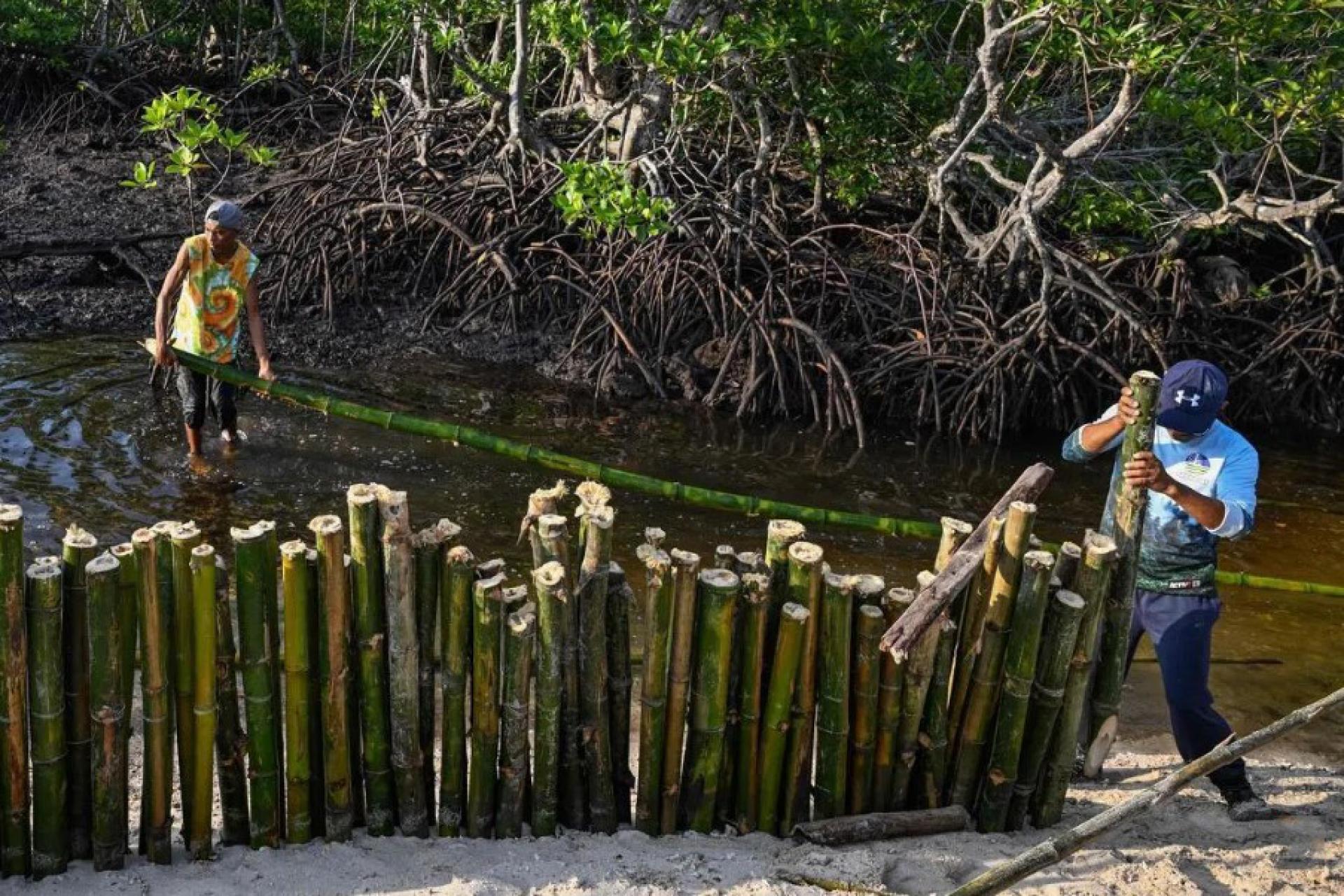
On the coast of Masbate province in the Philippines, Pimentel, project manager of World Wildlife Fund Philippines, leads staff in hammering bamboo poles into the seabed. They are trying to build bamboo fences to block sediment buildup and prevent silt from clogging the tidal channels that sustain mangroves.
Pimentel said that even though mangroves are resilient, they can hardly escape the onslaught of frequent and severe typhoons. If no action is taken, these natural barriers will eventually die.
"It has always been the mangroves protecting us from typhoons. Now it's time for us to protect them."
For years, forest ranger Almogralo has witnessed mangrove degradation. He worries that if mangroves disappear, houses in the village will be completely destroyed when super typhoons strike.
Although scientists remind us that building bamboo fences to block silt is not a long-term solution for saving mangroves, since the fences will rot within three years, for the Philippines—which is highly vulnerable to climate change—this is still the fastest and most cost-effective rescue method at present.
According to a 2024 study by the International Union for Conservation of Nature, half of mangrove ecosystems worldwide are on the verge of collapse due to climate change, rising sea levels, and human activity. Without proper conservation, about a quarter of mangroves could be submerged by 2050.
Filipino scientist Salmo, who has been studying mangroves for over 30 years, warns that large-scale loss in the past has made it harder for mangroves to adapt on their own, and if the government does not implement better policies and restoration plans, mangrove decline will continue.
Worsening climate change has made typhoons more frequent and severe. Strong winds and waves stir up large amounts of silt, clogging waterways and causing mangrove roots to suffocate and die.
Environmental groups and citizens in the Philippines are now racing against time to save mangroves. Environmentalists emphasize that without proper restoration projects and better government policies, mangroves will only continue to degrade in the future, and the most urgent task is to fully protect the existing vegetation.
On the coast of Masbate province in the Philippines, Pimentel, project manager of World Wildlife Fund Philippines, leads staff in hammering bamboo poles into the seabed. They are trying to build bamboo fences to block sediment buildup and prevent silt from clogging the tidal channels that sustain mangroves.
Pimentel said that even though mangroves are resilient, they can hardly escape the onslaught of frequent and severe typhoons. If no action is taken, these natural barriers will eventually die.
"It has always been the mangroves protecting us from typhoons. Now it's time for us to protect them."
For years, forest ranger Almogralo has witnessed mangrove degradation. He worries that if mangroves disappear, houses in the village will be completely destroyed when super typhoons strike.
Although scientists remind us that building bamboo fences to block silt is not a long-term solution for saving mangroves, since the fences will rot within three years, for the Philippines—which is highly vulnerable to climate change—this is still the fastest and most cost-effective rescue method at present.
According to a 2024 study by the International Union for Conservation of Nature, half of mangrove ecosystems worldwide are on the verge of collapse due to climate change, rising sea levels, and human activity. Without proper conservation, about a quarter of mangroves could be submerged by 2050.
Filipino scientist Salmo, who has been studying mangroves for over 30 years, warns that large-scale loss in the past has made it harder for mangroves to adapt on their own, and if the government does not implement better policies and restoration plans, mangrove decline will continue.