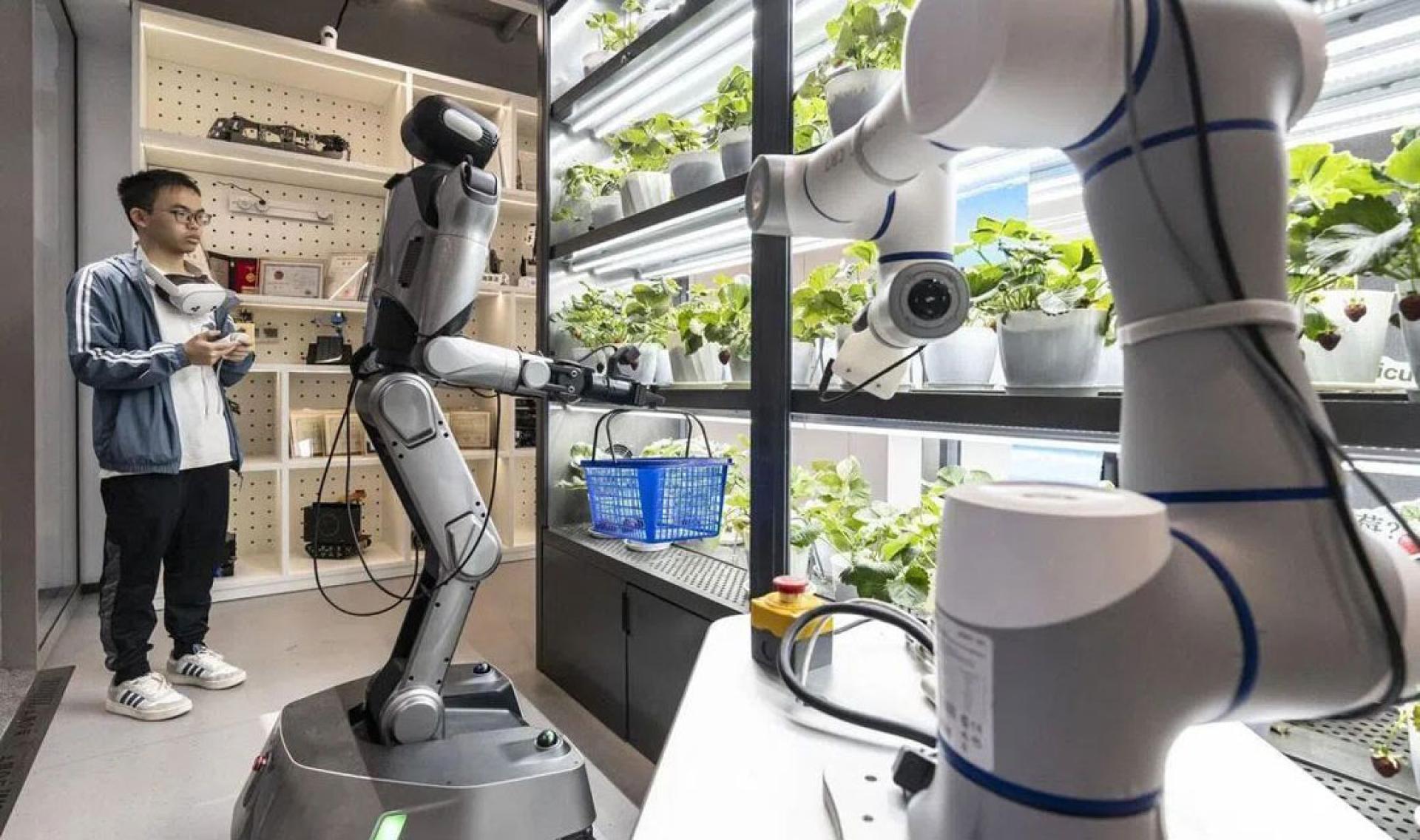
On June 2, 2026, a student trains a humanoid robot to pick strawberries at the Zijin'gang Campus of Zhejiang University.
China plans to incorporate artificial intelligence (AI) education into the teaching systems of schools at all levels to enhance students’ AI literacy, in line with the leadership’s strategy to promote technological innovation and seize a leading position in AI development.
According to reports from Xinhua News Agency and Bloomberg, the State Council of China released the “15th Five-Year Plan for Education Development” on Monday, which proposes advancing AI education across all school levels, improving students’ AI literacy, and “enhancing their ability to identify and solve problems.”
The plan also proposes to deeply implement the national education digitization strategy, launch the “AI+Education” initiative, and promote deep reforms in educational philosophy, talent cultivation models, examination and evaluation systems, scientific research paradigms, and governance mechanisms. The authorities will also establish a national AI (Education) application pilot base, improve the national smart education public service platform, promote the sharing of high-quality educational resources, and build an open-source and innovative AI ecosystem.
In addition, the plan calls for strengthening the development of digital Chinese, advancing the construction and application of a new type of national language corpus, and implementing plans to empower key areas of language technology. At the same time, it aims to improve the digital education standards system and reinforce AI ethics and safety supervision.
Bloomberg reports that the promotion of AI education is part of China’s strategy to seize the advantage in cutting-edge technology. In the face of ongoing Western restrictions on exports of advanced chips and key technologies, Beijing is actively cultivating domestic tech talent and innovation capabilities to strengthen technological self-reliance and international competitiveness.
However, against the backdrop of slowing economic growth and pressure in the job market, China is also striving to balance the increase in productivity brought about by AI with the need for employment stability. The Ministry of Education has previously required universities to step up AI training to help students find jobs.
Additionally, Chinese courts have recently ruled in several cases that companies may not unilaterally cut salaries or terminate contracts on the grounds of technological upgrades, reflecting Beijing's attempt to alleviate the impact of technological transformation on the job market while advancing AI development.