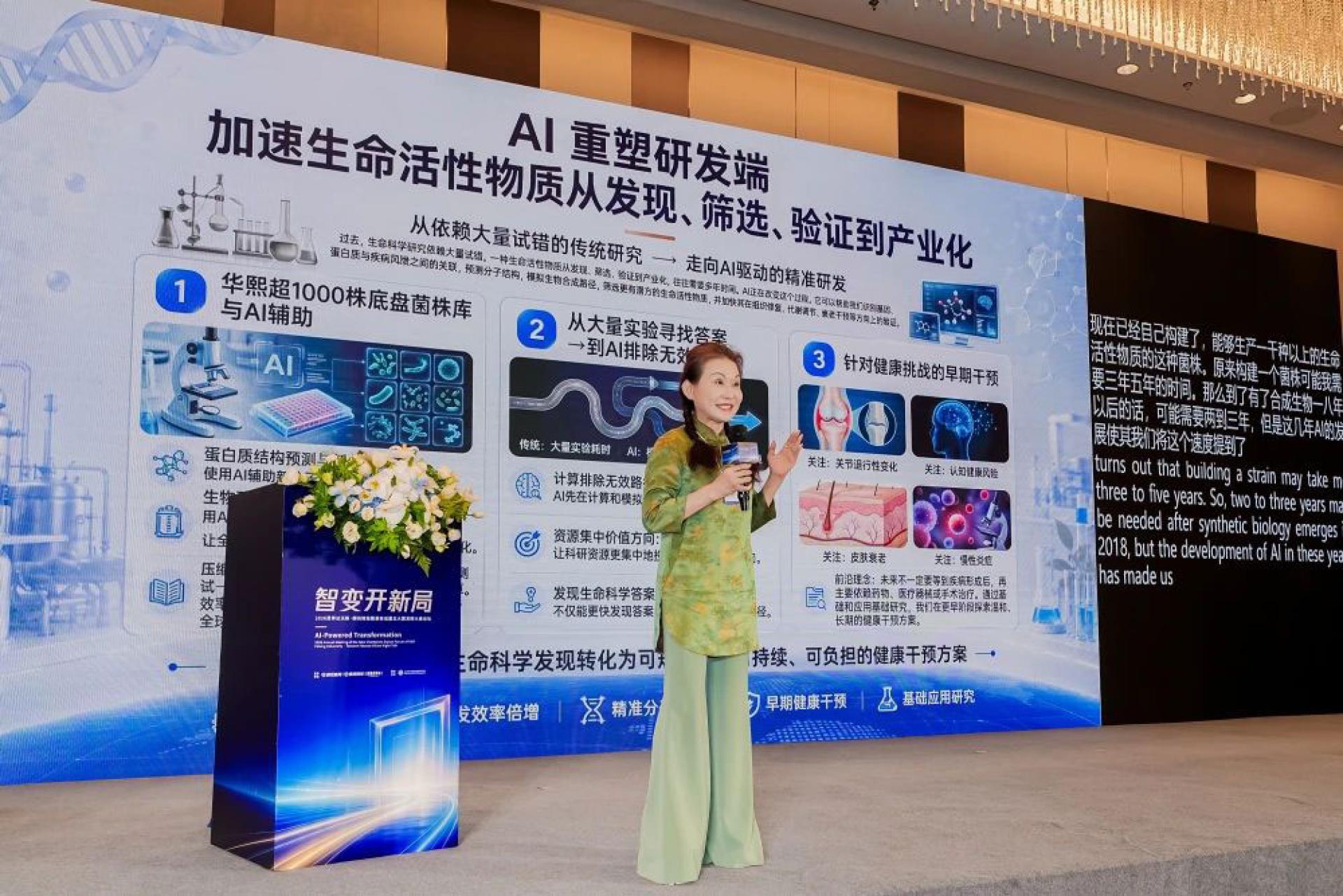
Zhao Yan, Chairperson and CEO of Bloomage Biotech, stated that AI is disrupting traditional health management models and making many previously 'impossible' things possible. In the next decade, humans may generally achieve high-quality healthy lifespans of over 120 years.
On the evening of June 23, the event "Economic Transformation for Fresh Opportunities—2026 Summer Davos Tencent Finance Vision Night and Peking University NSD Dalian Forum" was officially held, co-hosted by Tencent News and the National School of Development at Peking University. At the forum, Zhao Yan delivered a keynote speech titled “AI Reshapes Big Health: Restructuring the Global Value Chain of Chinese Biotechnology Brands.”
She gave examples such as degenerative joint changes, chronic inflammation, as well as diseases like Alzheimer's and Parkinson's, whose early signals usually appear when individuals are in their 30s or 40s. However, in the past, effective predictive methods were lacking. Today, aided by AI's continuous tracking and analysis of individual health data, risks can be identified in advance and interventions carried out, thereby preventing diseases from progressing to irreversible stages.
Focusing on how AI is specifically reshaping the big health industry, Zhao Yan elaborated from five perspectives: R&D, supply chain, market, scientific regulation, and industry value.
On the R&D side, AI has greatly shortened the discovery and production cycle of new active substances. Using biotechnology as an example, Zhao Yan explained that traditional research relied heavily on trial and error, but AI-driven protein sequencing and synthetic biology technologies have compressed the construction time for strains from the previous three to five years down to several months, or even a matter of days. Meanwhile, AI can predict trends of human degenerative diseases through massive amounts of health data, allowing for early intervention and prevention of problems like joint wear and chronic inflammation, thus avoiding the risk of severe disease.
On the supply chain end, AI combined with synthetic biology technology has enabled technological equity, making the large-scale and eco-friendly production of rare active substances that were previously difficult to obtain possible. She cited examples like human milk oligosaccharides and salidroside, substances that were originally hard to extract and produced in very low quantities. Now, with precise AI design and biomanufacturing, these can be made sustainably through cell factories, thus reducing reliance on natural resources and allowing more people to benefit from these valuable components.
On the market side, AI is driving health management into the era of 3.0—precision and personalization. Zhao Yan pointed out that traditional medicine 1.0 relied on experience-based consultation, while 2.0 was about precise diagnostics, but both have the problem of “treating different people the same way,” and cannot accommodate differences in genes, physiques, or living environments. The AI-driven 3.0 era enables customized health solutions for each individual—“one policy per person.” AI is likely to become the “super assistant” that understands individual health best.
Regarding scientific regulation, Zhao Yan called for a global consensus among countries on regulation of AI applications in life sciences. She emphasized that technological progress should not become a privilege for a handful of companies or select groups, but should benefit a broader population.
Finally, on the level of values, Zhao Yan believes that for Chinese biotechnology brands to go global, they must go deep into local markets, truly serve the local population, uphold the concept of “co-creation and co-construction,” and achieve win-win outcomes.