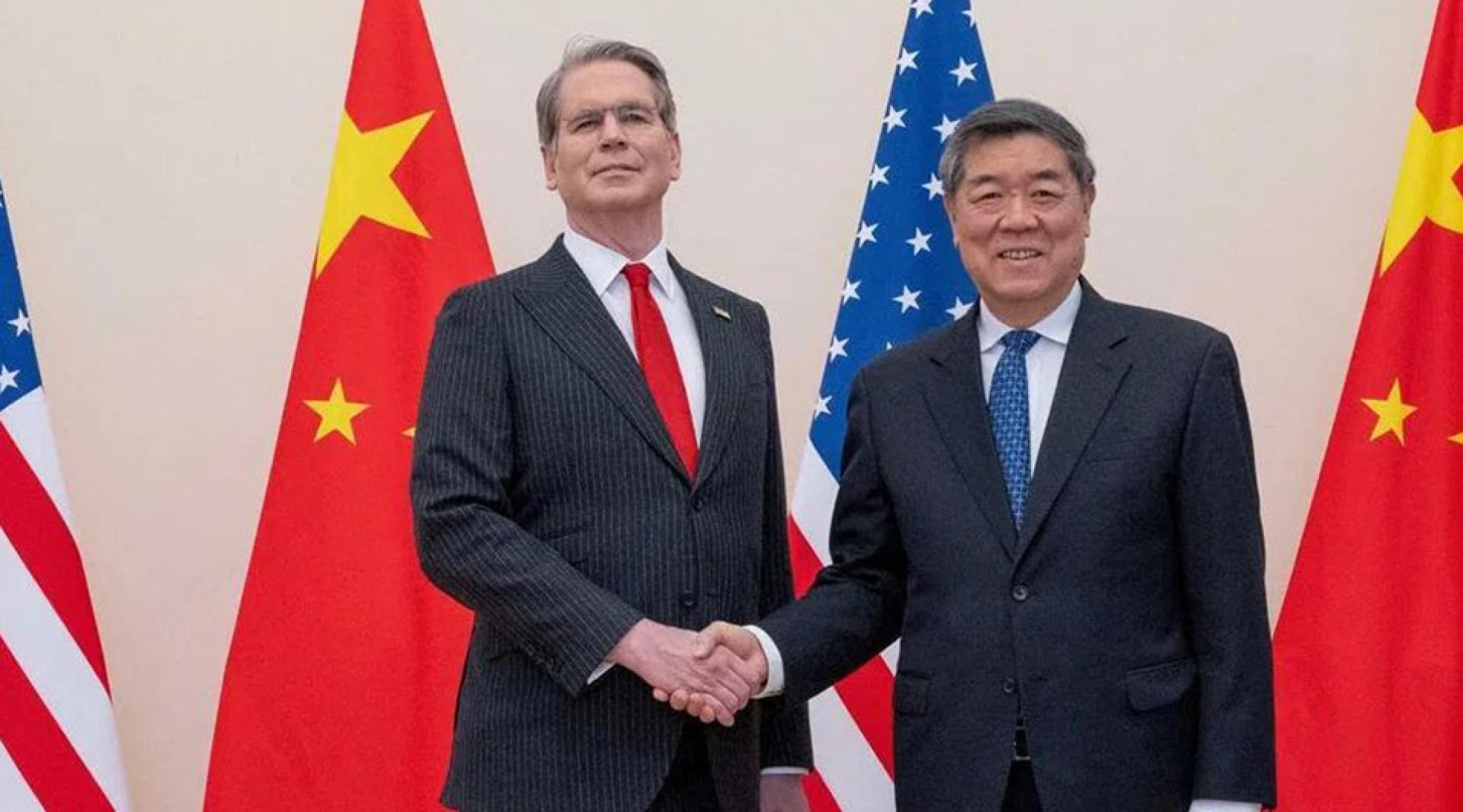
On the eve of U.S. President Trump’s visit to China this week, Chinese Vice Premier He Lifeng will travel to South Korea for two days to hold a new round of economic and trade consultations with U.S. Treasury Secretary Bensent and other officials.
The Chinese Ministry of Commerce confirmed the above arrangement on its official website Sunday night (10th). In a “spokesperson answers reporter’s question” format, the website stated that, as agreed by both China and the U.S., He Lifeng will lead a delegation to South Korea from Tuesday to Wednesday (12th-13th) to hold economic and trade consultations with the United States.
The Commerce Ministry spokesperson further stated that both sides will use the major consensus reached during the two countries’ presidents’ meeting in Busan and in previous calls as guidance, and will conduct consultations on economic and trade issues of mutual concern.
Previously, Bensent had already indicated that he would set out on Monday (11th), and, before the “Xi-Trump summit” is held this week, would first visit Japan and South Korea for a series of brief meetings.
Bensent disclosed on social media that he will meet Japanese Prime Minister Sanae Takaichi in Tokyo on Tuesday and meet with He Lifeng in Seoul on Wednesday.
Trump will pay a state visit to China from May 13th to 15th.
Gu Qingyang, Associate Professor at the Lee Kuan Yew School of Public Policy, National University of Singapore, said in an interview with Lianhe Zaobao that a summit meeting between the leaders of China and the U.S. is regarded as a “very solemn and serious” matter for China, and that fundamental principles must be determined before Xi Jinping and Trump meet.
Gu Qingyang analyzed that, with the “Xi-Trump summit” imminent, He Lifeng’s trip to South Korea for consultations with U.S. officials may suggest that some new developments have recently arisen, requiring further communication and coordination between both sides.
He pointed out that the situation in the Middle East might be one such variable. As the U.S. and Iran have recently experienced renewed military conflict, if China can play a positive role in easing the Middle East situation at this time, it will undoubtedly help advance China-U.S. negotiations.
He added that the Taiwan Strait issue may be another topic: this round of China-U.S. consultations may be aimed at “putting the Taiwan issue into a negotiable position,” laying the groundwork for the topic to be raised at the “Xi-Trump summit.”
Prior to this, Bensent and Trade Representative Greer had held a video call with He Lifeng on April 30. After the call, Bensent wrote on social media that the conversation with He Lifeng was “candid and comprehensive”; but he also wrote that China’s recent “provocative extraterritorial regulatory laws have had a chilling effect on global supply chains.”
The Xinhua News Agency report at the time stated that China expressed serious concerns over the recent U.S. trade restrictive measures against China, but both sides agreed to continue making good use of the China-U.S. economic and trade consultation mechanism to “continually increase consensus, manage differences, and strengthen cooperation.”
After that video call, China-U.S. trade friction has continued unabated. On May 2, China’s Ministry of Commerce issued a blocking order stipulating that it “shall neither recognize, enforce, nor comply” with the U.S. sanctions earlier imposed on five Chinese petrochemical companies.