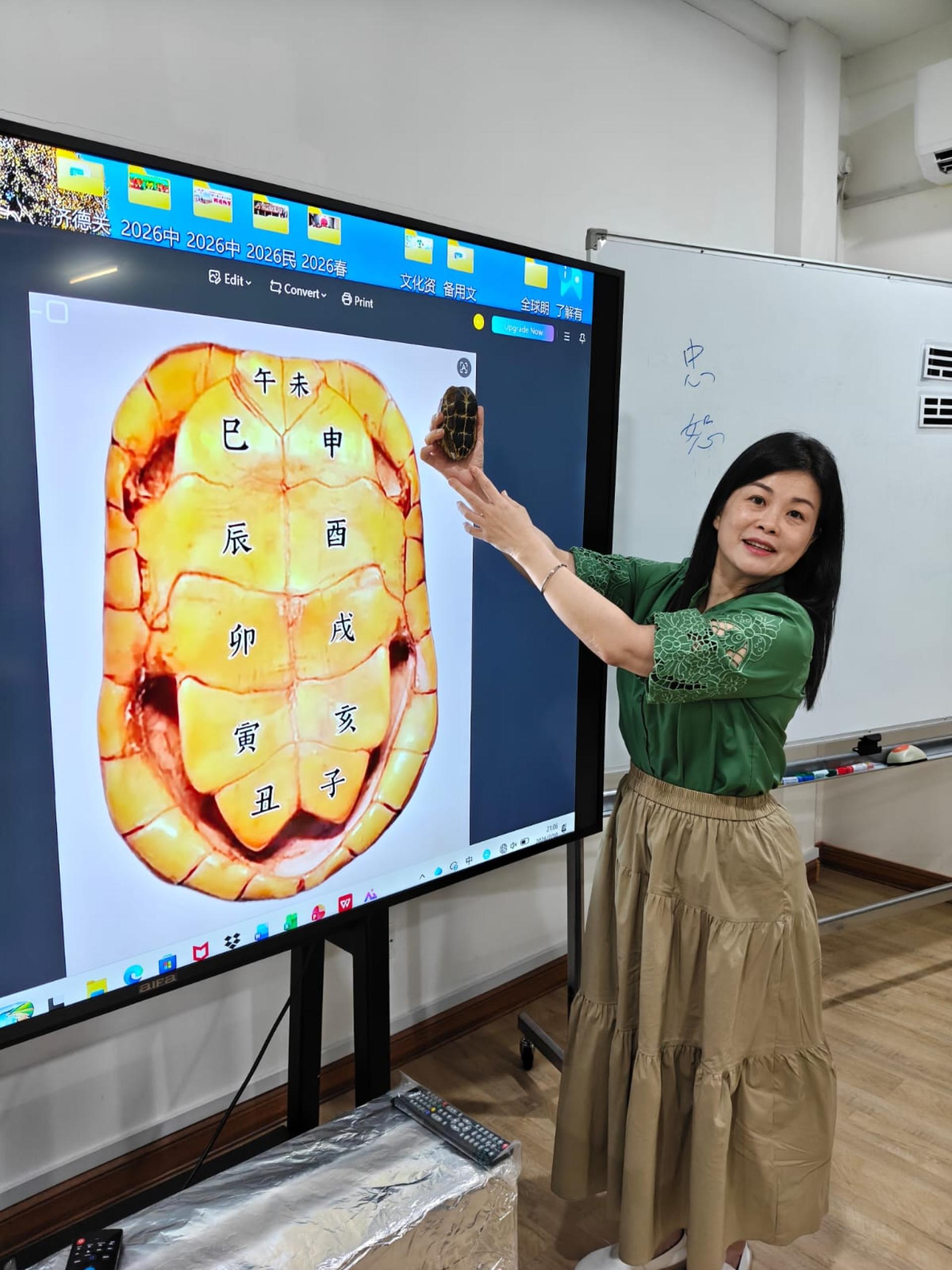
(Sibu, 13th) The Ji De Care Association’s Cultural Academy recently held a unique I Ching divination experience activity, guiding participants to follow ancient methods by using tortoise shells and coins for divination. At the same time, they delved into the Confucian concept of “rectifying one’s faults” and the developmental context of Chinese literature, presenting the diversity of traditional culture.
The divination activity was explained with real-life examples by Zheng Xiaoling, who elaborated on how the turtle’s carapace aligns with the eight trigrams, five elements, and the Heavenly Stems combined with the “heaven, earth, and humanity” trinity to form the sum of thirteen; the plastron corresponds to the twelve Earthly Branches, while the marginal scutes match the 24 solar terms. Later, with Zhang Yongfa operating and Shen Renxiang providing explanations, the group performed an authentic divination process using the tortoise shell and coins, ultimately drawing the 61st hexagram, “Zhong Fu” (Inner Truth). The meaning and symbolism of the hexagram were interpreted for the participants according to the I Ching text. Reportedly, the Cultural Academy had introduced the oldest divination methods of the I Ching in a planning session last year; this year, they once again used tortoise shells and coins to let participants experience the divination practices of the ancients.
The class also emphasized the core of Confucian self-cultivation, citing classic passages from The Analects, Mencius, the I Ching, and Zuo Zhuan, to systematically explain that “rectifying one’s faults” is an essential subject for the noble person (junzi). The discussion extended from personal introspection to taking responsibility, stressing that “improving oneself by amending faults” and “admitting and correcting mistakes” is a continuous thread in historical thought, followed by later generations’ reinterpretation of recognizing and correcting one’s errors.
In the literature history segment, all participants first recited four chapters of Laozi together. Then, the lecturer walked through the evolution of Chinese literature along a timeline: from the foundation and origins of pre-Qin literature, the unification and expansion during Qin and Han, the awakening and innovation of the Wei, Jin, and Northern and Southern Dynasties, the golden age of Tang poetry, the pinnacle of Song era poetry (ci) and prose, the flourishing drama of the Yuan dynasty, the rise of novels in the Ming, the summing up of classical literature in the Qing, and finally the transformation and rebirth of modern literature.
The entire event balanced hands-on experience with academic transmission, allowing participants not only to try divination but also to appreciate the spirit of self-reflection found in classics and the wisdom accumulated through the river of literature. The Cultural Academy stated that it will continue to launch diverse traditional culture courses, promoting the integration of classics into daily life and encouraging both inheritance and innovation.
The divination activity was explained with real-life examples by Zheng Xiaoling, who elaborated on how the turtle’s carapace aligns with the eight trigrams, five elements, and the Heavenly Stems combined with the “heaven, earth, and humanity” trinity to form the sum of thirteen; the plastron corresponds to the twelve Earthly Branches, while the marginal scutes match the 24 solar terms. Later, with Zhang Yongfa operating and Shen Renxiang providing explanations, the group performed an authentic divination process using the tortoise shell and coins, ultimately drawing the 61st hexagram, “Zhong Fu” (Inner Truth). The meaning and symbolism of the hexagram were interpreted for the participants according to the I Ching text. Reportedly, the Cultural Academy had introduced the oldest divination methods of the I Ching in a planning session last year; this year, they once again used tortoise shells and coins to let participants experience the divination practices of the ancients.
In the literature history segment, all participants first recited four chapters of Laozi together. Then, the lecturer walked through the evolution of Chinese literature along a timeline: from the foundation and origins of pre-Qin literature, the unification and expansion during Qin and Han, the awakening and innovation of the Wei, Jin, and Northern and Southern Dynasties, the golden age of Tang poetry, the pinnacle of Song era poetry (ci) and prose, the flourishing drama of the Yuan dynasty, the rise of novels in the Ming, the summing up of classical literature in the Qing, and finally the transformation and rebirth of modern literature.
The entire event balanced hands-on experience with academic transmission, allowing participants not only to try divination but also to appreciate the spirit of self-reflection found in classics and the wisdom accumulated through the river of literature. The Cultural Academy stated that it will continue to launch diverse traditional culture courses, promoting the integration of classics into daily life and encouraging both inheritance and innovation.