(Beijing, June 14, China News Service) As the first key archaic human species to migrate out of Africa and spread widely across Eurasia and Southeast Asia, whether Homo erectus has a connection with modern humans is a major unsolved mystery in the field of human evolution.
The team led by Fu Qiaomei at the Institute of Vertebrate Paleontology and Paleoanthropology, Chinese Academy of Sciences, in collaboration with others, has recently achieved a series of world-first scientific breakthroughs. By harnessing paleoproteomics, they have successfully cracked the 'molecular code' of 400,000-year-old Homo erectus, revealing that Homo erectus individuals represented by sites in Zhoukoudian (Peking Man) in Beijing, Hexian in Anhui, and Sunjiadong in Luan County, Henan, all belong to the same evolutionary group. They also discovered key evidence that their genes may have indirectly entered modern human populations via the known Denisovans.
This breakthrough study, which updates our understanding of population networks among East Asian archaic humans of the Middle Pleistocene and reshapes the narrative of human evolution, was published online in the international academic journal Nature on the night of the 13th Beijing time.
In this research, Fu Qiaomei's team, using an innovative acid-etching micro-sampling technique that leaves the integrity of the fossils intact, for the first time successfully obtained endogenous enamel protein data with phylogenetic information from six Middle Pleistocene Homo erectus tooth fossils, dating back 400,000 years, discovered at the three sites of Zhoukoudian, Hexian, and Sunjiadong.
This marks the first time in the world that molecular information with diagnostic features of Homo erectus has been obtained. It is also the oldest hominin proteome from East Asia to date, extending the East Asian ancient human protein data record from about 160,000 years ago to at least 400,000 years ago, and elevating ancient proteomics from a supporting tool to a core method for decoding human evolutionary history.
The enamel protein data from this study, for the first time using direct molecular evidence, confirm that although the Homo erectus individuals from Zhoukoudian, Hexian, and Sunjiadong show significant morphological differences, they are genetically highly similar and belong to the same unique evolutionary group. This resolves long-standing debates about the internal taxonomy of East Asian Homo erectus and fills the cognitive gap concerning the genetic features of Homo erectus.
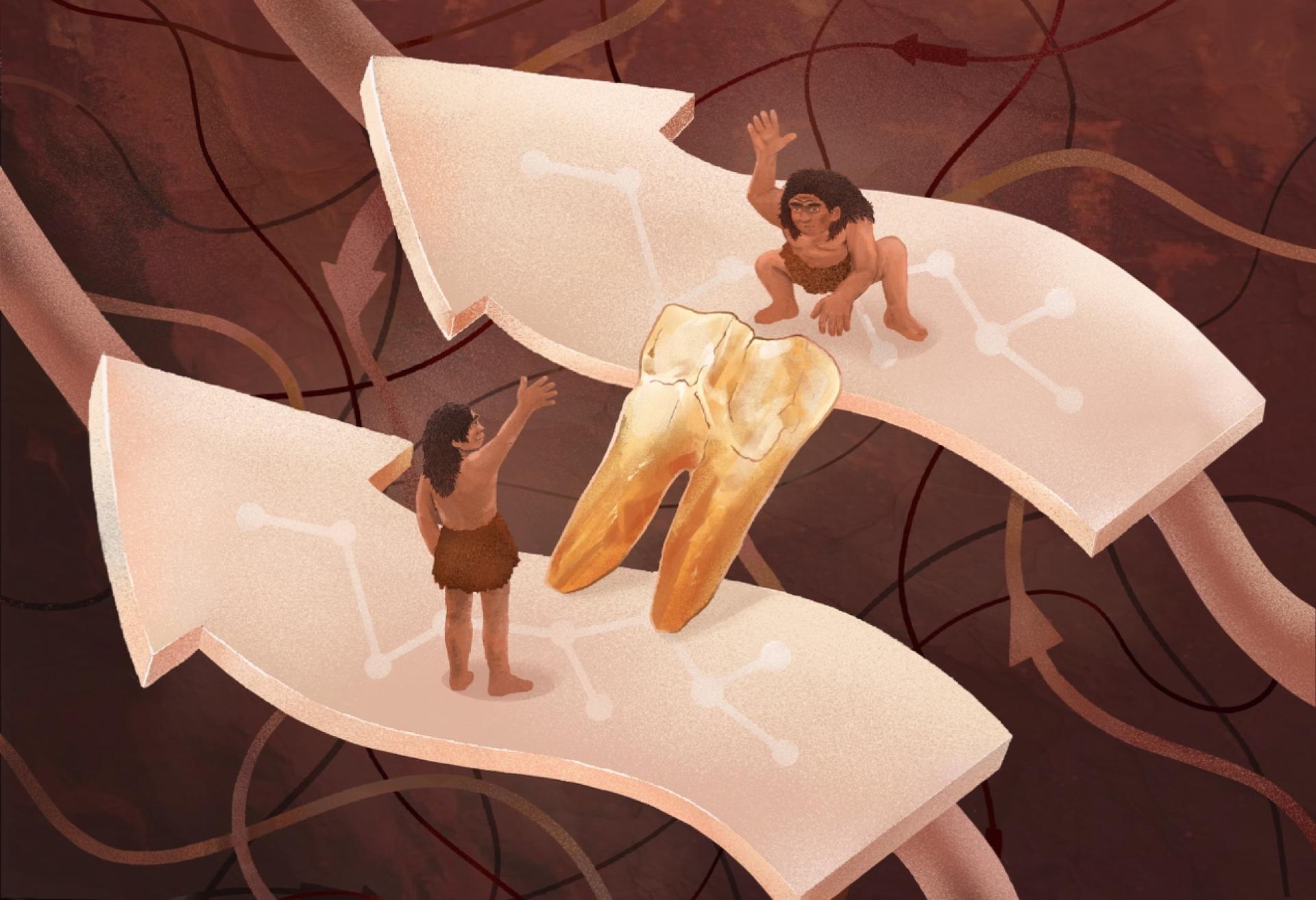
Further research also reveals for the first time that portions of the Denisovan genome introgressed into modern humans can be traced back to Middle Pleistocene populations linked to Zhoukoudian, Hexian, and Sunjiadong. This implies that, 400,000 years ago in East Asia, Homo erectus and known Denisovans likely coexisted in the same or adjacent regions, creating opportunities for gene flow between the two populations. As a result, ancient genes derived from Homo erectus could first flow into the Denisovan genome and subsequently be transmitted to modern human populations in East Asia, Southeast Asia, and Oceania through Denisovan-related genetic introgression events, ultimately exerting a profound genetic impact on modern humans.
The research team summarizes that this series of findings provides crucial evidence for understanding the complexity of ancient human evolution and the gene flow networks within the genus Homo, collectively painting a new tableau of human evolution: 400,000 years ago, East Asian Homo erectus represented by Peking Man were not only a unique evolutionary group but also one of the ancient genetic sources in the modern human gene pool.
This breakthrough study, which updates our understanding of population networks among East Asian archaic humans of the Middle Pleistocene and reshapes the narrative of human evolution, was published online in the international academic journal Nature on the night of the 13th Beijing time.
In this research, Fu Qiaomei's team, using an innovative acid-etching micro-sampling technique that leaves the integrity of the fossils intact, for the first time successfully obtained endogenous enamel protein data with phylogenetic information from six Middle Pleistocene Homo erectus tooth fossils, dating back 400,000 years, discovered at the three sites of Zhoukoudian, Hexian, and Sunjiadong.
This marks the first time in the world that molecular information with diagnostic features of Homo erectus has been obtained. It is also the oldest hominin proteome from East Asia to date, extending the East Asian ancient human protein data record from about 160,000 years ago to at least 400,000 years ago, and elevating ancient proteomics from a supporting tool to a core method for decoding human evolutionary history.
The enamel protein data from this study, for the first time using direct molecular evidence, confirm that although the Homo erectus individuals from Zhoukoudian, Hexian, and Sunjiadong show significant morphological differences, they are genetically highly similar and belong to the same unique evolutionary group. This resolves long-standing debates about the internal taxonomy of East Asian Homo erectus and fills the cognitive gap concerning the genetic features of Homo erectus.
Further research also reveals for the first time that portions of the Denisovan genome introgressed into modern humans can be traced back to Middle Pleistocene populations linked to Zhoukoudian, Hexian, and Sunjiadong. This implies that, 400,000 years ago in East Asia, Homo erectus and known Denisovans likely coexisted in the same or adjacent regions, creating opportunities for gene flow between the two populations. As a result, ancient genes derived from Homo erectus could first flow into the Denisovan genome and subsequently be transmitted to modern human populations in East Asia, Southeast Asia, and Oceania through Denisovan-related genetic introgression events, ultimately exerting a profound genetic impact on modern humans.
The research team summarizes that this series of findings provides crucial evidence for understanding the complexity of ancient human evolution and the gene flow networks within the genus Homo, collectively painting a new tableau of human evolution: 400,000 years ago, East Asian Homo erectus represented by Peking Man were not only a unique evolutionary group but also one of the ancient genetic sources in the modern human gene pool.