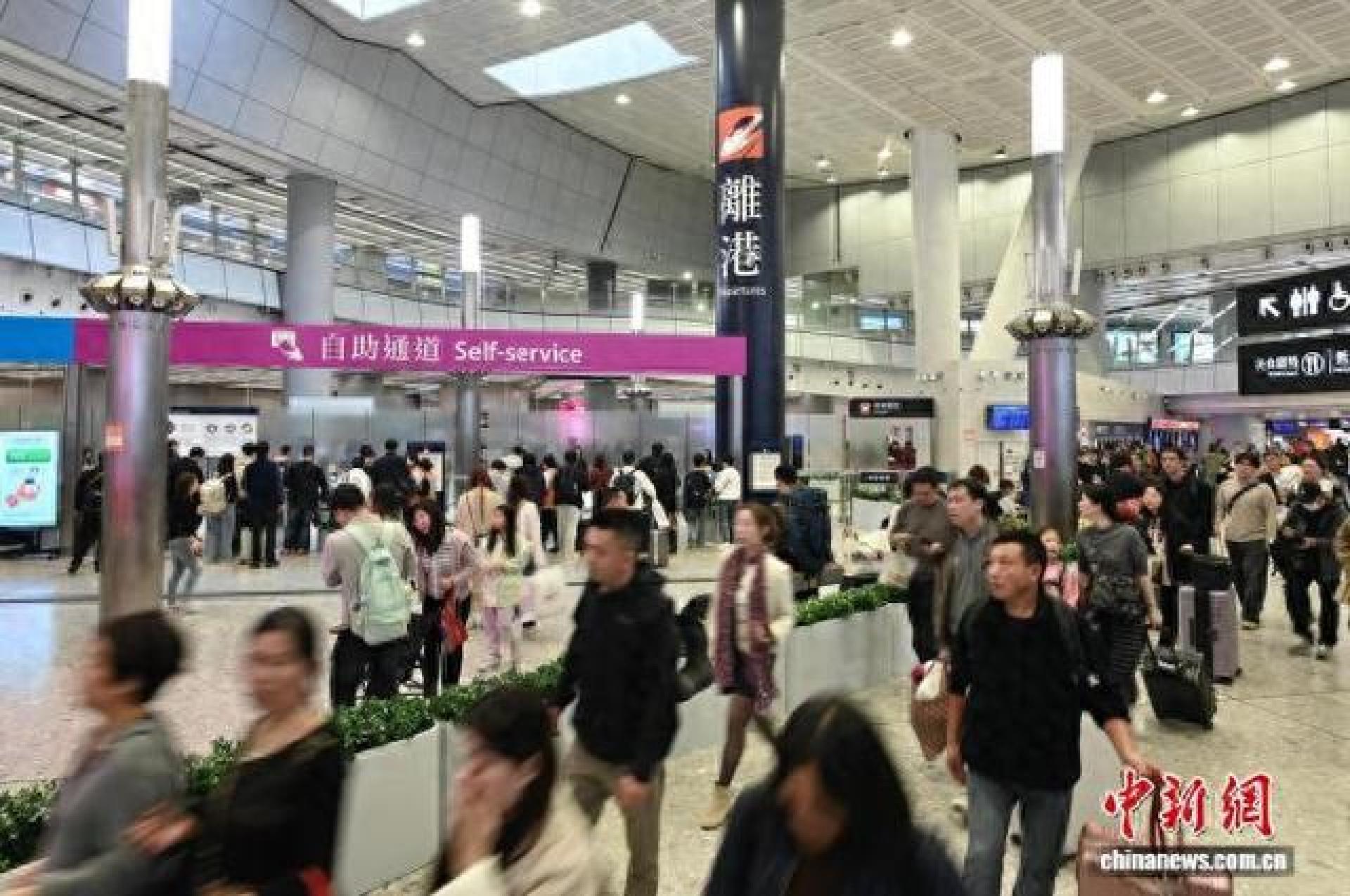
China's Qingming Festival holiday is approaching, and Hong Kong's Easter (April 3-4), Qingming Festival, and compensatory holidays (April 6-7) merge into a 5-day mini-holiday, igniting the travel enthusiasm of Hong Kong residents and forming a 'two-way travel' with the mainland’s Qingming mini-holiday.
According to data released by Tongcheng Travel and its international travel platform HopeGoo, as of March 25, the volume of flight bookings from Hong Kong to the mainland and overseas destinations has increased nearly fourfold year-on-year, and the popularity of mainland residents booking hotels in Hong Kong has also increased by more than 30% compared to last year.
Traveling north to consume has become a trend for Hong Kong residents. Ipsos’ report “2025 Connecting the Greater Bay Area: Decoding the Future Consumption Landscape of Hong Kong” shows that 45% of Hong Kong residents aged 18-64 travel north at least once a month.
Data from the Tongcheng Travel HopeGoo platform reveals key changes: public holidays are reshaping the structure of Hong Kong residents’ northbound travels. On the one hand, consumption patterns are upgrading significantly toward “leisure” and “quality.” During the holiday period, hotel bookings by Hong Kong residents increased more than eightfold year-on-year, with mid-to-high-end hotels accounting for over 40%. Bookings for family suites and parent-child themed rooms saw exceptionally prominent growth.
On the other hand, travel radius is rapidly expanding. Shenzhen, Guangzhou, Zhuhai and other Greater Bay Area cities remain the main destinations for Hong Kong residents’ short trips, but the holiday extends the travel distance—Shanghai, Beijing, Chengdu, Hangzhou, Changsha, Sanya and other cities have become popular long-distance destinations for Hong Kongers, with strong demand for specialty consumption such as health & beauty and leisure services.
It is worth noting that Hong Kong residents’ consumption habits are shifting from “material acquisition” to “experiential immersion.” In the past, social media was filled with scenes of Hong Kongers buying goods in Sam’s Club; now, Shenzhen’s bathhouses, spas, and dental clinics have become the new 'check-in spots.'
While Hong Kongers head north to enjoy a 'slow-paced life,' mainland residents are also flocking to Hong Kong during the Qingming mini-holiday. Tongcheng Travel data shows that Hong Kong ranks among the top outbound tourism destinations for mainland residents this Qingming Festival. Local hotel booking popularity increased nearly 30% year-on-year, and the average price of hotels in core business districts such as Tsim Sha Tsui and Causeway Bay has risen significantly, with per capita spending about HKD 1,400 per night.
Unlike Hong Kongers heading north seeking ‘ultimate value for money,’ mainland residents traveling to Hong Kong display a differentiated, complementary trait of 'unique experiences + trendy shopping.' Popular attractions include Hong Kong Disneyland, Victoria Peak, Victoria Harbour, and the Hong Kong Palace Museum.
The northbound flow of Hong Kong residents is underpinned by improvements in physical connectivity such as the high-speed rail network and 'Hong Kong cars going north,' as well as breakthroughs in ‘soft connectivity’ like mobile payments and mutual recognition of documents, and, moreover, the acceleration of cultural understanding—an increasing number of young Hong Kongers get recommendations about the mainland through platforms like Xiaohongshu.
On the other hand, Guangdong is steadily transforming from a transit and distribution hub into a world-class tourism destination. By promoting tax refunds on departure, enhancing multilingual services, and leveraging international platforms for precise marketing, Guangdong’s 'international tourism business card' is shining brighter.
With the Greater Bay Area's 'one-hour living circle' becoming increasingly mature, such 'two-way travels' are likely to become the new norm during holidays.