Cao Xiping's 'Absolutely No Inheritance for My Brothers' Reveals Family Scandals – Third Brother: Family Bond Still Remains
Published atJan 04, 2026 10:06 am
Veteran Taiwanese entertainer Cao Xiping passed away suddenly on December 29 last year at the age of 66. Because he had not been in contact with his four brothers for many years, his second brother declined to handle the aftermath upon hearing the news of his death, creating a temporary deadlock. After mediation by his third brother’s ex-wife, singer Long Qianyu, it was tentatively decided to entrust all funeral arrangements to his 34-year-old godson Jeremy (Wu), and his third brother Cao Nanping has confirmed he will return to Taiwan to attend the farewell ceremony.
In fact, Cao Xiping never shied away from exposing his family's dirty laundry during his life, bluntly stating that his brothers caused him immense psychological trauma, harshly accusing them: “I will never forgive them in my lifetime, because the difficult life I lead was all thanks to them.”
Cao Xiping’s father was a renowned urologist in Taichung. Their home was located behind the famous nightclub at the time. His mother was known for her bold character and excellent cooking. Many entertainers used to dine at their home and even receive free medical care. Cao Xiping was fourth among three elder brothers and one younger brother. For over 40 years in the industry, most of his hard-earned money was handed to his mother, who invested part of it in real estate in China and the U.S. and also helped the youngest brother study in the States. He once described his life as a drama, and the family scandals as a permanent pain in his heart. The family fell apart overnight after his mother’s passing, but what pained him even more was that his own brothers abandoned the care of their father. Every holiday triggered painful memories for him, recalling that when his mother died, his brothers didn’t even wear mourning attire to the funeral. At the burial site, not all brothers could even show up. He lamented: “Mom raised so many kids, fulfilled her children’s dreams, but sacrificed her own life. It really wasn’t worth it.”
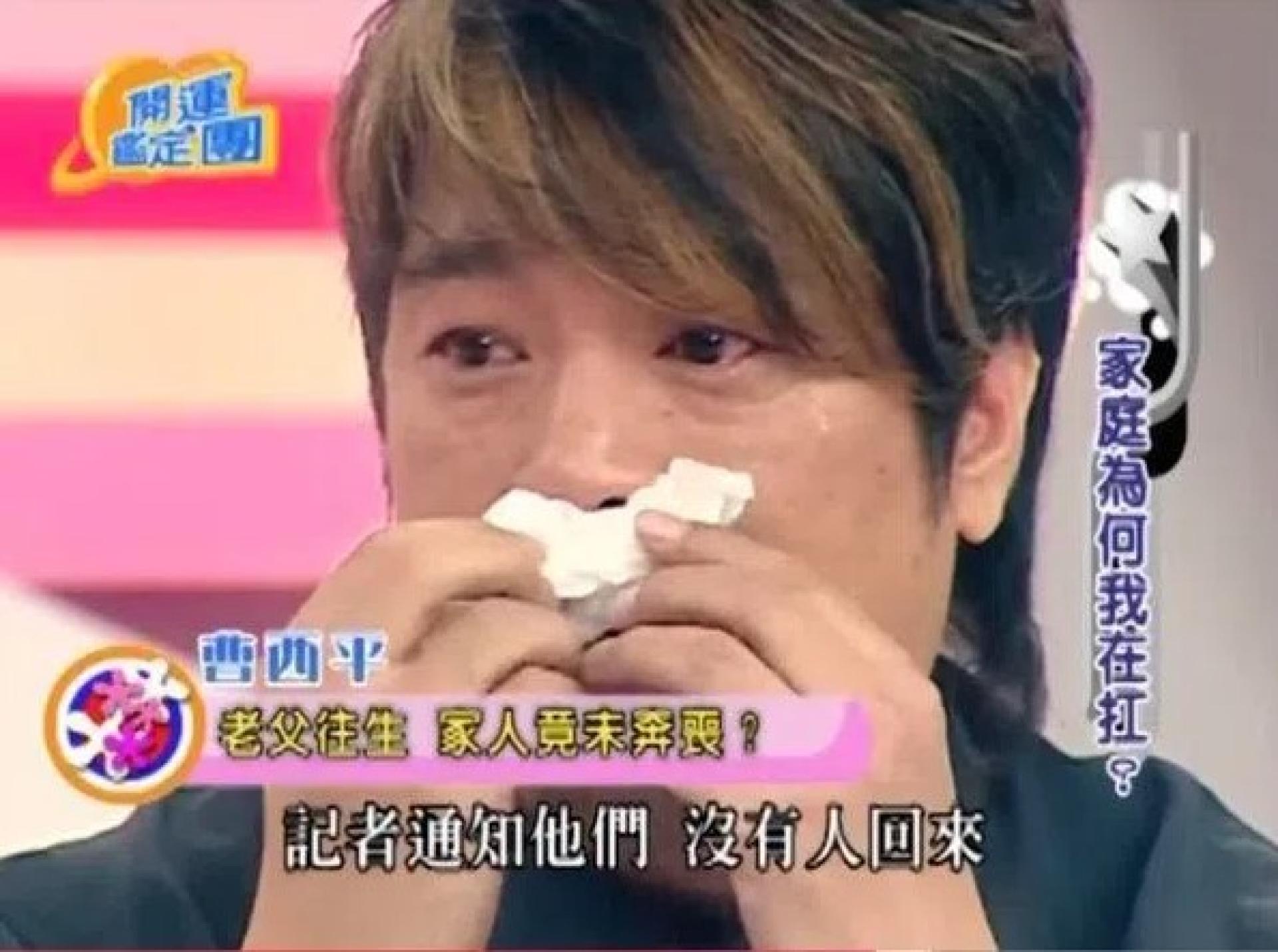
After his mother's death, he discussed inheritance distribution with his brothers, but his eldest and second brothers shirked responsibility, saying “investments are like throwing money into the water.” Later, the brothers went to court. Since the China property was registered under their mother’s name, the eldest brother ended up with a 12-story building, which brought in tens of thousands of Singapore dollars in annual rent, while Cao Xiping received nothing. Cao Xiping also let his brother live in the U.S. house, never collecting a dime in over 10 years. Later, he was left to care for his aging father alone, but when he asked for money, he was met with indifference—every family member avoided their responsibilities. He said: “Why did my sincerity get repaid with coldness? I treated you like this, why do you treat me like that? I just can’t understand.” 曹西平谈到家丑失控落泪。 Even though he was betrayed and underwent tremendous stress, what hurt him the most was that when his father passed away, not a single brother came back. Tearfully, he said: “The journalists notified them; none came back. I don't know what karmic sin my father committed to deserve such treatment. No one took care of him. I begged them. They don’t come in person, but want the money. But a person can always find many excuses for being unfilial.”
Cao Xiping found it impossible to let go of his conflicts with his brothers and sighed: “I could have been younger and happier. I love performing, so why did I become bald in patches? I used to be someone who could fall asleep as soon as I lay down, but now I toss and turn... All your promises were broken. The least you could do is be worthy of your mother and father.”
Unmarried and childless throughout his life, Cao Xiping broke off relations with his brothers due to the burden of caring for parents and inheritance disputes. He repeatedly accused them, both on TV shows and in public, of leaving him to shoulder mortgages and the care of their father alone, only to face suspicion and reproach from his siblings. He asserted several times before his death that if he were to pass away, he would “absolutely not let anyone with the surname Cao touch his inheritance,” and said he was considering making a will to leave everything to his godson, who had cared for him.
Cao Nanping recently spoke heartbreakingly about his younger brother’s passing: “As brothers, the bond and concern always remain. We sincerely ask the media to understand the family’s feelings and avoid excessive speculation or exaggeration. My younger brother was not without care, and everything will proceed according to his wishes and due process, so he may leave this world quietly and with dignity. We kindly ask for some space and peace for the family, and thank you for your concern and understanding. After this statement, the family will not make further public comments.”
In recent years, Cao Xiping lived with his godson Jeremy and Jeremy’s girlfriend, with the godson mainly taking care of his daily life. As past remarks and program footage resurfaced, Taiwanese lawyers pointed out there are still legal issues involved, such as the reserved portion under current law.
Lawyer Liu Weiting recalled on Facebook that he once appeared with Cao Xiping on the show “Zhen Zhen You Ci.” Cao mentioned at the time that outsiders accused him of misappropriating his father's five properties, rushing the burial without informing the family, and secretly keeping 10 million TWD in cash. Yet in reality, the properties were all bought with loans, and he was solely responsible for taking care of their father in his old age, repaying those loans, and even became depressed and sold crepes to pay off debts.
Liu Weiting pointed out that under Taiwanese law, a will can indeed leave assets to a non-statutory heir through a legacy; however, if it infringes on the statutory heir’s reserved portion, those heirs may seek a reduction by law. According to current regulations, if there is no spouse or children, and parents are deceased, brothers and sisters become the statutory heirs, whose reserved portion is one-third of their statutory share. He explained that if one wishes to prevent brothers and sisters from even receiving that reserved portion, it must fit the statutory grounds for loss of inheritance rights under Civil Code Article 1145, such as the heir committing serious abuse or insult, and the decedent having explicitly expressed that the heir shall not inherit.
Another lawyer, Ba Mao, noted that the range of serious insult or abuse is actually broad, and the godson might argue that the siblings should lose their inheritance rights by citing incidents such as Cao Xiping describing how his siblings mistreated him or stating he does not want them to inherit; such evidence could be presented.
Many netizens have questioned: “If their bond was so deep, why didn’t Cao Xiping simply formally adopt his godson?” On this, lawyer Lin Boxun explained in a post that the issue is not about the relationship, but a legal dilemma in the current system.
He explained that under Article 1077 (ii) of the Civil Code, upon adoption, the adopted child’s legal relationship with their biological parents and siblings is terminated, leaving only the legal tie to the adoptive family. In other words, if the godson had been formally adopted, he would have abandoned all legal ties to his birth family, possibly causing major issues in caring for his biological parents or dealing with that family’s affairs.
He bluntly stated that to ask someone to sever legal ties with their family just to care for a godparent is a choice many would not make; that’s why many choose to stay at the “godparent/godchild” level instead of formal adoption, despite being close as family.
The same reserved portion issue is also seen in Korea. Six years ago, after KARA member Goo Hara passed away, her mother, who had abandoned her in childhood, tried to claim inheritance, setting off a public furor. Goo Hara’s older brother lodged a petition, resulting in the creation of the “Goo Hara Act,” barring parents who neglect their duty of care from inheriting from their children. However, although the law passed, it will not take effect until New Year’s Day 2026, and Goo Hara’s mother already claimed half of her daughter’s inheritance.
This article has been translated using our AI technology. While we strive for accuracy,
AI translations
may contain errors. For the most precise information, please refer to the original article.