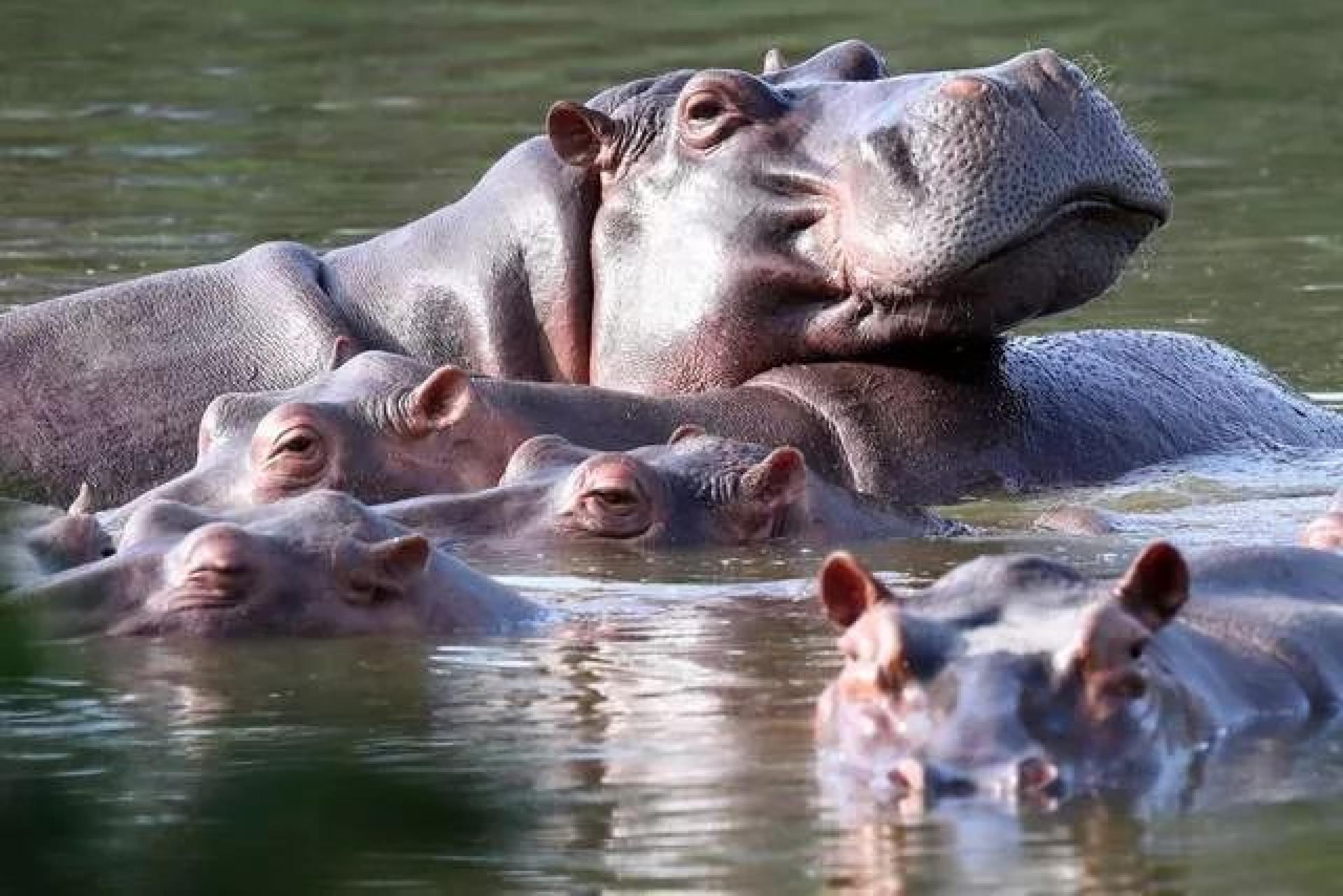
On April 13, 2026, the Colombian government officially approved a plan to cull 80 wild hippos within its territory. Although this decision has sparked fierce protests from animal rights advocates, authorities regard it as a necessary step for controlling the hippo population and protecting the ecological environment. Irene Vélez, Colombia’s Minister of the Environment, stated that culling was chosen because other control methods—such as sterilization and relocating the animals to zoos—are both expensive and ineffective, unable to fundamentally solve the problems caused by the hippo overpopulation.
Colombia is the only country outside Africa with a wild hippo population, and these hippos have a unique origin — they are descendants of four hippos introduced in the 1980s by the notorious drug lord Pablo Escobar.
At that time, Escobar built a private zoo at his Napoles Estate in the Magdalena River Valley—a property that also functioned as a ranch and private airstrip and served as his country residence. The four hippos were part of his zoo. After Escobar was killed in 1993, the Colombian government confiscated his assets. The estate has since been converted into a theme park, but the hippos were left behind and, with no natural predators, began to breed rapidly.
According to a 2022 study from the National University of Colombia, there were about 170 free-roaming hippos in the country at that time. Their range continues to expand, now stretching up to 100 kilometers north of the original introduction site. These large mammals not only pose a threat to local villagers—often coming into conflict with humans in farms and rivers—but also compete for food and living space with native species such as manatees, severely squeezing out native wildlife and disrupting the local ecological balance.
Notably, these hippos have also unexpectedly become a local tourist attraction. Residents of villages near Napoles Estate make a living by offering hippo viewing tours and selling hippo-themed souvenirs, forming a small tourism industry centered around the hippos. Over the past 12 years, during the terms of three Colombian presidents, attempts have been made to control hippo numbers through sterilization. However, due to the hippos’ aggressive nature, the difficulty of capturing them, and the high cost of sterilization procedures, the effectiveness of these efforts has been very limited. Additionally, because of the limited genetic pool, the hippos may carry diseases, making it unfeasible to relocate them back to their native habitats in Africa.
Animal welfare activists have long opposed the proposal to cull the hippos. They argue that the hippos should be treated humanely, and that solving this issue through violent means sets a bad precedent for a country that has endured decades of civil war. Currently, the Colombian government has not yet announced the specific start date of the culling operation. The controversy about ecological protection versus animal welfare continues, caught between the threat that the proliferating hippos pose to ecology and human safety, and the ethical concerns of animal protection. This dilemma has also sparked widespread discussion among global netizens over the boundaries between invasive species management and ecological conservation.
At that time, Escobar built a private zoo at his Napoles Estate in the Magdalena River Valley—a property that also functioned as a ranch and private airstrip and served as his country residence. The four hippos were part of his zoo. After Escobar was killed in 1993, the Colombian government confiscated his assets. The estate has since been converted into a theme park, but the hippos were left behind and, with no natural predators, began to breed rapidly.
According to a 2022 study from the National University of Colombia, there were about 170 free-roaming hippos in the country at that time. Their range continues to expand, now stretching up to 100 kilometers north of the original introduction site. These large mammals not only pose a threat to local villagers—often coming into conflict with humans in farms and rivers—but also compete for food and living space with native species such as manatees, severely squeezing out native wildlife and disrupting the local ecological balance.
Notably, these hippos have also unexpectedly become a local tourist attraction. Residents of villages near Napoles Estate make a living by offering hippo viewing tours and selling hippo-themed souvenirs, forming a small tourism industry centered around the hippos. Over the past 12 years, during the terms of three Colombian presidents, attempts have been made to control hippo numbers through sterilization. However, due to the hippos’ aggressive nature, the difficulty of capturing them, and the high cost of sterilization procedures, the effectiveness of these efforts has been very limited. Additionally, because of the limited genetic pool, the hippos may carry diseases, making it unfeasible to relocate them back to their native habitats in Africa.
Animal welfare activists have long opposed the proposal to cull the hippos. They argue that the hippos should be treated humanely, and that solving this issue through violent means sets a bad precedent for a country that has endured decades of civil war. Currently, the Colombian government has not yet announced the specific start date of the culling operation. The controversy about ecological protection versus animal welfare continues, caught between the threat that the proliferating hippos pose to ecology and human safety, and the ethical concerns of animal protection. This dilemma has also sparked widespread discussion among global netizens over the boundaries between invasive species management and ecological conservation.